A sociological analysis of self-injury, the causes of it, and the conditions surrounding those who commit it.
Why does an estimated 5% of the general population intentionally and repeatedly hurt themselves? What are the reasons certain people resort to self-injury as a way to manage their daily lives? In
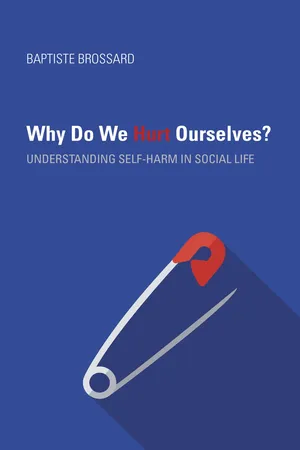
Why Do We Hurt Ourselves, sociologist Baptiste Brossard draws on a five-year survey of self-injurers and suggests that the answers can be traced to social, more than personal, causes. Self-injury is not a matter of disturbed individuals resorting to hurting themselves in the face of individual weaknesses and difficulties. Rather, self-injury is the reaction of individuals to the tensions that compose, day after day, the tumultuousness of their social life and position. Self-harm is a practice that people use to self-control and maintain order—to calm down, or to avoid "going haywire" or "breaking everything." More broadly, through this research Brossard works to develop a perspective on the contemporary social world at large, exploring quests for self-control in modern Western societies.
- 190 pages
- English
- ePUB (mobile friendly)
- Available on iOS & Android
eBook - ePub
About this book
Information
PART I
A PRACTICE OF SELF-CONTROL
Introduction
COMMON SENSE AND psychological literature apply many labels to self-injury. These labels plunge us into social imaginings that are more (or less) attractive by their marginality or their exoticism: craziness, adolescent suffering, suicide, initiation rituals, body art, mental disorders, or masochism. Ultimately though, self-injury is a practice; it is nothing more than an activity consisting of a set of repeated acts.
To study this practice, we must first describe how it occurs and trace the issues that the concerned individuals face. Their motivations to hurt themselves are embedded within the activities that make up their everyday lives. These activities produce the use of injuries, shape their practical modalities, elaborate the possibilities of saying or silencing them, and organize the conditions of their visibility. Such an examination, therefore, requires distinguishing three temporalities:
- The longest of these temporalities is the trajectory of the participants: during a given period of their life, they injure themselves on a regular basis. In this context, self-injury becomes a biographical period in which several stages can be identified, from the first wound to the cessation. But why opt for this unusual term, “trajectory”? Simply put, it is a matter of theoretical coherence. Adopting an expression such as “career” puts emphasis on a group’s influence on the evolution of the individual’s behaviors, while in this study, the participants are mostly loners. Moreover, the expression “path,” which might also be a suitable term, highlights the supposed freedom of an individual to “pursue their own path,” which, sociologically speaking, is disputable. Among these expressions, “trajectory” seems to be the most adequate because it refers metaphorically to the navigator within social space, evoking the intertwining of individual orientations and the structural forces shaping them, namely, a matter of agency. Self-injury trajectories will be developed in the chapters 1, 2, 3, and 4.
- The second temporality is composed of what we shall call the self-injury process. The self-injury process encompasses all significant interactions and moments that occur before an injury, which lead to and succeed the act of self-injury. This expression thus underscores that while, by definition, the act of injuring oneself is central to self-injury, self-injuring cannot be simply reduced to this act itself. This process will be recounted in chapter 5.
- Finally, the smallest temporal scale is the act itself: the wounding, an act that may last a few seconds or minutes. In this scale, the practical modalities of the injury (i.e., the type of self-harm, the degree of ritualization) and the associated emotional system (i.e., the relationship between the emotion to be discarded and the emotion sought) all play an essential role. This temporality will be dealt with in chapter 6.
1The First Time
UNDER WHAT CIRCUMSTANCES does the first injury occur?
This question falls within the sociological study of deviant behaviors, which, broadly defined, studies behaviors that are socially stigmatized because they transgress the norms of a social group. As Patricia and Peter Adler point out, self-injurers enter the two categories of lonely deviance developed by Joel Best and David Luckenbill: they are loners, given that they proceed without needing relations with similar others, and they are individual deviants, in that they engage in deviant activities by themselves.1 Consequently, for the sociologist accustomed to initially looking at the impact of groups and institutions on individuals, this practice remains mysterious.
As Best and Luckenbill suggest, solitary deviants are thus socialized into their deviance by “society at large,” rather than by supposedly deviant groups inaugurating a change in the individual’s mindset toward norms. The first step to understanding this difference in the case of self-injury is to explore how the first instance of self-injury occurs, and this chapter will outline some analytical categories to account for it.
What Happened?
Many of the participants of this study expressed a haziness surrounding the first instance of self-injury. Judith, with whom I conducted several interviews, is exemplary of this:
INTERVIEWER: Can you tell me when you started self-injuring?
JUDITH: Uh . . . I was in ninth grade, in fact . . . honestly, it’s a bit of a blur, how I started. . . It started . . . Not much eh . . . it was . . . At first, I didn’t even know what it was . . . [silence]
Judith does not remember exactly what happened. Indeed, while most participants remember their first injury, many do not perceive a specific reason for the act. Even if a significant event occurs that provokes the urge to hurt oneself, the motivation, like the choice of this practice rather than another, is completely vague. There is no reason to assume that the attack of the body is, in itself, the motivation for this type of activity. On this point, I share David Grange’s criticism against the teleological analyses of self-aggression: “behaviors such as bulimia/anorexia, alcoholism, drug addiction, self-neglect . . . have, in practice, a deleterious effect on the health of the person who does it. . . . It is a fact, but nothing indicates that this is their vocation.”2
Understanding the first self-wound, and moreover the management of its enunciation in an interview situation, leads us to look into a posteriori—constructed explanations. Amandine was nineteen years old at the time of our discussion, in March 2008. This young Quebecois explains to me:
[Instant messaging]
AMANDINE: I started almost five years ago. I do not remember how the idea came to my mind, I grabbed a compass and engraved the word DEAD on my wrist . . . without knowing what self-injury was. . . . I had great difficulties with my parents, I was in major suicidal depression, I went to PH [Psychiatric Hospital] for that and I went out . . . I continued SI [Self-Injuring] after that. . . .
INTERVIEWER: Ok . . . and you remember why you wanted to do it? Why the word “DEAD”?
AMANDINE: Why I wanted to do it, in the beginning, I think, was to make a concrete gesture toward my death . . . and the word “dead” because it was my goal . . . later I made five suicide attempts.
INTERVIEWER: It was like a kind of training?
AMANDINE: No . . . I don’t remember exactly that time . . . but I know that I quickly discovered the good it did . . . I switched to cuts after, it was much more liberating than simple letters with the compass.
Unable to remember her precise motives, Amandine introduces an “I think” before “to make a concrete gesture toward my death.” Here, we can perceive the influence of her studies in psychology on her narrative. This turn of phrase and the expression, “I was in major suicidal depression,” recall how mental health professionals talk and their inclination to interpret actions through unconscious reasons. Moreover, Amandine’s use of the expression, “I think, was to make a concrete gesture toward my death,” means both that she has developed this interpretation retrospectively and that she feels as though unconscious motivations were at work.
The initial enigma persists: was the first injury a purely “spontaneous” act? The elusive origin of this act is even more troubling because the first time takes on a particular importance within the self-harming trajectory. From this initial act, individuals realize that this behavior provides them with relief, and a sense of dependence develops. Over time, self-injury becomes a motivation in itself. But how should we study the motivations of the first wound when the people concerned express difficulty discussing it?
The Study of Motives
Howard Becker writes about people entering deviant careers, stating that “people usually think of deviant acts as motivated. They believe that the person who commits a deviant act, even for the first time (and perhaps especially for the first time), does so purposely. His purpose may or may not be entirely conscious, but there is a motive force behind it.”3 This de facto situation is not confined to illegal or illegitimate acts. Who knows the true motives of their daily practices, if such motives exist at all? Who is really aware, for example, of the reasons driving their initial participation in a leisure activity or, for that matter, their involvement in a given professional sector?
We generally assume that when someone develops a deviant practice, they have justification for it, while simultaneously we share an ignorance toward the motivations of our own socially accepted activities. In this regard, the participants’ narratives are likely to be much more elaborate than one given by an individual asked about a behavior deemed socially legitimate, such as playing ping-pong on a Sunday afternoon. Here, a justification by taste (“I like it”) may appear to be sufficient. But because they are engaged in unusual behaviors, the people I met had already reflected on a way to justify their practice, prior to the interviews. They are somehow socially summoned to hold a reflexive posture toward their behavior.
Moreover, I believe that the more socially illegitimate a behavior is, the more that it is suspected to rely on deep, unconscious, and inaccessible motivations. In our case, this implies that the quest for a motivation regarding the first injury constitutes also, and perhaps above all, an expectation toward the self-injurers. Howard Becker has encouraged us to reverse these questions, suggesting that “instead of the deviant motives leading to the deviant behavior, it is the other way around; the deviant behavior in time produces the deviant motivation.” In his seminal study of marijuana smokers, Becker showed how “vague impulses and desires . . . are transformed into definite patterns of action through the social interpretation of a physical experience which is in itself ambiguous.”4
We will see that self-injurers also gradually learn to find a precise sensation in the wound, although this learning often happens alone. But there is another difference. Through the social imaginary surrounding its consumption, the marijuana smoker has an idea of the effect that the drug should produce. Except for a few participants who explained that they had begun self-injuring after observing the relief that people around them seemed to gain from it, the motivating effects of self-injury are often unknown before the first wound.
The issue of motivation, even in Becker’s writing, is in fact too narrowly considered. In his study of marijuana smokers, he focuses on the longing to smoke marijuana or to socialize in a group of smokers. These motives are all directly related to drugs, whereas one can imagine someone starting to smoke for other reasons, such as escaping a social, familial, or emotional situation, or desiring to improve one’s popularity among school peers, including nonsmokers. We should not assume that only the content of a deviant behavior plays as a potential motivation for this behavior.
To avoid this difficulty, it is sufficient to consider that the first time is a biographical moment. In this context, the first injury becomes the intersection, at a given time, of an intention, a circumstance, and a biographical passage. The “intention” refers to the conscious motive expressed by the participant about this first self-injury (motivation, as we have said, is often insufficiently developed in the interviews). By “circumstance,” I mean the material framework of the wound, namely the place, the time of day, and the interactions preceding the act. Finally, the “biographical passage” describes the participants’ situation at this point in their lives, their preoccupations, their family and school situation, the events that they find significant, and so on.
An Intention, a Circumstance, a Biographical Passage
Let us take the example of Beatrix, a fourteen-year-old high school student in the tenth grade. She also expresses the haziness surrounding the reasons underlying her first injury. Nonetheless, she remembers its circumstances:
[Instant messaging]
INTERVIEWER: So, can you tell me when you started to self-injure? How did it happen?
BEATRIX: On a Thursday. Half the class had gone skiing, and it was a day of strike action, so I had not gone to school. A banal day. I had nothing to do.
Without acknowledging any motive, Beatrix finds herself in a situation of loneliness—which, as we shall see, often favors the recourse to self-injury—and in a biographical moment, characterized by the recent death of her father coupled with difficulties with friends. Solitude leads her to revisit her past. In other words, the circumstance in which she finds herself (solitude) momentarily reinforces the impact of her biographical passage (the death of her father).
For Lisa, a nineteen-year-old high school student in vocational training, the configuration looks similar:
[Instant messaging]
LISA: I do not remember exactly when it was. In the year when I turned fourteen, I walked ...
Table of contents
- Front Cover
- Half Title
- Title
- Copyright
- Contents
- Introduction
- Part I: A Practice of Self-Control
- Part II: A Social Positioning Practice
- Conclusion: A Self-Controlled Youth
- Notes
- Index
- Back Cover
Trusted by 375,005 students
Access to over 1.5 million titles for a fair monthly price.
Study more efficiently using our study tools.
Frequently asked questions
Yes, you can cancel anytime from the Subscription tab in your account settings on the Perlego website. Your subscription will stay active until the end of your current billing period. Learn how to cancel your subscription
No, books cannot be downloaded as external files, such as PDFs, for use outside of Perlego. However, you can download books within the Perlego app for offline reading on mobile or tablet. Learn how to download books offline
Perlego offers two plans: Essential and Complete
- Essential is ideal for learners and professionals who enjoy exploring a wide range of subjects. Access the Essential Library with 800,000+ trusted titles and best-sellers across business, personal growth, and the humanities. Includes unlimited reading time and Standard Read Aloud voice.
- Complete: Perfect for advanced learners and researchers needing full, unrestricted access. Unlock 1.5M+ books across hundreds of subjects, including academic and specialized titles. The Complete Plan also includes advanced features like Premium Read Aloud and Research Assistant.
We are an online textbook subscription service, where you can get access to an entire online library for less than the price of a single book per month. With over 1.5 million books across 990+ topics, we’ve got you covered! Learn about our mission
Look out for the read-aloud symbol on your next book to see if you can listen to it. The read-aloud tool reads text aloud for you, highlighting the text as it is being read. You can pause it, speed it up and slow it down. Learn more about Read Aloud
Yes! You can use the Perlego app on both iOS and Android devices to read anytime, anywhere — even offline. Perfect for commutes or when you’re on the go.
Please note we cannot support devices running on iOS 13 and Android 7 or earlier. Learn more about using the app
Please note we cannot support devices running on iOS 13 and Android 7 or earlier. Learn more about using the app
Yes, you can access Why Do We Hurt Ourselves? by Baptiste Brossard in PDF and/or ePUB format, as well as other popular books in Social Sciences & Global Development Studies. We have over 1.5 million books available in our catalogue for you to explore.