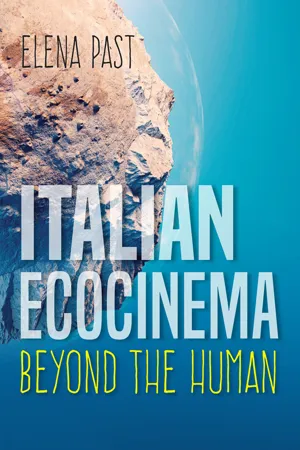
Ecocriticism and film studies unite in this examination of five Italian films and the environmental questions they raise.
Entangled in the hybrid fields of ecomedia studies and material ecocriticism, Elena Past examines five Italian films shot on location and ponders the complex relationships that the production crews developed with the filming locations and the nonhuman cast members. She uses these films—
Red Desert (1964),
The Winds Blows Round (2005),
Gomorrah (2008),
Le quattro volte (2010), and
Return to the Aeolian Islands (2010)—as case studies to explore pressing environmental questions such as cinema's dependence on hydrocarbons, the toxic waste crisis in the region of Campania, and our reliance on the nonhuman world. Dynamic and unexpected actors emerge as the subjects of each chapter: playful goats, erupting volcanoes, airborne dust particles, fluid petroleum, and even the sound of silence. Based on interviews with crew members and close readings of the films themselves,
Italian Ecocinema Beyond the Human theorizes how filmmaking practice—from sound recording to location scouting to managing a production—helps uncover cinema's ecological footprint and its potential to open new perspectives on the nonhuman world.
"[Past] uniquely and innovatively combines film studies and material ecocriticism with a focus on Italy. Such weaving of tales brings the films to life and reads them as ecological documents and Italian stories." —Heather I. Sullivan, author of
The Intercontextuality of Self and Nature in Ludwig Tieck's Early Works
"A timely and incisive study that interrogates a new, though growing, trend in film criticism and makes an important and rich contribution to Italian film studies, Italian cultural studies, and ecocriticism." —Bernadette Luciano, author (with Susanna Scarparo) of
Reframing Italy: New Trends in Italian Women's Filmmaking
"Part memoir, part close analysis of the films themselves, and illustrated with numerous excellent frame grabs, Past's book casts a dreamlike spell as it contemplates the past, present, and future of the cinema and moves smoothly between environmental issues and aesthetic and practical concerns." —
Choice
- 236 pages
- English
- ePUB (mobile friendly)
- Available on iOS & Android
eBook - ePub
About this book
Information
Subtopic
Film History & Criticism1
HYDROCARBONS, MOVING PICTURES, TIME: RED DESERT
IN THE AUDIO RECORDING OF MY 2013 INTERVIEW with Carlo Di Carlo in his apartment in Rome, our voices approach the microphone and then recede into the distance, and frequent silences are punctuated by the crisp sound of turning pages.1 As I took copious notes and flipped through volumes large and small, Di Carlo made trip after trip from the living room to his extensive library on the cinema of Michelangelo Antonioni to identify useful references for my bibliography. He spoke of an important interview Antonioni gave on the Maurizio Costanzo Show, an interview that would have been lost along with six years of misplaced footage of the popular television talk show had Di Carlo not recorded it on VHS. Clips from the interview were part of his project-in-progress. Di Carlo, a director and scholar, spent much of his life preserving Antonioni’s cinematic legacy, and his numerous books and documentary films comprise archives of interviews, essays, articles, project plans, and production diaries. Di Carlo met Antonioni in 1961 and published a book on Il deserto rosso (Red Desert) in 1964, the same year the film came out, initiating a long intellectual relationship with the director and his work.
Red Desert, a film that bears witness to the expanding industrial landscape of 1960s Italy, was filmed on location in Ravenna from November 1963 through March 1964. Like the places it captures on celluloid, the film is the product of an energy-intensive industry. Di Carlo’s trip to the set to study the film, and my visit to Di Carlo to learn from him, add further layers to the film’s hydrocarbon legacy. Along with the screenplay (attributed to Antonioni and Tonino Guerra), the print publication contains Antonioni’s famous essay on “The White Forest,” an essay by Di Carlo on color, a page written by producer Antonio Cervi, a series of photos from the set, and an extensive production diary written by Flavio Nicolini, one of the assistant directors. The book, a valuable account of a groundbreaking experience in cinematic history, is itself a material document produced with the help of plant, petroleum, and human resources, and is subject to the forces of time. The edges of the pages of my copy from the library (the original 1964 edition) are yellowed but not fragile. Di Carlo’s life work documents the collaborative networks that produced, promoted, and interrogated the films directed by Antonioni, but it also reveals the evanescence of the media, and the nonhuman and human energy—as all those trips to the bookshelf attest—required to create and preserve it.
Di Carlo died in 2016, while this manuscript was in progress. Listening to his voice now, while thinking about preservation, hospitality, fragility, and time, is both poignant and haunting.
This is a story of cinema, energy, and the passage of time, and it starts during Italy’s industrial boom.
Red Desert is a signal moment in Italian cinematic history because it illustrates an intense exchange between industry, cinema, and environmental awareness in Italy. Location shooting embedded the film deeply in the environment around Ravenna: the film production and cinematic narrative traverse and permeate the place in significant ways. Given the substantial transformations occurring in Italy at the time of filming, and in part because of the enduring artistic legacy of Red Desert, the 1964 film speaks eloquently for the convergence and mutual transformation of media and matter.
As scholars have often observed, Red Desert captures the advent of a culture of neocapitalist consumption that changed the landscape into something “that would have been unrecognizable only a decade or so before” (Restivo 2002, 140). The “boom” or “economic miracle,” which historian Paul Ginsborg (1989, 286–90) locates in the years spanning from 1958 to 1963, saw industrial production double, Italian exports increase dramatically, and both urban and rural landscapes change radically. Per capita income more than doubled between 1952 and 1970, and alongside newly acquired televisions, refrigerators, and other durable goods, a culture of mass mobility began to take shape (325–30). The wealthy protagonists of Red Desert are at the apex of the boom. Corrado (Richard Harris) and Ugo (Carlo Chionetti) are part of what P. Adams Sitney (1995, 211) identifies as “a new class of neocapitalist managers” who populate the coastal areas near Ravenna, where expansive petrochemical refineries amidst the Dantean pine forests provide a dramatic backdrop for many scenes in the film.
Environmental degradation accompanied this rapid industrial expansion and mass motorization. Near Ravenna, large fields of methane were discovered offshore in 1955, and ENI (Ente Nazionale Idrocarburi, or the Italian National Hydrocarbon Authority) constructed a petrochemical district that went active in 1958. Some of the main products manufactured near Ravenna, one of Italy’s primary port cities, were vinyl chloride and PVC, which were used to create the stuff of modernity: plastic and vinyl products, wires and cable coatings, packaging, and automotive parts. Methylmercury and other toxic, carcinogenic byproducts of the production process were dumped in a tributary channel through the mid-1970s. Recent studies have found that high concentrations of the contaminants persist in the area in the new millennium (Trombini et al. 2003, 1821–22). Red Desert demonstrates concern for this noxious element of boom-era prosperity through its focus on yellow smoke and other airborne vapors pouring from factory chimneys, and by following the liquid tributary channels via which these contaminants move and mingle with the surrounding environment and its human and nonhuman inhabitants.
In part in response to the swiftly changing industrial landscape of the boom, the environmental movement that was taking off around the globe began to take root in Italy around this same time. At first, Italian environmentalist concerns were primarily conservationist and aesthetic: Italia Nostra, a non-profit organization dedicated to protecting Italy’s artistic and environmental heritage, was founded in Rome in 1955 by seven prominent intellectuals, who contested the “sacking” of Italy’s cities by unchecked development (Della Seta 2000, 13).2 Then, in 1963 (the year Red Desert began filming), Rachel Carson’s Silent Spring was translated into Italian, and according to Roberto Della Seta’s (2000, 19–20) history of the environmental movement in Italy, attention shifted from conservation to the fight against pollution. In spite of their increasing visibility, though, in many ways ecological concerns remained marginal on a national-cultural level, and rather than becoming a central part of the social movements in the 1960s, they “were depicted largely as hobbies for the well-to-do” (Armiero and Hall 2010, 4). In 1963–64, during the filming of Red Desert, Italy’s first antismog legislation had not yet taken effect (it was instated in 1966), and national concerns about environmental crisis had not yet been honed by the dioxin disaster at Seveso or the arsenic poisoning at Manfredonia, both of which happened in 1976 (Adorno 2010, 182–83).3 At the end of Red Desert, Giuliana (Monica Vitti) explains to her son, who asks why the factory smoke is yellow, that it is poisonous. Her comments indicate a burgeoning awareness of the dangers of industrial pollution for human and nonhuman inhabitants of the region. Yet when her son worries that the birds flying through the smoke will die, she reassures him that they have learned to fly around it: a simple act of adaptability, she says, will keep them safe from harm.
According to the director, the question of adaptation to change was the guiding problem in creating the film. Antonioni ardently disavowed that his film was motivated by anti-modernist nostalgia, insisting, in an interview with Jean-Luc Godard, that he did not intend in Red Desert to “accuse this inhuman, industrialized world” but rather “to translate the beauty of this world, in which even the factories can be very beautiful [. . .]. It’s a rich world—living, useful” (Sarris 1972, 4). Yet Antonioni acknowledged in the same interview that he does not believe that “the beauty of the modern world in itself can resolve our dramas,” and asserts that Giuliana’s adaptive difficulty was simultaneously moral, perceptive, and “epidermic” (4–6, my emphasis). Although the bodily, “epidermic” crisis was listed by the director as the most obvious of the crises in Red Desert, a return to the material pathways navigated by the film exposes a subcutaneous—and subterranean—world of interpretation. Red Desert helps reveal that, as films represent experience, they also pass into human and nonhuman bodies to become part of experience in all kinds of material ways. The film is an apt starting point to see how, as Giorgio Bertellini (2012, 43) has argued, Italian film quite literally “has absorbed lessons and discourses that have recently risen to national consciousness about the defacement of the national territory” (my emphasis).
Showing the radical openness of the human in these toxic landscapes, in Red Desert, Giuliana is traversed by the things with which she comes into contact, things that can literally pass right through her skin. Stacy Alaimo (2010, 2) describes this experience of bodily porosity as “trans-corporeal,” and uses the word to describe the “interconnections, interchanges, and transits between human bodies and nonhuman natures.” Our bodies host toxins carried in air and by water; the film acknowledges these contaminations through the poisonous yellow smoke emitting from factory chimneys. Our bodies are sites of disease, as Red Desert reminds us when a ship docks and raises a flag to indicate that its passengers are infected by some kind of illness. Our bodies—and not just our human bodies, but nonhuman bodies, too—are subject to the flux and flow of global capital and to the technologies that modify landscapes; a conversation with fishermen along one of the shipping canals reveals that the eels swimming in the canal’s waters now taste like petroleum.4 It would perhaps not be too much of a stretch to suggest that some of the symptoms that Giuliana manifests—her convulsive lovemaking to Corrado, her fatigue, the apparent “brain fog” that causes her to see strange colors or nearly drive off of a pier—could be signs of multiple chemical sensitivity (MCS) or environmental illness (EI). As Alaimo explains, this controversial condition, for which no standard medical test or definition exists, is nevertheless a recognizable disease that may constitute a “somatic indictment of modernity” (Steve Kroll-Smith and H. Hugh Floyd qtd. in Alaimo 2010, 115).5 In any case, from Giuliana’s house, where enormous ships pass as if just outside the window, to the color stains that cloud her field of vision, to her disappearance into a foggy mist, the protagonist’s “domestic enclosure” is broken open, and as in Alaimo’s concept of trans-corporeal space, “human corporeality and textuality effortlessly extend into the more-than-human world. Word, flesh, and dirt are no longer discrete” (14).
The concept of trans-corporeality does not just help explain Giuliana’s environmental-existential crisis, though. It also urges us to contemplate a new, broadened interpretive frame for cinema—all cinema. First, this materialist philosophy of lived experience “necessitates more capacious epistemologies” and “allows us to forge ethical and political positions that can contend with numerous late twentieth- and early twenty-first century realities in which ‘human’ and ‘environment’ can by no means be considered as separate” (Alaimo 2010, 2). If we take seriously the movement of substances through human flesh and the openness of the human body to the world, we are bound to a corresponding opening of our ethical framework, compelled to consider the more-than-human world within and beyond our borders, including when we watch films. Second, although the notion of trans-corporeality proposes to read human experience with a heightened attention to the fabric of the human body, it “denies the human subject the sovereign, central position” and requires attention to “a more uncomfortable and perplexing place where the ‘human’ is always already part of an active, often unpredictable, material world” (16–17). If we recognize trans-corporeal movements of bodies when examining cinema, we can witness time and again how the human takes its place in a cosmography of beings that includes all manner of nonhuman actors.6 And at the same time, the world of the film passes in ways literal and figurative into our bodies.
Theories of trans-corporeality, which resonate strongly with Giuliana’s precarious experience as human protagonist in Red Desert, thus lead us into the posthuman domain, a space for questioning “the very structures of our shared identity—as humans—amidst the complexity of contemporary science, politics and international relations” (Braidotti 2013, 2). Because theories of the posthuman focus on our entanglement with nonhuman animals and technologies, they open myriad interpretative pathways for film, beginning with a film’s formal composition. Onscreen, Giuliana’s presence is frequently marginal, out of focus, off-center, and at times she wanders out of the frame entirely, leaving the camera to examine a more-than-human landscape without anthropic distractions. But once again, posthuman concerns should not only impact our understanding of the actors onscreen. Such a framework dissolves the surface of the screen, showing how film narrative intermingles in time and space with shooting locations, production timelines, film technologies, distribution networks, and human and nonhuman spectators and actors. This kind of theoretical stance urges us to see that, beyond its visual evocation of a posthuman terrain, Red Desert also leaves traces of its passage through a long chain of material interactions.7 The film’s position as a historical document of the Italian economic boom in 1963–64, its material-discursive presence today, and its ties to a political and ecological landscape that long preceded it in the world, reveal a network of what Rosi Braidotti (2013, 193) characterizes as “embodied subject[s] [. . .] shot through with relational linkages of the contaminating/viral kind which inter-connect it to a variety of others, starting from the environmental or eco-others and include the technological apparatus.” Regardless of any authorial forswearing of the risks or consequences of industrial modernity, Red Desert was thoroughly entangled in the petrochemical landscape in which it was filmed, and was a byproduct of those very industries. Red Desert, in other words, is not just an image that moves on the flat screen monitors in twenty-first century classrooms (or on laptops, iPhones, and tablets), nor is it just that play of light through celluloid that illuminated the screens in movie theaters in the 1960s. It is not just the story of Giuliana, Corrado, and Ugo, nor is it exclusively the product of one brilliant auteur’s imagination. Red Desert is the encounter of industry, location, local human laborers, professional and nonprofessional actors, human and nonhuman actors, and energy regimes, among other things, and the story, still in progress, of the mutual transformation and interpenetration of these actors.
This is not the first study to underscore the magnitude of the nonhuman presence in films directed by Antonioni. A long history of Antonioni scholarship has emphasized the importance of the material object for the director, or the role of landscape as protagonist.8 Some recent work has taken a more specifically posthuman or ecocritical approach to Antonioni’s films. In her innovative book Italian Locations, Noa Steimatsky (2008, 39) argues that from the start, Antonioni’s cinema was “based in a fracturing of the figure so as to test the ground and see how ground emerges as figure, capturing the movement by which one evolves into the other.” This movement between the human and the nonhuman is a critical tool in all of the essays in the section “Ecologies” in the edited volume Antonioni: Centenary Essays (Rascaroli and Rhodes 2011), where different kinds of matter become lively makers of meaning. For Karl Schoonover (2011, 238), the presence of waste (and specifically of discarded paper) is part of a declaration of the “abandonment of narrative authority, an invocation of the randomness of life and a reflection on modernity’s inherent relation to and production of excess.” Karen Pinkus (2011, 256) identifies a play on the concept of “ambiente,” which in Italian “refers simultaneously to both interior/set design and the Umwelt— what is ‘out there’ beyond the human.” Her essay suggests the ways in which Antonioni’s cin...
Table of contents
- Cover
- Title Page
- Copyright
- Dedication
- Contents
- Acknowledgments
- Note on Translation
- On Location: Italian Ecocinema
- 1. Hydrocarbons, Moving Pictures, Time: Red Desert
- 2. Location, Dirty Cinema, Toxic Waste, Storytelling: Gomorrah
- 3. Posthuman Collaboration, Cohabitation, Sacrifice: The Wind Blows Round
- 4. Silence, Cinema, More-than-Human Sound: Le quattro volte
- 5. Volcanoes, Transgenerational Memory, Cinema: Return to the Aeolian Islands
- Epilogue
- Bibliography
- Index
- About the Author
Trusted by 375,005 students
Access to over 1.5 million titles for a fair monthly price.
Study more efficiently using our study tools.
Frequently asked questions
Yes, you can cancel anytime from the Subscription tab in your account settings on the Perlego website. Your subscription will stay active until the end of your current billing period. Learn how to cancel your subscription
No, books cannot be downloaded as external files, such as PDFs, for use outside of Perlego. However, you can download books within the Perlego app for offline reading on mobile or tablet. Learn how to download books offline
Perlego offers two plans: Essential and Complete
- Essential is ideal for learners and professionals who enjoy exploring a wide range of subjects. Access the Essential Library with 800,000+ trusted titles and best-sellers across business, personal growth, and the humanities. Includes unlimited reading time and Standard Read Aloud voice.
- Complete: Perfect for advanced learners and researchers needing full, unrestricted access. Unlock 1.5M+ books across hundreds of subjects, including academic and specialized titles. The Complete Plan also includes advanced features like Premium Read Aloud and Research Assistant.
We are an online textbook subscription service, where you can get access to an entire online library for less than the price of a single book per month. With over 1.5 million books across 990+ topics, we’ve got you covered! Learn about our mission
Look out for the read-aloud symbol on your next book to see if you can listen to it. The read-aloud tool reads text aloud for you, highlighting the text as it is being read. You can pause it, speed it up and slow it down. Learn more about Read Aloud
Yes! You can use the Perlego app on both iOS and Android devices to read anytime, anywhere — even offline. Perfect for commutes or when you’re on the go.
Please note we cannot support devices running on iOS 13 and Android 7 or earlier. Learn more about using the app
Please note we cannot support devices running on iOS 13 and Android 7 or earlier. Learn more about using the app
Yes, you can access Italian Ecocinema by Elena Past in PDF and/or ePUB format, as well as other popular books in Media & Performing Arts & Film History & Criticism. We have over 1.5 million books available in our catalogue for you to explore.