"An extraordinary philosophical exploration of the political potential and continued political commitment of cinema today . . . An essential read." —Patricia Keller, Associate Professor of Spanish and Comparative Literature, Cornell University
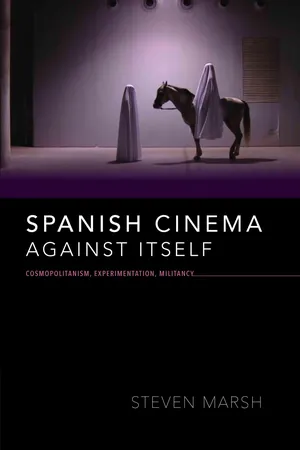
Spanish Cinema Against Itself maps the evolution of Spanish surrealist and politically committed cinematic traditions from their origins in the 1930s—with the work of Luis Buñuel and Salvador Dalí, experimentalist José Val de Omar, and militant documentary filmmaker Carlos Velo—through to the contemporary period. Framed by film theory this book traces the works of understudied and non-canonical Spanish filmmakers, producers, and film collectives to open up alternate, more cosmopolitan and philosophical spaces for film discussion. In an age of the post-national and the postcinematic, Steven Marsh's work challenges conventional historiographical discourse, the concept of "national cinema," and questions of form in cinematic practice.
"In this exhilarating counter-history of experimental filmmaking in Spain, Steven Marsh takes up the politics of form, the trouble with film history, and the theoretical potential of haunting, discontinuity, and absence . . .
Spanish Cinema Against Itself is an important intervention in Spanish film studies and, indeed, in the scholarship on world cinema." —Rosalind Galt, Professor of Film Studies, King's College London
- 270 pages
- English
- ePUB (mobile friendly)
- Available on iOS & Android
eBook - ePub
About this book
Information
Subtopic
European History1
INTERROGATIONS OF THE NATIONAL ALLEGORY
Trance Film and Ethnography
I BEGIN THIS INTERROGATION WITH TWO IMAGES FROM the introductory sequence of Jacinto Esteva’s Lejos de los árboles (Far from the trees) (1963–1971). In the first image, a raw egg left in a glass of water overnight, on the summer solstice, gyrates slowly; its white lingers and elongates in the fluid, and the strands of albumen delineate a seeping aquatic cartography caught in the light and in the glass. The bulbous yolk mutates, deforms, expands, shrinks, distends, and spreads, viscous and affecting. The other image is acoustic and precedes the visual image. Off-screen, we hear the unidentified and disembodied voice-over of two people—first a woman and then a man. They both utter the same words: “Erase una vez” (Once upon a time).
The dissonance between these two images highlights a disjunction that defines the entirety of this book. The egg swirling in slow motion contrasts with the pure speech act of the first words. The performative convention of fairy-tale openings is delivered anonymously in what purports to be a documentary film. The two images are defined by their liminal differences; by the permeable borders between sight and sound, between different genders, between the optical and the auditory, between claims to truth and falsehood, between the death of the old and new life, a rebirth. Also in this first sequence, the film cuts in scenes of young people in a nightclub who burst into frenetic dance, stop as if frozen, and then repeat their wild movements. The moments when the dancers stop are the only times then when the film stills, when the action slows, and we see the distension of the egg. It is a rhythm that sets the pace for the film.
Walter Benjamin famously writes in The Origin of German Tragic Drama, “In allegory the observer is confronted with the facies hippocratica of history as a petrified primordial landscape.”1 The image is like an X-ray; like a stark, dried outline left behind or like skin drawn tight over bones. Allegory, Bainard Cowan writes, is “veiled language”—allegoria, or other-discourse in its derivation from the Greek allos.2 Benjamin’s image stresses the excess, the washed-out, stretched, and death-like flesh of the face of history as seen and experienced from the sidelines.

Fig. 1.1 The distending, hypnotic egg left in the glass on Midsummer Night in the opening sequence of Lejos de los árboles.
This chapter introduces what will be a consistent conceptual theme throughout this book, evidenced by the initial sequence of Lejos de los árboles: that of the limit. Limit here refers to the interstitial zones between life and death, Eros and Thanatos, interiority and exteriority, self and other, and many more. I am interested in allegory as a form of writing rather than as an extended metaphor to be unpicked by an exegesis in search of correspondence. Allegory is customarily associated with depth of meaning; yet Benjamin’s image is telling in that it suggests an allegory as surface, as effect rather than explication. The Benjaminian theory of allegory as fragment—or the ruin that was later taken up by Paul de Man—is a significant element of this book, and particularly in contrast to the theory of national allegory posited by Fredric Jameson. Benjaminian allegory is, in my view, more apt for the reading of film. Vulgar interpretations of the work of André Bazin have generated a theory of cinematic montage—arguably a matter of the management of filmic time—in opposition to mise-en-scène, which is often concerned with the distribution of screen space. But recent work by Adrian Martin has facilitated a more complex use of Bazin.3 And Benjaminian montage techniques also contribute to the erosion of such a questionable dichotomy. Montage—the dialectical counterpoising of images in the editing process, according to Sergei Eisenstein’s formulation—was key to Benjamin’s method. As is well known, Benjamin sought to write in a way that reflected dialectical montage, fragmentation, and the spatial disturbance of time. The classical example of this approach in his work is the Arcades Project, with its amassed juxtaposed quotations and literary bricolage style.
In this chapter, I propose first a tentative inversion of the categorization that pairs surface against depth and space contra time. Benjamin insists that in allegory, form and content are the same thing within the movement he traces. Cowan, glossing Benjamin, writes, “Transforming things into signs is both what allegory does—its technique—and what it is about—its content.”4 Appearance and meaning are indivisible, and this leads to Benjamin’s—and Eisenstein’s—interest in the hieroglyph. Peter Brunette and David Wills, in their book on Derrida and film, draw attention to the similarity between Eisenstein’s interest in the hieroglyph and Derrida’s description of the same form, which is constituted by—to quote Derrida—“the organized cohabitation within the same graphic code, of figurative, symbolic, abstract, and phonetic elements.”5 Indeed, for Eisenstein, the hieroglyph is emblematic in montage of not only the conflicting dialectic between images but also that which relates to the distribution of elements within the assemblage of the individual image. Allegory as effect suggests an abrasive proximity to that which it claims an equivalence, a disturbance at the heart of representation that disrupts that equivalence. To this end, the hieroglyph might be conceived of as both trace and performance, an expressive form of writing that takes the unmoving shape of a seal, imprint, or stamp. It is the taut, paradoxical connection that holds together incompatible and impossible differences that Derrida calls the “spectral bond.”
The word bond is etymologically linked to boundary—the demarcation or enclosure of space (generic or national) in a framing that binds affiliation, and yet, as spectrality, that bond is rendered unstable. A boundary encloses an archive and stakes out a discrete, identifiable (and identitarian) territory—one imagines a national archive—but it also defines its outer edges and margins. The word archive here relates to the concept of supplement—both as a central repository of information and as surplus that seeps beyond the threshold of containment. Significantly, in Freud’s Beyond the Pleasure Principle, the word binden (gebunden) is translated as “annexed.” An annex is, of course, supplementary to the main text, as an appendix. In this context, it is no coincidence that all the films discussed in this chapter touch on the subject of death, or, at the very least, on the no-man’s-land that marks the meeting place of life and death.
The limit defines and reveals the topography of difference: of the shoreline, the border, gender, and genre. It is the brink, the cusp, the frame itself, the parergon. I am interested here in the overlap and excess that such an encounter produces, creating a tension that recalls not only Derrida’s hauntings—of historiography by historicity—but also his and Maurice Blanchot’s notion of spacing, the aperture in the graphology of the filmic text itself, and the relation between such spacing and filmic materiality. There is in spacing, as we will see, an additional connection between the hieroglyph and the freeze-frame. And there is, as Laura Mulvey has suggested, a further relation between this latter technique and death itself (and the death of cinema as a medium). Once more, death, in different ways, links all the films analyzed in this chapter.
If allegory is the discourse of the other, then ethnography is its field of study, its writing, and its documentation. Part of the purpose of this chapter is to query the term document, with its claims to truth and connotations of veracity and the verifiable. Early in his book on German tragic drama, Benjamin pens a striking description that resonates with a certain performativity (that is, surface effect) and has particular relevance to this chapter’s concern with what has come to be known as trance film: “Truth,” Benjamin writes, “bodied forth in the dance of represented ideas, resists being projected . . . into the realm of knowledge.”6 The checkered history of documentary cinema is littered with claims to truth. It is now quite commonplace to refer to Dziga Vertov’s coinage Kino-Pravda (Cinema-truth) as having a huge influence on ethnographer and filmmaker Jean Rouch, who, in turn, adopted the term cinema verité. There is also a long tradition of false documentaries—the genre’s counterfeits—that tell or seek to tell countertruths. Indeed, the parody of ethnography that imbues Luis Buñuel’s celebrated short film Las Hurdes: Land without Bread (1933) serves as a national precedent for several of the films discussed in this chapter (including Lejos de los árboles). The relation between documentary and allegory suggests a fictionalization and overlapping of contradictory signifying practices garnered through the modes of realism, ethnography, and filmic abstraction that characterized Spanish independent cinema of the 1960s to shed light on a subterranean avant-garde tradition. These spectral linkages connect the experimentalists of the 1960s with their predecessors of the 1930s. Such ghostly antecedents, figures from the past embedded within the strata of the filmic texts and whose persisting legacy suggests a temporal simultaneity, exceed empirical historiography’s capacity for representation.
The disturbance of representation generated by this kind of underground history returns us to the question of what Tom Gunning once called “truth claims” and the question of indexicality. It returns us to the Bazinian notion of the photographic image as the most faithful representation of the original object that it purports to represent. Mulvey, meanwhile, echoes Raymond Bellour, linking indexicality in the digital age with pre-cinema and the frozen filmic image—the photogram’s or the still’s uncanny “shudder”—with death itself. “In cinema,” Mulvey writes, “the blending of movement and stillness touches on this point of uncertainty so that, buried in the cinema’s materiality, lies a reminder of the difficulty of understanding passing time, and ultimately of understanding death.”7
Trance Film
The trance film is usually associated with ethnographic filmmakers Margaret Mead, Gregory Bateman, Jean Rouch, and Maya Deren. P. Adams Sitney uses the term specifically in reference to Deren, and its invention as a genre is sometimes attributed to him. However, it is noticeable that the term trance, used with respect to film, was deployed as early as 1928 by Antonin Artaud in his text “Sorcery and the Cinema.” Surrealism would prove important to Rouch and to Esteva (who befriended Salvador Dalí and visited him at his home in Cadaqués). Artaud writes, “Cinema in its raw state [le cinema brute] emits something of the atmosphere of trance conducive to certain revelations.”8 In the same text, Artaud refers directly to Germaine Dulac’s La Coquille et le Clergyman (1928), a film for which he wrote the scenario and that some two decades later would prove influential in the work of Deren.9 Decades later, Derrida, in a passage that resonates with the thrust of this book, would write: “The trance is that kind of limit (trance/partition), of unique case, of singular experience where nothing comes about, where what surges up collapses ‘at the same time,’ where one no longer can cut through to a decision between the more and the less.”10
Jacinto Esteva-Grewe was the founding member and central figure of the avant-garde group of filmmakers dubbed (by critic and producer Ricardo Muñoz Suay, in a deliberate promotional echo of the New York School) La Escuela de Barcelona (the Barcelona School). Aside from Esteva (whose family financed the initial project and the production company behind it, Films Contact), the principle members of the Barcelona School were Gonzalo Suárez, Joaquim Jordà, José María Nunes, Carlos Durán, and Vicente Aranda.11 Although he maintained friendly relations with the group, Pere Portabella, the doyen of Spanish experimental filmmaking whose work is discussed in chapters 2 and 3, declined to formally join the Barcelona School. Portabella’s refusal owes much to his political differences with the group. Although he originally colla...
Table of contents
- Cover
- Title Page
- Copyright
- Dedication
- Contents
- Acknowledgments
- Introduction: Différance. Otherness. Experiment.
- 1. Interrogations of the National Allegory: Trance Film and Ethnography
- 2. Intermediality, Intoxication, and the Infrathin
- 3. The Discontinuous Legacies of Pere Portabella: Between Heritage and Inheritance
- 4. History, Hauntology, Representation: Spanish Cinema against Itself
- 5. The Ex of Experimentation: Against Periodization
- 6. The Catacoustic and the Cosmopolitan: Rhythm and Timbre in the Films of Andrés Duque
- 7. Turns and Returns, Envois/Renvois: The Postal Effect in Recent Spanish Film
- 8. Retrospective Future Perfect: History, Black Holes, and Time Warps in the Films of Los Hijos and Luis López Carrasco
- 9. ¡No nos representan! : Performativity as Militant Film, the 15-M Archive
- Afterword: Unruly Archives. La décima carta and Buenas noches, España
- Bibliography
- Index
- About the Author
Trusted by 375,005 students
Access to over 1.5 million titles for a fair monthly price.
Study more efficiently using our study tools.
Frequently asked questions
Yes, you can cancel anytime from the Subscription tab in your account settings on the Perlego website. Your subscription will stay active until the end of your current billing period. Learn how to cancel your subscription
No, books cannot be downloaded as external files, such as PDFs, for use outside of Perlego. However, you can download books within the Perlego app for offline reading on mobile or tablet. Learn how to download books offline
Perlego offers two plans: Essential and Complete
- Essential is ideal for learners and professionals who enjoy exploring a wide range of subjects. Access the Essential Library with 800,000+ trusted titles and best-sellers across business, personal growth, and the humanities. Includes unlimited reading time and Standard Read Aloud voice.
- Complete: Perfect for advanced learners and researchers needing full, unrestricted access. Unlock 1.5M+ books across hundreds of subjects, including academic and specialized titles. The Complete Plan also includes advanced features like Premium Read Aloud and Research Assistant.
We are an online textbook subscription service, where you can get access to an entire online library for less than the price of a single book per month. With over 1.5 million books across 990+ topics, we’ve got you covered! Learn about our mission
Look out for the read-aloud symbol on your next book to see if you can listen to it. The read-aloud tool reads text aloud for you, highlighting the text as it is being read. You can pause it, speed it up and slow it down. Learn more about Read Aloud
Yes! You can use the Perlego app on both iOS and Android devices to read anytime, anywhere — even offline. Perfect for commutes or when you’re on the go.
Please note we cannot support devices running on iOS 13 and Android 7 or earlier. Learn more about using the app
Please note we cannot support devices running on iOS 13 and Android 7 or earlier. Learn more about using the app
Yes, you can access Spanish Cinema Against Itself by Steven Marsh in PDF and/or ePUB format, as well as other popular books in Media & Performing Arts & European History. We have over 1.5 million books available in our catalogue for you to explore.