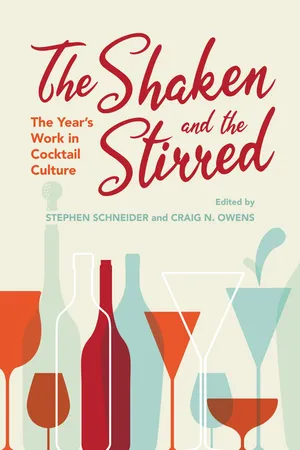
Over the past decade, the popularity of cocktails has returned with gusto. Amateur and professional mixologists alike have set about recovering not just the craft of the cocktail, but also its history, philosophy, and culture. The Shaken and the Stirred features essays written by distillers, bartenders and amateur mixologists, as well as scholars, all examining the so-called 'Cocktail Revival' and cocktail culture. Why has the cocktail returned with such force? Why has the cocktail always acted as a cultural indicator of class, race, sexuality and politics in both the real and the fictional world? Why has the cocktail revival produced a host of professional organizations, blogs, and conferences devoted to examining and reviving both the drinks and habits of these earlier cultures?
eBook - ePub
The Shaken and the Stirred
The Year's Work in Cocktail Culture
- 432 pages
- English
- ePUB (mobile friendly)
- Available on iOS & Android
eBook - ePub
The Shaken and the Stirred
The Year's Work in Cocktail Culture
About this book
Information
PART 1
Muddled Mythologies
ONE

“THE GREATEST OF ALL THE
CONTRIBUTIONS OF THE AMERICAN
WAY OF LIFE TO THE SALVATION OF
HUMANITY”
CONTRIBUTIONS OF THE AMERICAN
WAY OF LIFE TO THE SALVATION OF
HUMANITY”
On the Prehistory of the American Cocktail
JONATHAN ELMER
THERE IS A PARADOX AT the heart of the question of the American cocktail. Everyone seems to agree that the cocktail is American, but nobody really knows what that means. H. L. Mencken observes that the “cocktail, to multitudes of foreigners, seems to be the greatest of all the contributions of the American way of life to the salvation of humanity, but there remains a good deal of uncertainty about the etymology of its name and even some doubt that the thing itself is of American origin.”1 Mencken is writing in the immediate aftermath of World War II—the “American way of life” and “the salvation of humanity” were phrases often uttered in that moment with no trace of irony. But Mencken, I think, never removed his tongue from his cheek in anything he wrote. “Multitudes of foreigners” seem agreed that “the cocktail” is American. People need it to be so, evidently: as if American exceptionalism—Redeemer Nation bringing about the “salvation of humanity!”—was a status bestowed by others rather than fomented by American self-regard.
David Wondrich, our best contemporary authority on the history of mixed drinks, understands well that self-regard, and he offers a slightly different paean to the cocktail’s Americanness:
Anyone who has spent any time pondering the origins of the Cocktail . . . will agree that it’s a quintessentially American contraption. How could it be anything but? It’s quick, direct, and vigorous. It’s flashy and a little bit vulgar. It induces an unreflective overconfidence. It’s democratic, forcing the finest liquors to rub elbows with ingredients of far more humble stamp. It’s profligate with natural resources (think of all the electricity generated to make ice that gets used for ten seconds and discarded).
“In short,” Wondrich concludes, “it rocks.”2
Some time ago, I was given the task of writing about the “early American cocktail.” (This essay is the result.) It was my time to ponder the origins of the cocktail, and I was not exactly in a state of “unreflective overconfidence.” I knew the cocktail was American—as Mencken and Wondrich make clear, everybody knows that—but I was actually much more familiar with drinking in general in early America than I was with how and when the cocktail emerged from the mists of time. What I knew was this: people drank a lot—in early America, and elsewhere. Or perhaps I should say they used alcohol. Not merely something to imbibe in the seventeenth and eighteenth centuries, alcohol was the go-to liquid for all manner of everyday tasks. Until at least the mid-nineteenth century, most women bathed babies in spirits rather than water. Women applied wines stewed with thyme, sage, winter savory, sweet marjoram, and rosemary to their faces to maintain fairness, and rubbed their bodies with mead mixed with rose juice and petals. Women cleaned hats and boots with beer, silver and mirrors with gin, and metal with rum.3
I also knew some of Benjamin Franklin’s writings on booze, and the value of abstaining from it. As early as the 1720s, Franklin is publishing pieces with titles like “On Drunkenness,” “A Meditation on a Quart Mugg,” and “The Drinker’s Dictionary,” this last an alphabetically arranged compilation of phrases for being wasted. I offer here my own reduction of Franklin’s “dictionary”:
He’s Biggy, Burdock’d, Been at Barbados, and has a Head Full of Bees.
He’s Cherubimical, Crocus, Wamble Crop’d, and Half Way to Concord.
Sir Richard has Taken off his Considering Cap.
He’s Dipped his Bill and is Wet both Eyes—he’s in his Element.
Fox’d, Fuddled, and Fetter’d, His Flag is Out and he Fears no Man.
He’s Glaiz’d, Globular, Been with Sir John Goa, and Got the Glanders.
Hardy, Hiddey, He’s Got on his little Hat.
Jagg’d and Jambled, he’s seen the French King.
He sees two Moons, has Rais’d his Monuments, Eat the Cocoa Nut, and is altogether Nimptopsical.
He scalt his Head Pan and Been Among the Philistines and In his Prosperity.
He’s been too Free with Richard, like a Rat in Trouble. He’s half seas over, in the Sudds, As Stiff as a Ring-bolt, Stew’d, Stubb’d, Soak’d.
Top’d, Wet, and got the Indian Vapours.4
Being “too Free with Richard” was behavior observed only by the abstemious Franklin, who was called the “Water-American” by his beery colleagues in the printing house: “My Companion at the Press, drank every day a Pint before Breakfast, a Pint at Breakfast with his Bread and Cheese; a Pint between Breakfast and Dinner, and another when had done his Day’s-Work.”5 He goes on: “I drank only Water; the other Workmen, near 50 in Number, were great Guzzlers of Beer. On occasion I carried up & down Stairs a large Form of Types in each hand, when others carried but one in both hands. They wondered to see from this & several Instances that the Water-American as they call’d me was stronger than themselves who drunk strong Beer.”6 These passages are vintage Franklin: preening and wily and satirical all at once. He looks down on drinking and drinkers, but he also takes delight in the slang of it. Franklin might be called the first theorist of American drinking. He sets the stage for the uniquely American conjunction of exuberance and censoriousness that marks the country’s relation to its alcoholic ways.
But I had been tasked with writing about the early American cocktail, not boozing in general, and the responsibility of understanding origins weighed heavily on me. It was perhaps for this reason that, when I made the acquaintance of a major collector of early Americana, I blurted out: “I have to write an essay on early American cocktails! I bet you have some awesome punch bowls!” He raised his eyebrows at my enviable commission. He did indeed have some awesome punch bowls. Thus did I wangle an invitation to a late-summer gathering at my acquaintance’s country retreat, the other guests being other collectors and experts in early American material culture.
Of course, the punch bowls were a bit of a red herring. Punch may have been the “Monarch of mixed drinks,” as Wondrich calls it, but punches are not cocktails.7 My collector friend told me he would not be making punch or mixing drinks but that I was welcome to do so if I liked. I boned up on punches, shrubs, toddies, and flips. I learned that the American Revolution began outside a bar, which probably should not have surprised me. An engraving by Amos Doolittle shows the “Battle of Lexington” with Buckman’s Tavern in the background.8 The story goes that the militiamen who met the British had been knocking back flips in the dead of night. Of all the named drinks from this colonial era, the flip is the most attractive to me: a mélange of ale, rum, sugar or molasses, a beaten egg, and a scrape of nutmeg. But the proper preparation of a flip involves plunging a red-hot poker into the mix, to create a smooth, frothy, slightly burnt finish, and I thought brandishing a hot poker amidst the priceless objets d’art was probably ill-advised.
What did I think I would learn at this event? Hard to say, exactly. Expertise certainly—given all the authorities there, I might learn some hard facts useful to my writing. But more generally, I was drawn to the aura of authenticity itself, as if being in the company of these amazing artifacts would rub off on me, and I’d be able to bottle some of that in my essay. And I did learn about authenticity, though not what I had expected to learn. My host had written a few days before that his concession to my assignment was the procuring of some fine thirty-year-old Madeira. This was hardly a cocktail, of course, but I had no objections: if it was good enough for George Washington, who reportedly drank several glasses of Madeira every evening, it was good enough for me. As promised in the invitation, we “dined al fresco in the potting shed.” We dined—and we drank. By the time we sat down to a delicious meal, we had been through some bubbly and a Côte de Beaune. The Madeira made a round. I had prepared some notes to share with the other guests—including Franklin’s funny “dictionary”—but we were well into it now, and the notes would have to wait.
One difficulty with nailing down the early American origin of the cocktail is that name and thing don’t always coincide—in fact, they rarely do. This “lexical flexibility” bedevils all discussion of cocktails.9 As Wondrich points out, the word cocktail is used to denote all manner of drinks today—he has a special horror of the “Chocolate Martini”—that have no right to the name, and the same was true early on: “For a while there in the very early part of the [nineteenth] century that name appears here and there attached to drinks that in later years any self-respecting saloon denizen would have looked at with slantindicular gaze had it been proffered to him as a Cocktail—things such as ‘rum and honey,’ which may be a fine drink but ain’t no Cocktail.”10 To study this subject, one must become lexicographer and linguist, in addition to historian. Mencken offers seven possible etymologies for “cocktail.” Two of these trace to the French: that it derives from coquetier, an eggcup, which non-French speakers in New Orleans pronounced “cocktay”—this traces the drink to Henri Peychaud, famous for Peychaud’s Bitters; or that it derived from coquetel, the name of a mixed drink from Bordeaux. On the English side, the possible origins are more grotesque. Surely the idea that “cocktail” derives from “cock-ale”—a concoction involving a bird beaten to a pulp suspended in the cask so that its fowl essence pervades the whole—is just a sick joke. Then there’s the idea that it comes from cock-tailed, meaning “having the tail cocked so that the stump sticks up like a cock’s-tail.”11 Some historians aver that this effect was achieved by the application of raw ginger to a horse’s rear end.
Mencken’s researches have been superseded by those of Wondrich, who confirms evidence for this last narrative. “Feaguing” was the practice of putting “a clove of ginger up the poor tired [horse’s] ‘fundament’ before showing it,” explains Wondrich. “We may take the name cock-tail to be what linguists call an ‘exocentric noun-verb compound,’ like breakwater, scarecrow, and pickpocket. A cocktail is something that cocks up your tail . . . that something being a glass of ginger beer or ginger extract mixed with ale. In America, the tails took a little extra cocking.”12 This sketchy business with the ginger draws Wondrich into still deeper linguistic waters: “The issue has been confused by its use of the old rhetorical trick of hypallage or transferred epithet: In reality, it’s the drink that’s ginger, and cock-tail is the vulgar appellation.”13 But Wondrich’s citations indicate something different: “Cock-tail—is ginger,” writes John Badcock in Sportsman’s Dictionary (1825), and the same author’s Boxiana; or, Sketches of Ancient and Modern Pugilism (1828) describes fight fans in a country pub drinking “gin and [that is, or] beer, or both combined with a scratch or two of cock-tail in it.”14 Wondrich asserts that this “scratch or two of cock-tail” “has to be something like ginger extract,” but how do you scratch an extract?15 Leaving aside such quibbles, this much is clear: The word cock-tail seems to be first associated with a drink not in America, but in England. It refers to a drink with ginger in it, which by association with the practice of feaguing suggests a perking or picking up of spirits (or tails).
On this side of the pond, the crucial ...
Table of contents
- Cover
- Title Page
- Copyright
- Contents
- Introduction: The Shaken and the Stirred
- Part 1: Muddled Mythologies
- Part 2: Spirits of the Age
- Part 3: Mixed Messages
- Part 4: In a Glass, Darkly
- Afterword: Confessions of a Cocktail Nerd
- Contributors
- Index
Trusted by 375,005 students
Access to over 1.5 million titles for a fair monthly price.
Study more efficiently using our study tools.
Frequently asked questions
Yes, you can cancel anytime from the Subscription tab in your account settings on the Perlego website. Your subscription will stay active until the end of your current billing period. Learn how to cancel your subscription
No, books cannot be downloaded as external files, such as PDFs, for use outside of Perlego. However, you can download books within the Perlego app for offline reading on mobile or tablet. Learn how to download books offline
Perlego offers two plans: Essential and Complete
- Essential is ideal for learners and professionals who enjoy exploring a wide range of subjects. Access the Essential Library with 800,000+ trusted titles and best-sellers across business, personal growth, and the humanities. Includes unlimited reading time and Standard Read Aloud voice.
- Complete: Perfect for advanced learners and researchers needing full, unrestricted access. Unlock 1.5M+ books across hundreds of subjects, including academic and specialized titles. The Complete Plan also includes advanced features like Premium Read Aloud and Research Assistant.
We are an online textbook subscription service, where you can get access to an entire online library for less than the price of a single book per month. With over 1.5 million books across 990+ topics, we’ve got you covered! Learn about our mission
Look out for the read-aloud symbol on your next book to see if you can listen to it. The read-aloud tool reads text aloud for you, highlighting the text as it is being read. You can pause it, speed it up and slow it down. Learn more about Read Aloud
Yes! You can use the Perlego app on both iOS and Android devices to read anytime, anywhere — even offline. Perfect for commutes or when you’re on the go.
Please note we cannot support devices running on iOS 13 and Android 7 or earlier. Learn more about using the app
Please note we cannot support devices running on iOS 13 and Android 7 or earlier. Learn more about using the app
Yes, you can access The Shaken and the Stirred by Stephen Schneider, Craig N. Owens, Stephen Schneider,Craig N. Owens in PDF and/or ePUB format, as well as other popular books in Social Sciences & Popular Culture. We have over 1.5 million books available in our catalogue for you to explore.