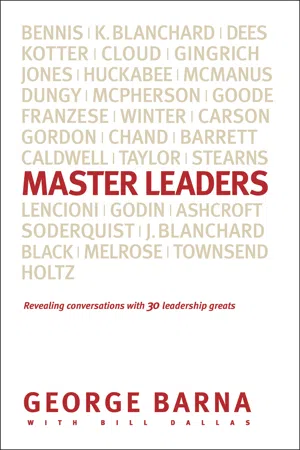
Imagine the chance to sit down with 30 of the world's best-known and most-respected leaders as they share their secrets to success. That's Master Leaders—the most valuable leadership book of the decade, now available in softcover. Based on personal interviews and conversations with "the greats" (including Ken Blanchard, Colleen Barrett, Ben Carson, Tony Dungy, Newt Gingrich, Seth Godin, Patrick Lencioni, and many others), Master Leaders offers 16 key distinctives that you need to know in order to be a successful leader. Coauthored by George Barna ( Revolution) and Bill Dallas ( Lessons from San Quentin), Master Leaders contains top-of-the-line insider information on leading wisely and well . . . from the people who know.
eBook - ePub
Master Leaders
Revealing Conversations with 30 Leadership Greats
- 231 pages
- English
- ePUB (mobile friendly)
- Available on iOS & Android
eBook - ePub
Master Leaders
Revealing Conversations with 30 Leadership Greats
About this book
Information
Topic
Theology & ReligionSubtopic
LeadershipCHAPTER 1
UNEXPECTED DISCOVERIES
AS EXPECTED, ONE, THEN A FEW, then many people started coursing through the greenroom, mostly oblivious to my presence as they focused on their own pressing tasks. My nerves began to get the best of me, so I decided to do what I imagined all great leaders do when faced with pre-event jitters: eat.
I made my way to the nearest food table and began selecting pieces of sliced fruit to devour. Naturally, as soon as I stuffed the first piece of cantaloupe into my mouth, four of our guest speakers arrived. Hoping to find a familiar face, or at least to get some guidance, they stared right at me. So much for first impressions.
I quickly surrendered my plate and hurried over to greet them. Don Soderquist, who had been president of Ben Franklin, the large chain of retail stores, and, later, the longtime COO of Wal-Mart, was there. So was John Townsend, the popular psychologist and bestselling author. Tony Dungy, the Super Bowl–winning coach was also there, alongside Ken Melrose, who had served as CEO and chairman of Toro for many years.
After welcoming them and introducing them to each other, I led the group to the food table. They chose their food and then we hit that first awkward moment—even high-powered leaders feel a little uncomfortable making conversation sometimes. It was time to break the ice.
“I am so excited to be with all of you for this conference,” I began, stating the obvious. “The other speakers will all be here soon, so we’ll have a lot of new faces to meet, although you probably all know each other at least by reputation. I think the audience is in for a treat these next two days.”
There were murmurs of agreement, which encouraged me to plunge on. “I’m telling you, I wouldn’t want to be in your shoes. You guys are positioned as the gurus of leadership.” Amidst their groans of protest and mock horror, I continued. “So, tell me, over the course of your years in leadership, what have been some of the great discoveries, the ‘aha’ moments, that have shaped your thinking about what it means to be a leader?”
I could hear the chomping of food and the slurping of coffee as they each waited for someone else to get the ball rolling. Finally Don Soderquist smiled and launched the conversation to a great start.
“You know, one of the things I discovered is that you can’t change everybody.” He was immediately interrupted by a chorus of amens and then laughter. He pushed forward with his discovery. “I really believed that I could change everybody if I was honest and fair with them. I believed that if I painted a clear picture of how that individual was performing and what his or her potential was, then I could change that person.
“After a time,” Don continued, “I came to realize that really I can’t change anybody. I could counsel with them, I could coach them, I could lead them, I could hold up the mirror for them and everything. But ultimately change has to come from them. It dawned on me that if they didn’t change themselves, if they didn’t have the desire and the will to change, I couldn’t change them.”
Someone suggested that sometimes the changes that do happen are not the kinds of changes you were shooting for in the first place.
Don acknowledged the thought. “Absolutely. In fact another surprise I encountered was that people often change as they move up the organizational ladder. Egos get bigger and people become more arrogant, the higher their position. And it was a big surprise to me to see how many people at the highest level in an organization didn’t know what humility means. Suddenly it was all about them. I had many examples of store managers who became district managers because they had done such a good job as store managers. But the moment they put on the coat of a district manager, they’d change for the worse. They didn’t rely on what they had done well as store managers. They thought district managers needed to be tougher or needed to be different somehow. Instead of accepting the fact that they were successful because of who they were and the way they treated people, they changed all of that and struggled as a result.”
I made a mental note of his point: leadership is not about your position as much as it’s based on who you are as a person and the capabilities you demonstrate. Don’s thoughts had clearly struck a chord with our group. There were nodding heads all around the circle of munchers. After a brief silence, Ken Melrose took up the thread.
“When I started working at Toro, the leadership model of the day was pretty much a top-down model. The big brass, the big shots with the titles, made all the decisions and told their minions what to do. As a young guy starting out, that was my model. I didn’t know anything else or any executives who did things differently. But I learned that approach didn’t work very well because it didn’t engage the organization or create a trusting atmosphere. It emasculated employees from taking risks with new ideas.”
Ken paused to take a sip of his drink, and sensing that his peers were waiting for the rest of his revelation, he ventured forth. “I eventually learned that a much better way to lead was from underneath the organization, where you’re coaching and mentoring and serving the constituency and employees, trying to make them successful. If you get rid of your ego about being the powerful executive and focus on the success of others, and then they do the same with their people—so we’re all focusing on the team’s success instead of our own—then by virtue of the fact that they become successful, it guarantees that the boss becomes successful too. It unleashes all the potential in the employee base.”
Leadership is not about one’s position as much as it’s based on who you are as a person and the capabilities you demonstrate.
We had now been joined by a few more speakers who had wandered in, picked up something to eat or drink, and gathered around to be part of the conversation.
Ken continued to describe his journey. “Using that approach, our people became more trusting, they felt they could try some new things, their self-esteem went up, and they were willing to share ideas without worrying about being chewed out if they were wrong. So the whole idea of helping those people as a servant leader who focused on them evolved into a leadership philosophy. In essence, if the CEO behaved as if he worked for management, and management behaved as if they worked for the employees, and if employees worked to serve customers, you’d have a great organization that benefited all the stakeholders—stockholders, customers, and employees.”
The sound of agreement and approval filled the room. “I bet you had a continual series of examples where the culture changed because of that leadership approach,” I noted.
Ken nodded and recalled one such example, talking about one of his first experiences while he was rising through the ranks and championing that approach. “One time I had to manage a new organization within Toro that we had acquired. That company made commercial playground equipment. I didn’t know anything about their business, but as I got involved it became clear that they didn’t want to make any decisions because my predecessor in that company had always made all the decisions for them. Early on, the purchasing manager came to me and said he wanted to buy some steel. Their organization was kind of downtrodden and unsophisticated, and most of the employees were perfectly happy with the big boss making all the decisions.
“So the purchasing agent wanted me to tell him how much steel he should order to manufacture some swings and slides. I told him, ‘Well, you’re the purchasing manager; go ahead and order what you need.’ He said, ‘But Bob, our old boss, always made that decision for us.’ I told him again that I couldn’t make that decision for him. I wasn’t being obstinate; I just didn’t have any idea how much steel any of the equipment they made would take. But he had such low self-esteem and no confidence in his ability to make that decision.
“At that point we invited a few others from sales, inventory control, and production to join us and then went through some questions regarding what it took to make the swing, how many swings we needed to make, how much inventory we wanted to have on hand, and a few other matters. They had never done this kind of thing, getting all the people together to talk about the process and our needs.
“Pretty soon, all these people were going, ‘Aha,’ like it was a great revelation to them how their job was done. But it also got me thinking that even though this is just commonsense stuff, once they understood the process, you could see how it changed them. These people were sitting up straighter in their chairs. When the purchasing manager left the room, he said, ‘Wow, now I know how much steel to order. We need twenty-two tons. I can do that.’ I’m telling you, it looked like he was an inch taller already.” He chuckled at the memory, and everyone around the table smiled at the mental portrait he had painted for us.
“That was a real aha to me,” Ken continued, “because of how that simple process of empowering them lifted the employees’ spirits and self-esteem. After the meeting, I sat there for a while trying to figure out what had happened that was so earth shattering. We had simply freed them to rise to the potential God had given them.”
By now our circle had grown. I took a moment to welcome the newcomers and quickly introduce everyone. I hated to lose the momentum, so I asked if anyone else had experienced such moments of insight that had altered their own views about leading.
John Townsend shared one of his discoveries. “My original concept was that a leader is someone who has the techniques and strategies to influence people in an organization to reach goals. While a leader needs those strategies and techniques, now I recognize that it’s far more important that the person have two additional characteristics. One is that he or she is the right person inside, someone who has a good level of character structure and maturity—that he or she is the real deal, so to speak. And secondly, that person must know how to relate to people on an authentic and real level.”
As John reached for his cup, someone asked if he had found that people with those qualities generally rise above the rest to become successful leaders.
Thinking back on his long history of interaction with leaders, John responded, “I’ve found that successful leaders are much more aware of their subjective, emotional responses than you would expect. My book Leadership Beyond Reason is all about how I learned that successful leaders are highly objective and understand data, spreadsheets, journals, research, and all the diligence they are supposed to have to influence people and make decisions. But,” he said with emphasis, “the really successful leaders also pay attention to their guts, intuition, hunches, emotional reactions, passions, and creativity—all of that soft-science, subjective stuff. They really give a lot of attention to that input, and it gives them the wealth of information they need in a complex organization. Now, because I believe that God made reality to be integrated, so that truth is truth whether it is objective or subjective, I believe those leaders are able to make far more discerning judgments about decisions because they can listen to their guts as well as their heads.”
While a few speakers echoed John’s sentiments, I welcomed Barry Black, who serves as chaplain of the U.S. Senate; Ken Blanchard, the world-renowned management and leadership expert; Miles McPherson, pastor of a megachurch in San Diego; and Sam Chand, a former college president currently engaged in leadership consulting around the world. By now we had about one-third of our total group of speakers in the room.
For those just joining us, I explained that I had been asking people about some of their aha leadership moments. I summarized how some of our colleagues had discovered that leadership is less about commanding and more about empowering people to live up to their potential by using all of their abilities.
Sam Chand chimed in almost immediately. “I’ll tell you,” he said with a characteristic mischievous gleam in his eye, “on my journey I have discovered some defining things, and one of them is how little I can do by myself and how much more I can do through others. I discovered that I was perpetuating a vicious cycle of not developing other leaders. I was born and raised in a pastor’s home in India, and eventually became a pastor, then a college president, but I have yet to have somebody put his arm around me and say, ‘Sam, I see some gifts in your life, some talents. Let me take you under my wing and mentor you. There’s no use in you making the same mistakes I made.’ That has not happened in my life, and so I began perpetuating the same cycle. When I left the church I was leading in Michigan, it was then that I realized I had not really grown people because I did not know how to grow people. Once I realized I needed to be intentional about how to do that, I became a student of it, and that’s much of what I do now.”
Leadership is less about commanding and more about empowering people to live up to their potential by using all of their abilities.
I related well to Sam’s tale. Growing yourself as a leader is one thing; knowing how to help other people reach their leadership potential is something else altogether. It really does take a willingness to focus on others rather than self. Meanwhile, Chaplain Black offered one of his “lightbulb” moments.
“As my understanding of leadership has evolved, I have come to see leadership as far more collaborative than I had previously suspected. Earlier I had a more heroic model of a leader. I saw great leaders like John Kennedy and Martin King and assumed that the power of their charisma enabled them to get people to do whatever they articulated in their speeches or in their writings. As the years have gone by, I have come to think of leadership as the mobilization of people toward a shared objective. And that mobilization requires the leader to first listen in order to learn, in order to lead. It does not mean that you do not have an individual vision. Nehemiah knew he wanted to rebuild the walls, but he still listened in order to learn before he started to lead the people. So leadership has become far more collaborative in the later stages of my experience than in the early stages.”
This line of reasoning got Ken Blanchard’s juices flowing. He was enthusiastically nodding as Barry spoke. Ken seemed eager to build on the foundation the chaplain had laid. It didn’t surprise me; Ken has been a leading champion of collaborative leadership models for years.
“When I first started, and even when The One Minute Manager came out, there was much more of a hierarchical view of organizations, where the manager took the lead in setting the goals and deciding whom to praise and whom to reprimand and redirect. Today I look at leadership much more as a partnership than any kind of hierarchical arrangement. Young people in particular are fascinated when you talk to them about the shift in thinking. They just can’t believe that we ever used the term ‘superior.’ And who works for superiors? Well, subordinates—you know, sub-ordinary people. And then they get a big kick out of saying: ‘What’s your role?’ I’m in supervision. ‘Well does that mean you see things a lot clearer than these stupid people that work for you?’ So I think it’s much more of a partnership now, and we spend a lot of time talking about partnering for higher performance. A big aha for me was to realize that all the effective aspects of leadership are about servant leadership—about serving your customers and serving your people.”
Ken had written a series of popular books on that very transition in his thinking and in the field of leadership. He would be speaking on the topic of servant leadership later in the conference. That was clearly his sweet spot—we...
Table of contents
- Cover Image
- Half Title Page
- Title Page
- Copyright
- Contents
- Acknowledgments
- Preface
- Introduction: Leadership Fantasy Camp
- Chapter 1: Unexpected Discoveries
- Chapter 2: Defining and Evaluating Real Leadership
- Chapter 3: Vision and Values
- Chapter 4: Creating Culture
- Chapter 5: Developing Leaders
- Chapter 6: Hiring the Right People
- Chapter 7: Leading Well
- Chapter 8: Earning and Maintaining Trust
- Chapter 9: Confrontation and Conflict
- Chapter 10: Character
- Chapter 11: Following
- Chapter 12: Team Building
- Chapter 13: Faith and Morals
- Chapter 14: Power
- Chapter 15: Criticism and Pressure
- Chapter 16: Skills and Discipline
- Next Steps
- Appendix 1: About the Master Leaders
- Appendix 2: The Master Leader Library
- About the Authors
- Index
Trusted by 375,005 students
Access to over 1.5 million titles for a fair monthly price.
Study more efficiently using our study tools.
Frequently asked questions
Yes, you can cancel anytime from the Subscription tab in your account settings on the Perlego website. Your subscription will stay active until the end of your current billing period. Learn how to cancel your subscription
No, books cannot be downloaded as external files, such as PDFs, for use outside of Perlego. However, you can download books within the Perlego app for offline reading on mobile or tablet. Learn how to download books offline
Perlego offers two plans: Essential and Complete
- Essential is ideal for learners and professionals who enjoy exploring a wide range of subjects. Access the Essential Library with 800,000+ trusted titles and best-sellers across business, personal growth, and the humanities. Includes unlimited reading time and Standard Read Aloud voice.
- Complete: Perfect for advanced learners and researchers needing full, unrestricted access. Unlock 1.5M+ books across hundreds of subjects, including academic and specialized titles. The Complete Plan also includes advanced features like Premium Read Aloud and Research Assistant.
We are an online textbook subscription service, where you can get access to an entire online library for less than the price of a single book per month. With over 1.5 million books across 990+ topics, we’ve got you covered! Learn about our mission
Look out for the read-aloud symbol on your next book to see if you can listen to it. The read-aloud tool reads text aloud for you, highlighting the text as it is being read. You can pause it, speed it up and slow it down. Learn more about Read Aloud
Yes! You can use the Perlego app on both iOS and Android devices to read anytime, anywhere — even offline. Perfect for commutes or when you’re on the go.
Please note we cannot support devices running on iOS 13 and Android 7 or earlier. Learn more about using the app
Please note we cannot support devices running on iOS 13 and Android 7 or earlier. Learn more about using the app
Yes, you can access Master Leaders by George Barna,Bill Dallas, George Barna in PDF and/or ePUB format, as well as other popular books in Theology & Religion & Leadership. We have over 1.5 million books available in our catalogue for you to explore.