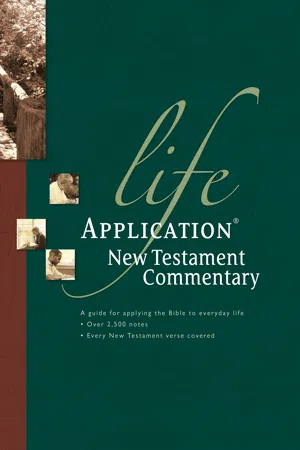
Based on the best-selling Life Application Commentary series, this single, handy volume holds practical, concise insight on every verse in the New Testament. Now readers can get all the useful background information they need, without a lot of obscure facts they don't need. A key resource for every Bible teacher and anyone else who wants to understand the New Testament and how it applies to real life.
- English
- ePUB (mobile friendly)
- Available on iOS & Android
eBook - ePub
About this book
Information
Topic
Theology & ReligionSubtopic
Biblical Commentary1 CORINTHIANS
INTRODUCTION
Lawsuit.
Split.
Scandal.
Tragically, contemporary headlines often trumpet bad reports from local churches. News of leaders’ sexual escapades, disgruntled and disgraced members’ lawsuits, unethical and irresponsible fiscal practices, and blatant heresies seems to parade weekly across television screens. Jesus had told the Twelve that his followers would be known by their love (John 13:35). Yet, today, many who claim to follow him are marked by anything but love. Instead of standing apart from the world, the church has taken the appearance of other, secular institutions and has blended in.
What would God say to these errant believers, to churches and individuals who have strayed from obeying his commands? He said it nearly 2,000 years ago through Paul to Christians in decadent Corinth, a city similar to many communities today. Paul wrote letters, now known as 1 and 2 Corinthians, urging believers to focus on Christ, forsake immorality, settle their differences, reject false teachers, unify, and love. As you read these personal and powerful epistles written first to ancient Greeks, know that the words and principles apply to this generation as well.
AUTHOR
Paul (Saul of Tarsus): former Pharisee, apostle, pioneer missionary of the church.
Paul visited Corinth on his second missionary trip. At the time of Paul’s visit, Corinth was a bustling commercial city, a center of Mediterranean trade. It is no wonder that Paul easily found work as a tentmaker (most likely working with goat’s-hair cloth, a prominent trade of Paul’s native region, Cilicia). In his spare time, Paul began to speak about Christ to Jews at the local synagogue, but he received a cold reception. Undaunted by opposition, Paul began teaching next to the synagogue in Titius Justus’s house. This infuriated the Jews. Paul’s congregation probably included many God-fearing Gentiles who used to attend the synagogue right next door. Because these Corinthian Jews hated Paul, they presented an official complaint to Gallio, the governor of Achaia. Gallio refused to hear his case, however, because he viewed the early Christians as simply another sect of Judaism. Ironically, this mistaken perception protected the infant church from being rigorously persecuted by the Romans. With his opponents defeated, Paul was free to stay in Corinth for a year and a half (around A.D. 50–52), one of Paul’s longest stays in any one city during his missionary journeys. Perhaps he envisioned Corinth as a center of evangelism for all of Greece.
The two letters to the Corinthians preserved in the Bible are evidence that Paul took special interest in the spiritual welfare of the Corinthian church. His long stay in the city made it painful for him to hear of the problems that had begun to plague the church there. Paul himself had established the church. He had endured much ridicule in order to preach the gospel. He had worked hard in order to preach free of charge. As these two letters make clear, however, the Corinthian church struggled in Paul’s absence.
Paul’s authorship of 1 Corinthians has never been seriously questioned by Bible scholars. In the very first verse of 1 Corinthians, he identifies himself as the author and Sosthenes as his secretary. This evidence, along with the Pauline emphasis on the believer’s freedom in Christ (10:23-33), is enough to convince most scholars.
For more about Paul, see the Author section in the Introduction to the book of Romans.
DATE AND SETTING
Written from Ephesus around A.D. 55.
Near the end of 1 Corinthians, Paul reported the details of his recent travel plans and revealed that he was writing from the city of Ephesus (16:8). On his third missionary journey, Paul stayed in Ephesus for three years. Ephesus, a bustling seaport town in Asia Minor (present-day Turkey), was a strategic city for the spread of the gospel message in Asia Minor. Located at the intersection of two ancient overland routes (the coastal road running north to Troas and the western route to Colosse, Laodicea, and beyond), Ephesus became a customary stopping point for ships sailing through the Aegean Sea. Thus, the city became known as the gateway to Asia. During the first century, however—the time period of Paul’s ministry—the harbor began filling up with silt. This condition caused a slight economic downturn.
The numerous visitors who came to Ephesus every month kept revenue flowing into the town. The magnificent temple to Diana (the goddess of fertility, also called Artemis) was located in Ephesus. Four times larger than the Parthenon, this marble temple was considered one of the wonders of the ancient world. People from throughout the Roman Empire came to worship Diana there. In addition to the temple of Diana, Ephesus boasted an immense amphitheater that could seat twenty-five thousand and an equally huge stadium that hosted all types of gladiator fights. A sparkling marble street flanked by colonnades ran through the city, directing all visitors to the amphitheater. Because of its temples to pagan gods and goddesses, Ephesus was one of the great tourist capitals of the ancient world. It was no wonder that the craftsmen of that city became alarmed at the spread of Christianity among the populace (see Acts 19:21-41).
Perhaps it was because the city was such a center for tourism and trade that Paul spent three full years there—teaching the gospel in the lecture hall of Tyrannus. According to Luke, the author of Acts, this lecture hall became a gathering place for people from all over the province of Asia Minor who were interested in the Good News of Jesus Christ (see Acts 19:9-10). During this extended stay in Ephesus, Paul wrote 1 Corinthians.
AUDIENCE
The church in Corinth.
Along with Rome and Alexandria, Corinth was one of the major cities of the Roman Empire. Its prominence and wealth were derived from the extraordinary amount of shipping and commerce that passed through its harbors. The location of Corinth on a four-and-a-half-mile isthmus that connected mainland Greece and Achaia made it an ideal shipping hub. Ships were placed on wooden platforms and dragged across a stone road on the isthmus between the two ports of Corinth-Lechaeum and Cenchrea. A canal would have been ideal, but the Romans never built one. The lack of a canal, however, did not impede the ship traffic across the isthmus. It was easier and safer for a ship captain to pay the fees to have his ship dragged across the isthmus than to sail around Achaia, a two-hundred-mile journey known for its severe and unpredictable storms.
Although the Romans destroyed Corinth in 146 B.C. for taking a leadership role in a rebellion, Julius Caesar rebuilt the city in 46 B.C. The city quickly regained its former prominence, and by 27 B.C., it was named the capital of a senatorial province of Achaia. By the first century A.D., the city was the most influential commercial center in Greece. In addition to being a commercial center, Corinth was a manufacturing center for bronze, a metal used in the construction of many of the Roman amphitheaters. The prestige of Corinth was elaborately displayed at the biennial Isthmian games in that city (a series of games equivalent to the Olympic games). Paul drew upon the images of the athletes and awards in these games to illustrate the nature of the Christian life (9:24-27).
The wealth accompanying commercial success often breeds moral laxity; that certainly was the case in Corinth. Throughout the ancient world, the city was known for its moral decadence. Plato used the term “Corinthian girl” to refer to a prostitute; and Aristophanes used the verb “to act like a Corinthian” to refer to fornication. The magnificent temple of Aphrodite (the goddess of love, fertility, and beauty) stood on the mountain that overlooked Corinth as a monument to this immoral lifestyle. That temple was the center of many varieties of religious prostitution.
As a strong commercial center, Corinth drew a substantial number of people from every corner of the Roman Empire, so the city was ethnically and religiously diverse. In addition to the temple of Aphrodite, Corinth contained a temple for Asclepius, the Greek god of healing, as well as sites to venerate Issi, the Egyptian god of seafarers, and Poseidon, the Greek counterpart to Issi. There is even archeological evidence of a Jewish synagogue dating back to the third century. The diversity of the city was reflected in the makeup of the Corinthian congregation (12:13).
Corinth was the last city Paul visited on his second missionary journey (Acts 18:1-18). He stayed in Corinth for eighteen months, establishing a church there. Apollos, who had been taught the basics of the Christian faith by Aquila and Priscilla in Ephesus, visited the church at a later time, encouraging the believers (1:12).
Unfortunately, the Corinthian church not only reflected the city’s multiethnic character, but also its moral depravity. Paul’s exhortations against incest (5:1-5) and against soliciting prostitutes (6:9-20) indicate that members in the church were struggling to resist the pervasive immorality of their city. But Paul wouldn’t compromise the high standards of Christian conduct for the church in Corinth. Being surrounded by ubiquitous immorality did not make the Corinthians an exception. Instead, he called them to a pure life, set apart for God. He even compared their bodies to God’s temple (6:18-20). Even with its numerous problems, the Corinthian body of believers became a strategic church for the propagation of the gospel. Its location on the major trade routes of the Roman Empire made it a key outpost for spreading the gospel in Achaia (present-day Greece).
OCCASION AND PURPOSE
To answer some questions about church order, to identify some problems in the Corinthian church, and to teach the believers how to live for Christ in a corrupt society.
In his travels throughout the Mediterranean world, Paul had visited numerous towns and seaports, establishing small cells of committed believers in almost every place he visited. During his travels Paul had dealt with a wide variety of people—from mad mobs to subtle philosophers—and with various situations—from fierce persecution to moral laxity. Throughout all this, he showed keen interest in the spiritual welfare of every person with whom he came in contact. His letters frequently recount how he wrestled in prayer for a church or an individual (2 Corinthians 13:7; 1 Thessalonians 3:10). This genuine concern prompted Paul to write letters to his converts, instructing them in the faith, and it compelled him to visit churches again and again. Corinth was no exception.
The very first letter that Paul wrote to the Corinthian believers has been lost. First Corinthians 5:9 mentions this previous letter. Obviously, it could not have been 1 Corinthians. The exact contents of this letter are unknown; 1 Corinthians 5 implies that Paul had warned the Corinthians in that letter not to associate with so-called Christians who engaged in sexual immorality.
The problems in Corinth. Near the end of his stay in Ephesus, Paul wrote a second letter, the epistle entitled 1 Corinthians. He wrote this letter in response to a message delivered by Stephanas, Fortunatus, and Achaicus (16:17). Stephanas and his companions had asked Paul a series of questions, mostly concerning church order. In his long letter in response, Paul answered the questions related to Christian marriage (7:1-16), food sacrificed to idols (8:1-13), spiritual gifts (12:1-31), and the procedure for collecting money for the relief of the Jerusalem church (16:1-14). This is why 1 Corinthians is arranged topically. Instead of a theological treatise, with a central thesis and a number of arguments supporting the main point, 1 Corinthians is a practical letter addressing a variety of issues faced by the church.
In addition, Paul addressed problems that had surfaced in an unofficial report from Chloe’s household in Corinth (see 1:11). According to that report, persistent problems had been plaguing the church. Specifically, members were quarreling with each other and forming cliques around various teachers—especially Paul, Peter, and Apollos (1:10-17). Corinthian believers were even suing each other (6:1) and arguing when they met to celebrate the Lord’s Supper (11:17-22). Even more disturbing was the report of a case of incest in the church that had not been confronted by the church leaders (5:1). Paul responded to each of these very serious issues. In fact, 1 Corinthians seems to almost follow Chloe’s report as an outline, as it answers the problems and issues raised.
The Gentile heritage. At first, many of the conflicts addressed in 1 Corinthians seem to be unrelated and disconnected. A careful analysis of all the problems and disputes, however, reveals a predominantly Gentile church. First, sexual permissiveness in the church would have been more a problem for Gentiles than for Jewish believers, who were already familiar with Old Testament restrictions on their sexual appetites (6:12-20). Second, numerous lawsuits would not have been a problem among Jewish Christians, for Jews were forbidden to use heathen courts and were expected to resolve their differences with the elders of the local synagogue (6:1-11). Only Gentile Christians would be inclined to sue each other in Roman courts. Third, Paul’s extensive discussion on the wisdom of the Spirit compared to the foolishness of people confirms that his audience was primarily composed of Gentile Christians. Greek philosophers would demonstrate their so-called wisdom with lavish rhetoric. That’s why Paul had to explain his reason for not presenting the gospel with “lofty words” but instead with the power of the Holy Spirit (2:1-4).
First Corinthians clearly shows that some of the philosophies of the Greek and Roman world were coloring the Corinthians’ perception of their newfound faith in Jesus. This letter was written to a group of believers who were still influenced by philosophical dualism. Ever since Plato, much of Greek philosophy had been based on the belief that the spiritual and the material were completely separate spheres of human existence. According to this view, the material or physical side of human nature was inherently corrupt and doomed for destruction. By contrast, the spiritual side could gradually lose its connection to the material and ascend to God, the pure Spirit. This type of thinking was absorbed by Gnostics in the second century and probably formed the foundation of the Corinthians’ denial of a bodily resurrection (see Paul’s defense of Jesus’ resurrection in 15:12-34).
Philosophical dualism led to two opposite extremes. Some people concluded that because the physical/material was irredeemable, what a pe...
Table of contents
- Cover
- Copyright
- Contents
- Introduction
- Matthew
- Mark
- Luke
- John
- Acts
- Romans
- 1 Corinthians
- 2 Corinthians
- Galatians
- Ephesians
- Philippians
- Colossians
- 1 Thessalonians
- 2 Thessalonians
- 1 Timothy
- 2 Timothy
- Titus
- Philemon
- Hebrews
- James
- 1 Peter
- 2 Peter
- 1 John
- 2 John
- 3 John
- Jude
- Revelation
- Harmony of the Gospels
- Bibliography
Trusted by 375,005 students
Access to over 1.5 million titles for a fair monthly price.
Study more efficiently using our study tools.
Frequently asked questions
Yes, you can cancel anytime from the Subscription tab in your account settings on the Perlego website. Your subscription will stay active until the end of your current billing period. Learn how to cancel your subscription
No, books cannot be downloaded as external files, such as PDFs, for use outside of Perlego. However, you can download books within the Perlego app for offline reading on mobile or tablet. Learn how to download books offline
Perlego offers two plans: Essential and Complete
- Essential is ideal for learners and professionals who enjoy exploring a wide range of subjects. Access the Essential Library with 800,000+ trusted titles and best-sellers across business, personal growth, and the humanities. Includes unlimited reading time and Standard Read Aloud voice.
- Complete: Perfect for advanced learners and researchers needing full, unrestricted access. Unlock 1.5M+ books across hundreds of subjects, including academic and specialized titles. The Complete Plan also includes advanced features like Premium Read Aloud and Research Assistant.
We are an online textbook subscription service, where you can get access to an entire online library for less than the price of a single book per month. With over 1.5 million books across 990+ topics, we’ve got you covered! Learn about our mission
Look out for the read-aloud symbol on your next book to see if you can listen to it. The read-aloud tool reads text aloud for you, highlighting the text as it is being read. You can pause it, speed it up and slow it down. Learn more about Read Aloud
Yes! You can use the Perlego app on both iOS and Android devices to read anytime, anywhere — even offline. Perfect for commutes or when you’re on the go.
Please note we cannot support devices running on iOS 13 and Android 7 or earlier. Learn more about using the app
Please note we cannot support devices running on iOS 13 and Android 7 or earlier. Learn more about using the app
Yes, you can access Life Application New Testament Commentary by in PDF and/or ePUB format, as well as other popular books in Theology & Religion & Biblical Commentary. We have over 1.5 million books available in our catalogue for you to explore.