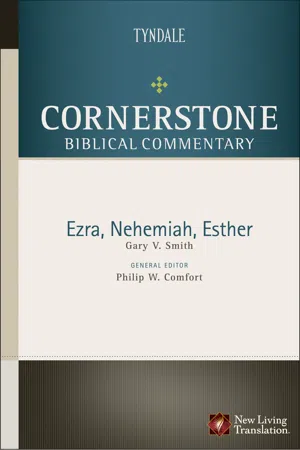
The Cornerstone Biblical Commentary series provides up-to-date, evangelical scholarship on the Old and New Testaments. Each volume is designed to equip pastors and Christian leaders with exegetical and theological knowledge to better understand and apply God's Word by presenting the message of each passage as well as an overview of other issues surrounding the text. The commentary series has been structured to help readers get at the meaning of Scripture, passage by passage, through the entire Bible. Each Bible book is prefaced by a substantial book introduction that gives general historical background important for understanding. This is volume 5b in the series.
Gary V. Smith (Ph.D., Dropsie College) was a member of the translation teams for both the NLT and HCSB Bible translation projects and has written numerous articles, reviews, and books on the Old Testament. These include Hosea, Amos, and Micah for the NIV Application Commentary series and Isaiah in the New American Commentary series. He has taught Old Testament at Bethel Theological Seminary in Minnesota and was professor of Old Testament and Hebrew at Midwestern Baptist Theological Seminary in Missouri. In 2004 he began teaching at Union University, where he is currently professor of Christian Studies.
- 304 pages
- English
- ePUB (mobile friendly)
- Available on iOS & Android
eBook - ePub
Ezra, Nehemiah, Esther
About this book
Information
Print ISBN
9781414322070
TEXT [Commentary]

A. God Returns the Exiles to Jerusalem (Ezra 1:1–2:70)
1. God stirs people to go to Jerusalem to rebuild the Temple (Ezra 1:1-11)
1 In the first year of King Cyrus of Persia,[*] the LORD fulfilled the prophecy he had given through Jeremiah.[*] He stirred the heart of Cyrus to put this proclamation in writing and to send it throughout his kingdom:
2 “This is what King Cyrus of Persia says:
“The LORD, the God of heaven, has given me all the kingdoms of the earth. He has appointed me to build him a Temple at Jerusalem, which is in Judah. 3 Any of you who are his people may go to Jerusalem in Judah to rebuild this Temple of the LORD, the God of Israel, who lives in Jerusalem. And may your God be with you! 4 Wherever this Jewish remnant is found, let their neighbors contribute toward their expenses by giving them silver and gold, supplies for the journey, and livestock, as well as a voluntary offering for the Temple of God in Jerusalem.”
5 Then God stirred the hearts of the priests and Levites and the leaders of the tribes of Judah and Benjamin to go to Jerusalem to rebuild the Temple of the LORD. 6 And all their neighbors assisted by giving them articles of silver and gold, supplies for the journey, and livestock. They gave them many valuable gifts in addition to all the voluntary offerings.
7 King Cyrus himself brought out the articles that King Nebuchadnezzar had taken from the LORD’s Temple in Jerusalem and had placed in the temple of his own gods. 8 Cyrus directed Mithredath, the treasurer of Persia, to count these items and present them to Sheshbazzar, the leader of the exiles returning to Judah.[*] 9 This is a list of the items that were returned:
| gold basins | 30 |
| silver basins | 1,000 |
| silver incense burners[*] | 29 |
| 10 gold bowls | 30 |
| silver bowls | 410 |
| other items | 1,000 |
11 In all, there were 5,400 articles of gold and silver. Sheshbazzar brought all of these along when the exiles went from Babylon to Jerusalem.
NOTES
1:1 the LORD fulfilled the prophecy. Lit., “in order to complete the word of the LORD.” The infinitive construct keloth [TH3615, ZH3983] (complete, fulfill) indicates purpose. The text does not just assure the reader that God fulfilled his promise through Jeremiah; it makes it clear that God acted with the purpose of completing what he said he would do. This fine distinction highlights God’s faithfulness to his foreordained plans. The “word of the LORD” refers to Jeremiah’s prophecy of 70 years of exile (Jer 25:11-12; 29:10), as well as to key passages in Isaiah (Coggins 1976:11). The 70 years of exile began in 605 BC when the first groups of Hebrews were brought to Babylon (Dan 1:1-3), and came to an end following Cyrus’s decree that allowed the people to return to Jerusalem in 538 BC. If it took around a year for people in exile to get ready to return (to sell their homes and businesses) and then walk the 800 miles back to Jerusalem, then the people should have arrived in Jerusalem no later than 536 BC. See G. Larsson 1967:417-423 and C. F. Whiteley 1954:60-72 for further discussion. Allen (2003:16) points out that there is no evidence that Jews from the northern nation of Israel who were taken captive by the Assyrians in 721 BC returned to Yehud (Judah) at this time.
He stirred the heart of Cyrus. Lit., “The LORD stirred the spirit of Cyrus.” The reason for Cyrus’s proclamation was God’s persuasive movement in his life. The Hebrew word he‘ir [TH5782, ZH6424] (arouse, stir, move) refers to actions that enliven a person to do something. When the heart is stirred, it is motivated to respond and cannot sit passively. The prophecies about God’s stirring up Cyrus’s spirit are found in Jer 51:1 (see also Isa 13:17; 45:13; Jer 50:9). Information about the timing of God’s fulfillment was derived from Jeremiah’s prophecy concerning the 70 years of captivity, but the idea of God’s stirring up Cyrus’s heart is common to both Isaiah and Jeremiah. Ezra 1:1 and the other references to Cyrus emphasize that this king would not act on his own accord but was stirred or aroused to act by God. Not even the Persian Empire or its powerful king controls the future—God does (for a word study of this key concept of he‘ir, see NIDOTTE 3.357-360).
1:2 This is what King Cyrus of Persia says. This standard formula for introducing messages in the ancient Near East is found often in the Bible and is sometimes called a “messenger formula.”
The LORD, the God of heaven. “God of heaven” (’elohe hashamayim [TH430/8064, ZH466/9028]) is a typical title in the postexilic books (17 times in Ezra, Nehemiah, and Daniel) to identify the God of the Hebrews as a high god rather than a local deity connected to a specific city or part of nature. It is quite unexpected that the pagan king Cyrus would use the Hebrew divine name Yahweh (cf. NLT, “LORD”), for even the Hebrews tended not to speak this name for fear of taking God’s name in vain. It is possible that Cyrus knew this name because of Daniel (Dan 6). On the other hand, this statement may actually be the author’s interpretation of the essence of what Cyrus said; thus, it would not be an exact quote, but would capture the spirit of what Cyrus said from a Hebrew theological perspective.
1:4 let their neighbors contribute toward their expenses. It is unclear if “their neighbors” (lit., “the men of his place”) just referred to Jewish neighbors, as the use of sha’ar [TH7604, ZH8636] (cf. 1 Chr 13:2; 2 Chr 30:6; 36:20) might suggest (Bickerman 1946:258-260), or if this means that both Jews and Babylonians (Brockington 1969:49) helped the returnees with their financial or travel needs. The suggestion that Babylonians gave assistance proposes an unusual situation in which pagans were helping provide sacrifices for Israel’s God. One should not read into this verse a parallel to the Israelites’ spoiling the Egyptians as some do (see Blenkinsopp 1988:75; Allen 2003:17; see Exod 3:21-22; 12:35-36). In this case, fellow Hebrews who stayed in Babylon provided financial aid and animals for sacrifices to their Hebrew brothers who returned to Jerusalem. There was no “spoiling” when the Hebrew people left Babylon, God did not defeat the Babylonians with plagues, and there was no second Passover or anything similar to the Red Sea crossing. The only thing that is somewhat similar to the Exodus is that in both cases Hebrew people left a foreign land to return to Israel.
1:5 God stirred the hearts of the priests and Levites and the leaders of the tribes of Judah and Benjamin. God sovereignly moved spiritual leaders (priests and Levites) who were needed to renew worship in Jerusalem, as well as the sociopolitical heads of key family units. Important leaders, who could secure the unified effort of an extended family toward a common goal, headed up the ancestral houses (ra’she ha’aboth [TH7218/1, ZH8031/3], “heads/chief of the fathers”), the basic social unit in the postexilic era. Living on the ancestral land would be difficult at best, so survival in a hostile economic and political setting like Yehud was next to impossible for a single family. These extended family units provided the necessary numbers and skills to form a self-sufficient group, so they would immigrate as a unit. This verse suggests that no members of the other 10 tribes of Israel returned at this point. One of the reasons for this is that they were exiled by Assyria about 140 years before the people of Judah came to Babylon. This verse, however, does not address what happened in other parts of the empire, so one should not argue from its silence that no one from the other tribes returned.
1:6 all their neighbors assisted. Like the admonition in 1:4, this phrase (kol-sebibothehem [TH3605/5439, ZH3972/6017], “all those surrounding them”) is vague and includes the possibility of both Jewish and Babylonian help (Williamson 1985:16). Some find an Exodus motif behind this statement and try to make this act comparable with the plundering of the Egyptians in Exod 12:35-36, but there is no slavery in this context or plundering of anyone here (contra Breneman 1993:71; Van Wijk-Bos 1998:18, 20). This association with the Exodus reads too much into the text and inserts a parallelism that was not clearly expressed by the writer. Although a comparison of the return of the exiles from Babylon with the Exodus is present in other texts, that association was not clearly made here.
1:7 articles that King Nebuchadnezzar had taken from the LORD’s Temple. These “articles” (keli [TH3627, ZH3998], “vessels”) were the gold and silver basins, incense burners, and bowls used in the sacrificial system at the Temple in Jerusalem (listed in 1:9-11). Nebuchadnezzar may have taken these in the 586 or 605 BC captivities of Judah (see 2 Kgs 25:13-14; Jer 52:17; Dan 1:1-2) and put them in Marduk’s temple in Babylon. These were the same vessels that Belshazzar drank from the night Babylon was captured (Dan 5:23). The act of putting the vessels in Marduk’s temple symbolized Marduk’s power over Israel’s God. There is some confusion about whether all the utensils were returned at this time because 7:19 refers to additional utensils being returned to the Temple in 458 BC. Presumably, these new cultic utensils in 7:19 are gifts from the Persian authorities and not part of the original vessels taken from the Temple in Jerusalem by Nebuchadnezzar.
1:8 Mithredath, the treasurer. It is unclear why the “treasurer” (gizbar [TH1489, ZH1601], a Persian loan word) would be in charge of these items unless these valuable items of gold and silver were being stored in the treasury instead of in the temple of Marduk.
Sheshbazzar, the leader of the exiles. Lit., “Sheshbazzar, the prince of Judah.” Later in 5:14-16 Sheshbazzar is called the appointed “governor” who laid the foundations of the Temple. Other biblical texts state that Zerubbabel was involved with laying the foundation (3:2-10) and was governor (Hag 1:1), but totally ignore Sheshbazzar. One solution to this problem is to hypothesize that these two names refer to the same person. First Esdras 6:18 and Josephus (Antiquities 11.13-14) indicate that these were Babylonian and Hebrew names for the same person, similar to Daniel’s having a Hebrew and a Babylonian name (Belteshazzar in Dan 1:7). Unfortunately, the Bible never makes this identification, and most commentaries conclude that both names are Babylonian. Some suggest that Sheshbazzar is Jehoiachin’s fourth son Shenazzar (1 Chr 3:17-18), who died shortly after arriving back with the exiles (Clines 1984:41). Others believe the title “prince of ...
Table of contents
- Cover
- Title Page
- Contributors
- Copyright
- Contents
- How to Navigate the Cornerstone Biblical Commentary
- About the Author
- Preface
- Abbreviations
- Transliteration and Numbering System
- Introduction to Ezra-Nehemiah
- Ezra-Nehemiah
- Ezra 1:1-11
- Ezra 2:1-70
- Ezra 3:1-13
- Ezra 4:1-5
- Ezra 4:6-23
- Ezra 4:24–5:17
- Ezra 6:1-12
- Ezra 6:13-22
- Ezra 7:1-28a
- Ezra 7:28b–8:36
- Ezra 9:1-15
- Ezra 10:1-44
- Nehemiah
- Nehemiah 1:1-11
- Nehemiah 2:1-10
- Nehemiah 2:11-20
- Nehemiah 3:1-32
- Nehemiah 4:1-23
- Nehemiah 5:1-19
- Nehemiah 6:1–7:3
- Nehemiah 7:4-73a
- Nehemiah 7:73b–8:18
- Nehemiah 9:1-37
- Nehemiah 9:38–10:39
- Nehemiah 11:1-36
- Nehemiah 12:1-26
- Nehemiah 12:27-43
- Nehemiah 12:44–13:3
- Nehemiah 13:4-31
- Bibliography
- Introduction to Esther
- Esther
- Esther 1:1-22
- Esther 2:1-18
- Esther 2:19-23
- Esther 3:1-6
- Esther 3:7-15
- Esther 4:1-17
- Esther 5:1-8
- Esther 5:9-14
- Esther 6:1-14
- Esther 7:1-10
- Esther 8:1-14
- Esther 8:15–9:19
- Esther 9:20-32
- Esther 10:1-3
- Bibliography
- NLT Notes
Trusted by 375,005 students
Access to over 1.5 million titles for a fair monthly price.
Study more efficiently using our study tools.