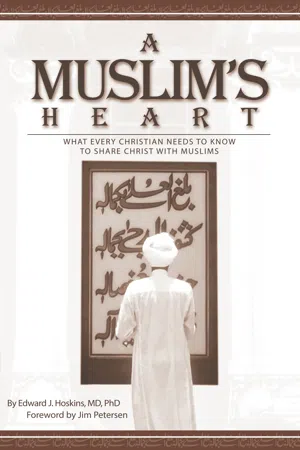
In an age when Christians are often more fearful and suspicious of Muslims than warm and relational, A Muslim's Heart will help you understand Muslim culture and how to share Christ within the context. A practical, quick-to-read guide, this book is ideal for those befriending Muslims at home and abroad.
eBook - ePub
A Muslim's Heart
About this book
Information
Topic
Theology & ReligionSubtopic
Islamic TheologyCHAPTER 1
ISLAM 101
ON A FRIDAY AFTERNOON, white-robed men with untrimmed beards file out of the local mosque. Smells from a restaurant advertise chicken biryani. Children play while women in headscarves exchange news with friends. Bits of conversation in Arabic, Indonesian, and Urdu can be overheard. Welcome to Indiana.
With minor variations, this scene is being played out in Chicago and Chattanooga, in Los Angeles and Lafayette. Witness the emerging face of Islam in America.
If you’re picking up this book, it’s probably because you’re part of one of these communities. Maybe your casual acquaintances with Muslim neighbors or coworkers—not to mention the events of September 11—are driving you to ask deeper questions about Muslims. What do they believe and why? How do we answer their claims? How do we relate to them? How can we effectively live out the Gospel with them? What can we learn from them?
In answer to these questions, I challenge you with the words of the Master, “Come and see!”
WHAT IS ISLAM AND WHO ARE MUSLIMS?
“Islam” is an Arabic word meaning “surrender” or “submission.” It is a religion embraced by one-fifth of the world’s population. A person who follows the religion of Islam is called a Muslim. A person becomes a Muslim by reciting the following creed: “There is no God but Allah, and Muhammad is the messenger of Allah.”
IS ALLAH GOD?
Some Christians believe and teach that Allah is not the same as God, and that when Muslims say the word “Allah” they are not referring to the one true God. Our response to this issue has significant missiological and theological implications. If we say that Allah is God, are we encouraging idol worship? If we use a different word than “Allah,” where is our common ground, our starting point for introducing them to Jesus?
The main difficulty with asking “Is Allah God?” is that it is really two questions. The first is linguistic: Can we legitimately use the word “Allah” for God in relating and witnessing to our Muslim friends? The second is theological: Is the character of Allah taught in traditional Islam the same as that taught about God in the Bible? If the answer to the second question is “no,” do we need to find another word besides “Allah” when we speak about God to Muslims?
Linguistically, the word “Allah” comes from the Arabic Al-Ilah, meaning “The God.”1, 2 It has the Semitic root, ilah, corresponding to the Hebrew eloah (singular form of the more familiar plural Elohim)2. “Allah” is the word for God currently used in the Arabic Bible and has been reverently used by many millions of Arab Christians since the first century A.D.
By way of contrast, the Greek translation of our own word for God (theos) actually has a “heathen” Greek origin3 with an Indo-European root, dhes.2 The pagan Greek Zeus has the Indo-European root of dyeu and is the origin of Deus (“God” in the Latin Vulgate Bible), Dios (Spanish), and Dieu (French).2 Finally, our English word “God” comes from the proto-Germanic pagan word for a god or idol. It was neutral in gender until it was masculinized by Germanic tribes who converted to Christianity in the mid-first millennium A.D.1
In fact, Arab Christians may well have a better case for not wanting to translate their word “Allah” into the English “God” for fear that our word has pagan origins! They might just as well ask, “Is God Allah?”
The theological question is more difficult to tackle. It is clear that many similarities exist between the God of Judaism and Christianity, and Islam’s Allah. Both Muslims and Christians believe that God is the Creator of heaven and earth, that He is all powerful and all knowing, and that He communicates to human beings through His spoken and written word. Both Christianity and Islam have angels, prophets, and a final day of judgment, which includes a literal heaven and hell. But there are also significant differences.
Islam’s Allah is totally “other,” transcendent, and uniquely “one.” As a result, no person or object can ever represent Allah or show others what he is like. He is therefore unknowable and free, being bound by nothing—not rules, covenants, or even his own word. In Islam, Allah has 99 names, but not one of them is sacrificial agape love. Muslims recognize sin but not the concept of original sin. Forgiveness exists, but it’s based on Allah’s unpredictable decree and not on any absolute standard or justice. Because sin does not need to be paid for, there is no need for atonement, a savior, or a cross.
To Christians, it is clear that the Islamic portrayal of Allah is, at best, inadequate; at worst, it’s inaccurate, negating the centrality of Christ. But think about this: Since when does a people group’s inaccurate concept of God require us to use a different word for Him? What about the millions of Americans who have an incorrect view of God? Do we need to use a different word for God with them? More important, what about the 15 million Arabic-speaking Christians who use the word “Allah” for God? In relating to Muslims, it is not the word for God (or Allah) that needs to be changed, but their concept of who God is.
THE FIVE PILLARS OF ISLAM
Classical Islam is based on five foundations, called “pillars,” which include the witness, prayer, giving alms, fasting, and pilgrimage. In addition, jihad is sometimes included as a sixth pillar. An explanation of each pillar follows.
The witness—Shahada (sha-HAA-da)
Meaningfully saying (in Arabic), “There is no God but Allah, and Muhammad is the messenger of Allah” is all it takes to become a Muslim. This phrase, the shahada, is the most frequently repeated sentence in Islam and is spoken daily during prayers and at other times. It is the first thing whispered into the ear of a newborn Muslim baby and the last thing heard and spoken at death.
Prayer—Salat (sa-LAAT)
Muslims pray facing Mecca (a city in southwestern Saudi Arabia) five times a day: dawn, noon, mid-afternoon, sunset, and late evening. Before they pray, Muslims must ritually cleanse certain parts of their bodies—hands, arms to the elbows, face, head and scalp, ears, nose, and feet to the ankles—with water; this is known as wuthu (wuu-DTHUU). As they pray, Muslims assume special prayer positions at special times, including standing respectfully (with arms folded), kneeling prostrate (with nose, forehead, hands, knees, and the bottoms of the feet all touching the prayer rug), kneeling while sitting up, and bending over at the waist. As they go through these prayer positions, specific memorized prayers are repeated that include portions from their holy book, the Qur’an (kuur-AAN).
Praying may be done individually, but whenever possible, it is done in a group with one respected Muslim leading the prayers. After praying, they turn toward their right and left shoulders and speak the Muslim greeting, “Peace be upon you” (as-sa-LAAM-uu a-LAY-kuum), addressing first the angel who records their good deeds (the one who sits on their right shoulder) and then the one who records their bad deeds (on their left shoulder).
Men and women do not pray together. Women can go to the mosque, but there is always a separate room for them.
Giving alms/Charity—Zakat (za-KAAT)
Muslims are expected to give two-and-a-half percent of their income to charity. Often, this takes the form of food—feeding beggars who come to the door or paying for sacrificial animals during Ramadan for those who can’t afford them.
Fasting—Soum/Siyam (SOWM, see-YAAM)
When physically possible, every adult Muslim is expected to fast—abstaining from eating, drinking, smoking, swallowing saliva, and sexual intercourse—from dawn until dusk during the entire ninth lunar Islamic month of Ramadan. This is the month when Muslims believe Allah caused the Qur’an to descend from heaven and gave it verbally to Muhammad. (The lunar year is approximately 11 days shorter than the solar year, which we follow in the United States. For this reason, Ramadan does not occur at the same time each year. The dates change, falling about 11 days earlier in each consecutive year.) When the month-long fast ends, there is a three-day celebration that includes singing, dancing, visiting, gift-giving, and often fireworks. It is possibly the biggest, most joyful event in a Muslim’s year.
Pilgrimage—Hajj
Once in his or her lifetime, every Muslim is expected, if physically and financially able, to make a pilgrimage to Mecca. This involves a complex set of rituals as they reenact Muhammad’s flight (or pilgrimage) from Mecca to the nearby city of Medina.
Jihad (jee-HAAD)
Jihad is sometimes included as a sixth pillar. It is less frequently discussed and is often misunderstood, especially by Westerners. Jihad simply means “struggle,” but it can be interpreted in various ways. It certainly denotes an internal struggle as a person strives against his or her own sinful nature or bad habits while trying to gain religious merit. (Western Christians call this a struggle against “the flesh.”) A second form of jihad is the struggle within Islam to better the community (through education, for example). It can also mean external struggle (outside Islam) against anyone or any group that threatens the safety of Islam or Muslims. The most extreme interpretation comes when a respected Muslim leader believes that all Islam is in danger and calls for a general jihad, or holy war, to be fought against “unbelievers” (non-Muslims). This is not, however, the most common meaning of jihad. Most Muslims tell me that the first two are the primary interpretations.
THE LIFE OF MUHAMMAD
In A.D. 570, Muhammad was born into the family of Banu Hashim. The Banu Hashim, a clan of the larger Quraish tribe, are believed to be descended from Abraham’s son Ishmael.
Muhammad’s father died on a caravan journey before his son was born, and so the young boy was raised by his grandfather. When his grandfather died, Muhammad’s uncle Abu-Talib, then head of the Banu Hashim clan, raised him. Muhammad did not inherit wealth, but he served as the business agent and caravan leader for a wealthy older widow named Khadija. They were married when he was 25 and she was 40. They had six children, but only the girls survived. Khadija died in A.D. 619.
Muhammad, who was appalled at the idol worship prevalent in his day, was in the habit of meditating each evening. Muslims believe that in the year A.D. 610, while he meditated in a cave outside Mecca, Muhammad was visited by the angel Jibreel (Gabriel), who commanded Muhammad to “Recite!” After several commands, Muhammad memorized what the angel told him and then repeated these messages to his family and friends. Throughout the remainder of his life (he died in A.D. 632 at age 62), Muhammad received numerous other revelations. These were compiled into the Qur’an, which means “recitation.”
By the year A.D. 613, Muhammad was publicly preaching his message from Allah, telling the people of Mecca to submit and surrender to Allah. He called for a stop to idol worship, denounced selfishness and materialism, and warned people of the coming “Day of Judgment.”
Some listened and submitted, but most did not. With opposition growing, Muhammad fina...
Table of contents
- Front Cover
- Title Page
- Copyright
- Dedication
- Acknowledgment
- Contents
- Foreword by Jim Petersen
- Introduction
- Chapter 1: Islam 101
- Chapter 2: The Muslim Worldview
- Chapter 3: Relational Tips
- Chapter 4: Emergency Apologetics: Answering Common Objections
- Chapter 5: Six Keys to Communicating the Gospel
- Chapter 6: Final Comments
- Appendix 1: Culturally Sensitive Personal Testimony
- Appendix 2: Suggested Reading List
- Appendix 3: The King’s Gift
Trusted by 375,005 students
Access to over 1.5 million titles for a fair monthly price.
Study more efficiently using our study tools.
Frequently asked questions
Yes, you can cancel anytime from the Subscription tab in your account settings on the Perlego website. Your subscription will stay active until the end of your current billing period. Learn how to cancel your subscription
No, books cannot be downloaded as external files, such as PDFs, for use outside of Perlego. However, you can download books within the Perlego app for offline reading on mobile or tablet. Learn how to download books offline
Perlego offers two plans: Essential and Complete
- Essential is ideal for learners and professionals who enjoy exploring a wide range of subjects. Access the Essential Library with 800,000+ trusted titles and best-sellers across business, personal growth, and the humanities. Includes unlimited reading time and Standard Read Aloud voice.
- Complete: Perfect for advanced learners and researchers needing full, unrestricted access. Unlock 1.5M+ books across hundreds of subjects, including academic and specialized titles. The Complete Plan also includes advanced features like Premium Read Aloud and Research Assistant.
We are an online textbook subscription service, where you can get access to an entire online library for less than the price of a single book per month. With over 1.5 million books across 990+ topics, we’ve got you covered! Learn about our mission
Look out for the read-aloud symbol on your next book to see if you can listen to it. The read-aloud tool reads text aloud for you, highlighting the text as it is being read. You can pause it, speed it up and slow it down. Learn more about Read Aloud
Yes! You can use the Perlego app on both iOS and Android devices to read anytime, anywhere — even offline. Perfect for commutes or when you’re on the go.
Please note we cannot support devices running on iOS 13 and Android 7 or earlier. Learn more about using the app
Please note we cannot support devices running on iOS 13 and Android 7 or earlier. Learn more about using the app
Yes, you can access A Muslim's Heart by Edward Hoskins in PDF and/or ePUB format, as well as other popular books in Theology & Religion & Islamic Theology. We have over 1.5 million books available in our catalogue for you to explore.