![]()
Living “Questionable” Lives
Before we get to the five habits themselves, allow me to sketch the background. Evangelistic mission works effectively when we are living generous, hospitable, Spirit-led, Christlike lives as missionaries to our own neighborhoods —and when the gifted evangelists in our midst join us in sharing Christ with our neighbors. That’s not just good evangelism strategy. That’s the biblical model.
A Twofold Approach to Evangelism
With all the best intentions in the world, some people will tell you that every Christian is an evangelist and bears the responsibility to share Christ with others. I certainly agree with the latter part of that contention (that we bear responsibility to share our love for Jesus with others). But I fear that the first part of that statement (that every Christian is an evangelist) is unhelpful.
Are we really all evangelists? Certainly the vast majority of Christians I know don’t feel much like evangelists. It’s as if we’re being told that —even though we don’t believe we’re evangelists, and don’t perform very effectively when we act like evangelists —we are nonetheless, deep down in our bones, really truly evangelists who just need to step into our true identities and fulfill our calling to share Christ with others. Is this fair, and more importantly, is it true?
Contrary to the myth that every believer is an evangelist, the apostle Paul assumes a twofold approach to the ministry of evangelism.
- First, he affirms the gifting of the evangelist —interestingly, not the gift of evangelism but the evangelist herself is the gift (see Ephesians 4:11).
- Second, he writes as though all believers are to be evangelistic in their general orientation.
Paul clearly places himself in the first category, seeing his ministry not only as that of an apostle but also as that of an evangelist. But it doesn’t appear that he believes all Christians bear the responsibility for the kind of bold proclamation to which he is called. Note his description of this twofold approach in his letter to the Colossians:
Devote yourselves to prayer, being watchful and thankful. And pray for us, too, that God may open a door for our message, so that we may proclaim the mystery of Christ, for which I am in chains. Pray that I may proclaim it clearly, as I should. Be wise in the way you act toward outsiders; make the most of every opportunity. Let your conversation be always full of grace, seasoned with salt, so that you may know how to answer everyone.
COLOSSIANS 4:2-6
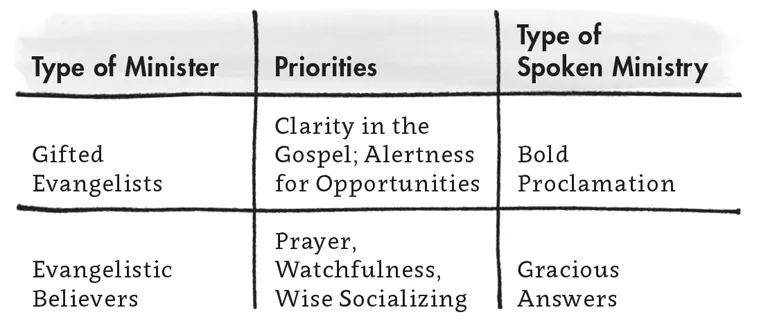
For evangelists, Paul asks for opportunities to share Christ and for the courage to proclaim the gospel clearly (verses 3-4). But he doesn’t suggest the Colossians pray as much for themselves. Rather, evangelistic believers are to pray for the evangelists’ ministry, to be wise in their conduct toward outsiders, and to look for opportunities to answer outsiders’ questions when they arise (verses 2, 5-6). When it comes to the spoken aspect of their ministries, evangelists are to proclaim, and believers are to give answers.
Paul’s twofold approach to evangelism in the church
I think Paul assumed that the number of gifted evangelists wouldn’t be great. It seems clear that he thinks the gifted evangelists can be local (like Timothy —see 2 Timothy 4:5) or translocal (like himself). He seems also to have assumed that some gifted evangelists would occupy a leadership function in local churches (see Ephesians 4:11), building up the church to be increasingly evangelistic.
While evangelism is an essential gifting for all churches, it isn’t a gifting given to every believer. Believers, as noted, were to pray like crazy and to conduct themselves, in word and deed, in such a way as to provoke unbelievers to question their beliefs and enter into an evangelistic dialogue. On this Peter is in agreement with Paul:
Always be prepared to give an answer to everyone who asks you to give the reason for the hope that you have. But do this with gentleness and respect, keeping a clear conscience, so that those who speak maliciously against your good behavior in Christ may be ashamed of their slander.
1 PETER 3:15-16
In other words, the biblical model is for leaders to (1) identify, equip, and mobilize gifted evangelists (who then take a leadership responsibility for the church’s evangelism) and (2) inspire all believers to live questionable lives. If all believers are leading the kinds of lives that evoke questions from their friends, then opportunities for sharing faith abound, and chances for the gifted evangelists to boldly proclaim are increased. In brief, our task is to surprise the world!
Some evangelists have taken me to task for teaching this biblical model. They fear I am letting people off the hook when it comes to evangelism. I have been told by more than one gifted evangelist that telling people they’re not required to create opportunities for bold evangelistic proclamation means that people will never tell others about Jesus. I disagree. I think gifted evangelistic leaders bear the responsibility to equip their congregations to be able to tell others about Jesus, but the opportunities for faith sharing will emerge from questioning unbelievers. Gifted evangelistic leaders should be training their congregations to speak about Jesus conversationally when questioned about how they deal with suffering, or why they spend their vacation serving the poor, or why they’ve opened their home to refugees, or why they’re fasting during Lent, or why they’ve made career choices that allow them to contribute to the greater social good.
The fact is, gifted evangelists telling the rest of us that we should behave like gifted evangelists has a debilitating effect. We look at confident, articulate, theologically trained evangelists preaching in our churches, and we hear their stories of sharing the gospel on the back of a napkin in a restaurant or a plane, and then we hear them tell us that we, too, can (and indeed, should) do what they do —and we freeze! We know we can’t do what they do.
But I don’t hear Paul telling his congregations to preach in the Areopagus like he did. He doesn’t berate them for not creating opportunities for bold, clear proclamation. He does want them to talk about Jesus, but as we’ve seen, he assumes it should be in the context of wise socializing, prompted by the questions of others.
Taking Over the Empire
This twofold approach literally transformed the Roman Empire. While evangelists and apologists such as Peter and Paul were proclaiming the gospel and defending its integrity in an era of polytheism and pagan superstition, hundreds of thousands of ordinary believers were infiltrating every part of society and living the kind of questionable lives that evoked curiosity about the Christian message. They surprised the empire with their unlikely lifestyle.
These ordinary believers devoted themselves to sacrificial acts of kindness. They loved their enemies and forgave their persecutors. They cared for the poor and fed the hungry. In the brutality of life under Roman rule, they were the most stunningly different people anyone had ever seen. Indeed, their influence was so surprising that the fourth-century emperor Julian (AD 331–363) feared they might take over the empire. Referring to Christians as “Galileans” and Christianity as “atheism” (because of their denial of the existence of pagan gods) and believing their religion to be a sickness, he penned this directive to his officials:
Julian was concerned that the Christians’ acts of hospitality and philanthropy were winning too many of his subjects. He decided to launch an offensive against them by mobilizing his officials and the pagan priesthood to out-love the Christians. He decreed that a system of food distribution be started and that hostels be built for poor travelers:
Perhaps not surprisingly, Julian’s new social program utterly failed. He couldn’t motivate pagan priests or Roman officials to care that much for the poor. He failed to realize that the Christians were filled with the Holy Spirit of love and motivated by his grace. The message they shared —that God loved the world —was patently absurd to the average Roman; the pagan gods cared nothing for humankind. And yet in the miserable world of the Roman Empire, the Christians not only proclaimed the mercy of God but also demonstrated it. They not only fed the poor; they welcomed all comers, regardless of their socioeconomic status. The nobleman embraced the slave. Moreover, Christians opened their fellowship to anyone irrespective of ethnicity, and they promoted social relations between the sexes and within families. They were literally the most surprising alternative society, and their conduct raised an insatiable curiosity among the average Roman.
You can see how the proclamation of gifted evangelists would have been far more effective among a society of people living such questionable lives. I think this is what Paul referred to as “adorning” the gospel —or in more contemporary language, making the gospel attractive. He uses this phrase when exhorting Titus to teach sound doctrine:
You, however, must teach what is appropriate to sound doctrine. Teach the older men to be temperate, worthy of respect, self-controlled, and sound in faith, in love and in endurance.
Likewise, teach the older women to be reverent in the way they live, not to be slanderers or addicted to much wine, but to teach what is good. Then they can urge the younger women to love their husbands and children, to be self-controlled and pure, to be busy at home, to be kind, and to be subject to their husbands, so that no one will malign the word of God.
Similarly, encourage the young men to be self-controlled. In everything set them an example by doing what is good. In your teaching show integrity, seriousness and soundness of speech that cannot be condemned, so that those who oppose you may be ashamed because they have nothing bad to say about us.
Teach slaves to be subject to their masters in everything, to try to please them, not to talk back to them, and not to steal from them, but to show that they can be fully tru...