Teaching World Languages for Specific Purposes provides learner-centered strategies, models, and resources for the development of WLSP curricula. This guide bridges theory and practice, inviting scholars, educators, and professionals of all areas of world language specialization to create new opportunities for their students.
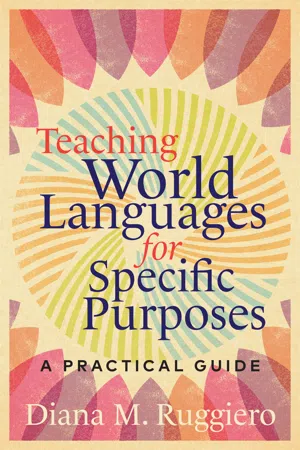
- 136 pages
- English
- ePUB (mobile friendly)
- Available on iOS & Android
eBook - ePub
About this book
Information
Publisher
Georgetown University PressYear
2022Print ISBN
9781647121594
9781647121587
eBook ISBN
9781647121600
Topic
EducationSubtopic
Education Teaching Methods1
Teaching WLSP
THIS BOOK IS ABOUT the teaching of world languages for specific purposes (WLSP) and its place and value within the landscape of higher education. Based on over ten years of curriculum development, teaching, and research experience in the field of WLSP as well as on current best practices in the field, it provides postsecondary world language educators of all language teaching and educational backgrounds with practical strategies, teaching examples and materials, and resources for developing courses, lessons, and assignments in WLSP and in community-service learning (CSL), a key learning tool connecting the classroom and community in the teaching of WLSP. Though perhaps unfamiliar territory for world language educators with backgrounds in literature and culture, the teaching of WLSP encompasses and accommodates a diverse range of pedagogical methods. World language teachers of all backgrounds already possessing a foundation in world language pedagogy will therefore find this book useful as a complement to their existing curricula and approach to language teaching. The strategies, examples, and resources presented here are therefore offered as a launching point for professional development and as a heuristic guide in the teaching of WLSP.
The world today is changing, and language departments at institutions of higher learning around the world are rethinking and revamping their vision and curricular offerings as a result. WLSP presents a solution to these challenges in that it reflects a move toward bridging the classroom and community, the student and the work-place, and language, culture, and society through the study of language and culture in specific contexts. As a means of providing teachers and students with contextual and background information on WLSP and the contents of this book, this chapter introduces the field of WLSP, its definition, scope, and objectives, and briefly addresses how this book can serve as a resource in the development and teaching of WLSP curricula in higher education.
WLSP: Definition, Aim and Scope
For the purposes of this book, WLSP is defined as an interdisciplinary, multidisciplinary, and transdisciplinary field encompassing the teaching, learning, and research of languages within and for specific, purpose driven contexts (Ruggiero 2019a, 49). This includes the professions, community initiatives, community uses for and by language users, and the arts. WLSP is interdisciplinary and multidisciplinary in that it is informed by and contributes to many different related disciplines and fields, such as linguistics and cultural studies, and transdisciplinary in that it transcends the boundaries of any one specific discipline or field.
The term WLSP was first proposed by Barbara Lafford, Carmen King de Ramírez, and the contributing authors of the edited volume Transferable Skills for the 21st Century with the publication of that same volume (King de Ramírez and Lafford 2018, 4). Its use is intended to differentiate WLSP from the related field of English Language for Specific Purposes, also referred to as ESP, ELSP, and LSP, with respect to its divergent research and teaching aims and objectives, including its focus on world languages, cultures, and communities. Among the primary concerns of this group of scholars was the idea that WLSP has more to contribute to students, language programs, and the world than specialized language skills. Though indeed important, it is not understood as the sole objective of WLSP pedagogy.
With the growth in scholarship in and relating to WLSP, there have been a number of definitions of the field offered, whether implicitly or explicitly (see Ruggiero 2019a). Many of these definitions depart from the traditional view of WLSP as commerce-centered and language-acquisition-focused to recognize the interdisciplinary nature of the field and to include other specific contexts and pedagogical objectives, such as the community and intercultural and translingual competence (e.g., Doyle 2018; King de Ramírez and Lafford 2018; M. Long 2017b; Sánchez-López 2013a). This trend in the emerging scholarship reflects the recent shift in world language education currently envisioned by the Modern Language Association (see MLA 2007) and the current institutional, departmental, student, and community needs and demands observed in the United States in particular (M. Long 2017a, 1). This book, in its definition of the field and in its pedagogical orientation, reflects this trend and contributes to existing definitions in recognizing its transdisciplinary nature.
The teaching of WLSP, such as for health care, commerce, and the community, is relatively new in the history of world language education. Most scholars place the origins of this movement globally in the mid-twentieth century, following the second world war (M. Long 2017a, 2). By all accounts, the initial emphasis worldwide was on language for business and on the need to provide students with the necessary language skills to successfully compete in the emerging modern global market economy (see Grosse and Voght 1990; King de Ramírez and Lafford 2018; M. Long 2017b). Since that time, however, this diverse field has grown significantly in its pedagogical objectives and scope as well as in its research agenda, matching the distinct and shifting needs and demands of higher education, language departments, students, the market economy, national interests, and local communities (see M. Long 2017b; Sánchez-López, Long, and Lafford 2017). Today, WLSP is a fast growing field of research and teaching distinct in its aim and scope that is coming into its own in the twenty-first century (Lafford 2012; M. Long 2017b; Ruggiero 2018c; Sánchez-López, Long, and Lafford 2017).1
Courses in WLSP to date span the professions, the arts, community initiatives, and community uses for and by language users. These include courses in language for commerce, health care, the legal professions and law enforcement, public services, translation and interpreting, and broader courses exploring the intersection of language and culture within specific contexts in local communities, among others. Courses in WLSP often integrate community-based education and outreach initiatives, such as internships, service learning, and community-centered courses. In linking language, culture, and community, WLSP is well positioned to fulfill the Five C’s of the American Council on the Teaching of Foreign Languages (ACTFL) World Readiness Standards: communication, cultures, connections, comparisons, and communities (Abbott and Lear 2010). These are the foundations upon which language programs are now building their curricula and other initiatives. Though community-based education is sporadically used across the world language curriculum, it is a central component of WLSP (see Ruggiero 2018b).
Current research in WLSP reflects these concerns and increases in interest in the field. Over the past twenty years, numerous conference panels, national and international conferences, and organizations on WLSP have emerged as well as scholarly articles and special journal issues on WLSP as well as on community service learning (CSL), including focus issues of the periodicals Hispania and the Modern Language Journal (Sánchez-López, Long, and Lafford 2017, 13; Ruggiero 2018b). New peer-reviewed journals devoted specifically to WLSP have also surfaced, as have edited volumes, including the periodicals Journal of Languages for Specific Purposes, Business Languages, and volumes edited by Mary Long (2017), Lourdes Sánchez-López (2013c), and Carmen King de Ramírez and Barbara Lafford (2018). More recently, teaching materials such as textbooks, manuals, and method books have also surfaced (e.g., Abbott 2009; Blanca 2012; Lear 2019; Risner n.d.; Trace, Hudson, and Brown 2015). Collectively, the recent scholarship provides readers with a significant overview of the field: its scope and aims, history, and research and teaching objectives and methods.
As the current academic literature on WLSP shows, the aim of WLSP is to produce students who are capable of not only navigating competently within a global economy, but also contributing to the betterment of local communities in meaningful and interculturally competent ways.2 The question of who is qualified to teach WLSP and how to approach the pedagogy of WLSP, however, is currently being negotiated as the field expands. This book addresses these questions in inviting world language educators of all backgrounds to participate in the development of this emerging field.
Teaching WLSP
Currently, WLSP does not represent a new pedagogical theory or approach in the teaching of world languages. Rather, as a multi-, trans- and interdisciplinary field, it accommodates a broad and diverse range of teaching methodologies currently espoused and used in world language education. What does unite the field with regard to teaching, however, is an emphasis on student-centered learning (M. Long 2017, 4). For this reason, much of the discussion surrounding teaching and learning in WLSP revolves around the question of student, program, and community needs (M. Long 2017a, 4; Sánchez-López 2013a, x). For the purposes of this book, it is therefore more useful to think in terms of student learning needs and common objectives in the teaching of WLSP in higher education.
There are currently three main goals that WLSP teachers, regardless of disciplinary background, strive toward in delivering their courses: (1) teach specialized language and grammar for the benefit of aspiring professionals, (2) teach cultural knowledge for use within specific contexts for ease of cross-cultural communication, and (3) foster intercultural competence for the benefit of individuals and the community (M. Long 2017a, 4; King de Ramírez and Lafford 2018, 2; Ruggiero 2018b). More recently, greater emphasis is being placed on the part of WLSP scholars on social justice and leadership (e.g., Derby et al. 2017; Doyle 2018; S. Long et al. 2014; Martinez 2010; Ruggiero 2018c), cultural awareness and intercultural sensitivity (e.g., King de Ramírez 2016; McBride 2010; Petrov 2013; Ruggiero 2018a, 2019b), the community (e.g., Abbott 2009; Abbott and Dias 2018; Hellebrandt and Varona 1999; Lear and Abbott 2010; Ruggiero 2018c), and transferable skills (see King de Ramirez and Lafford 2018). As a result, it can be said that WLSP pedagogy is concerned with producing well-rounded students who are able to contribute meaningfully not only to their professional workplace, but to their communities and society as a whole.3
Following these trends, the strategies, examples, and resources offered in this book reflect the objectives and concerns of WLSP teachers and are in keeping with the current student-centered curricular design emphasis observed in the teaching of WLSP (M. Long 2017a, 4). For this reason, I place particular care in this book to suggest teaching strategies and curricular examples that are student-centered in addition to context-specific and culture- and community-oriented. Among the types of teaching activities and materials I include in this book, for example, are the following:
• Community-based learning activities
• Experiential learning activities
• Metacognitive activities
• Reflective assignments
• Formative assessments
• WLSP syllabi, calendars, and lesson plans
• Cultural activities and strategies for connecting the teaching and learning of WLSP with culture and community
In addition, I include strategies for addressing the following common topics in the teaching of WLSP:
• Student and teacher readiness
• WLSP course design
• Lesson planning for WLSP-specific courses
• Integrating WLSP topics and objectives in non-WLSP courses
• Developing community partnerships for CSL projects in WLSP
• Developing and integrating CSL projects in WLSP
• Teaching interpreting for WLSP
• Integrating culture into WLSP for the purposes of developing intercultural competence
• Teaching WLSP for heritage learners (HLs)
• WLSP in the time of COVID-19
It is important to note that the strategies, sample teaching materials, and re...
Table of contents
- Cover
- Half Title
- Title Page
- Copyright
- Dedication
- Contents
- Preface
- Acknowledgments
- 1 Teaching WLSP
- 2 WLSP in Higher Education
- 3 Teacher and Student Readiness
- 4 Curriculum Development for the WLSP Classroom
- 5 Developing Community Partnerships for CSL in WLSP
- 6 Designing and Integrating WLSP CSL Projects
- 7 Integrating WLSP into Non-WLSP Courses
- 8 Interpreting in WLSP
- 9 Culture and WLSP
- 10 Heritage Language Learners and WLSP
- 11 Communication Technology, WLSP, and CSL in the Wake of COVID-19
- Appendixes
- References
- About the Author
- Index
Trusted by 375,005 students
Access to over 1.5 million titles for a fair monthly price.
Study more efficiently using our study tools.
Frequently asked questions
Yes, you can cancel anytime from the Subscription tab in your account settings on the Perlego website. Your subscription will stay active until the end of your current billing period. Learn how to cancel your subscription
No, books cannot be downloaded as external files, such as PDFs, for use outside of Perlego. However, you can download books within the Perlego app for offline reading on mobile or tablet. Learn how to download books offline
Perlego offers two plans: Essential and Complete
- Essential is ideal for learners and professionals who enjoy exploring a wide range of subjects. Access the Essential Library with 800,000+ trusted titles and best-sellers across business, personal growth, and the humanities. Includes unlimited reading time and Standard Read Aloud voice.
- Complete: Perfect for advanced learners and researchers needing full, unrestricted access. Unlock 1.5M+ books across hundreds of subjects, including academic and specialized titles. The Complete Plan also includes advanced features like Premium Read Aloud and Research Assistant.
We are an online textbook subscription service, where you can get access to an entire online library for less than the price of a single book per month. With over 1.5 million books across 990+ topics, we’ve got you covered! Learn about our mission
Look out for the read-aloud symbol on your next book to see if you can listen to it. The read-aloud tool reads text aloud for you, highlighting the text as it is being read. You can pause it, speed it up and slow it down. Learn more about Read Aloud
Yes! You can use the Perlego app on both iOS and Android devices to read anytime, anywhere — even offline. Perfect for commutes or when you’re on the go.
Please note we cannot support devices running on iOS 13 and Android 7 or earlier. Learn more about using the app
Please note we cannot support devices running on iOS 13 and Android 7 or earlier. Learn more about using the app
Yes, you can access Teaching World Languages for Specific Purposes by Diana M. Ruggiero in PDF and/or ePUB format, as well as other popular books in Education & Education Teaching Methods. We have over 1.5 million books available in our catalogue for you to explore.