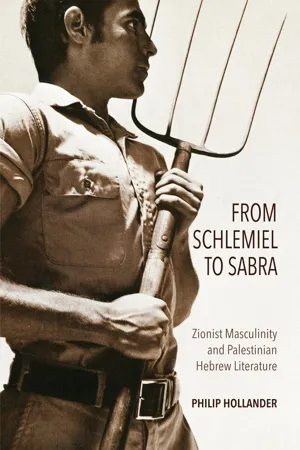
In From Schlemiel to Sabra Philip Hollander examines how masculine ideals and images of the New Hebrew man shaped the Israeli state. In this innovative book, Hollander uncovers the complex relationship that Jews had with masculinity, interrogating narratives depicting masculinity in the new state as a transition from weak, feminized schlemiels to robust, muscular, and rugged Israelis. Turning to key literary texts by S. Y. Agnon, Y. H. Brenner, L. A. Arieli, and Aharon Reuveni, Hollander reveals how gender and sexuality were intertwined to promote a specific Zionist political agenda. A Zionist masculinity grounded in military prowess could not only protect the new state but also ensure its procreative needs and future. Self-awareness, physical power, fierce loyalty to the state and devotion to the land, humility, and nurture of the young were essential qualities that needed to be cultivated in migrants to the state. By turning to the early literature of Zionist Palestine, Hollander shows how Jews strove to construct a better Jewish future.
eBook - PDF
From Schlemiel to Sabra
Zionist Masculinity and Palestinian Hebrew Literature
- 272 pages
- English
- PDF
- Available on iOS & Android
eBook - PDF
About this book
Information
Table of contents
- Cover
- Title Page
- Copyright
- Dedication
- Contents
- Acknowledgments
- Note on Transliteration and Translation
- General Introduction: A Rhetoric of Empowerment
- Of Their Time and Their Places: A Biographical Introduction to the Self-Evaluative Writers
- 1. Holding Out for a Hero: Crisis and the New Hebrew Man
- 2. “He Needs a Stage”: Masculinity, Homosociality, and the Public Sphere
- 3. Contested Masculinity and the Redemption of the Schlemiel
- 4. Homosexual Panic and Masculinity’s Advancement
- 5. Self-Evaluative Masculinity’s Interwar Apex and Eclipse
- Afterword: The Lesson, Legacy, and Implications of Self-Evaluative Masculinity
- Selected Bibliography
- General Index
- Index of Cited Works
- About the Author
Trusted by 375,005 students
Access to over 1.5 million titles for a fair monthly price.
Study more efficiently using our study tools.
Frequently asked questions
Yes, you can cancel anytime from the Subscription tab in your account settings on the Perlego website. Your subscription will stay active until the end of your current billing period. Learn how to cancel your subscription
No, books cannot be downloaded as external files, such as PDFs, for use outside of Perlego. However, you can download books within the Perlego app for offline reading on mobile or tablet. Learn how to download books offline
We are an online textbook subscription service, where you can get access to an entire online library for less than the price of a single book per month. With over 1.5 million books across 990+ topics, we’ve got you covered! Learn about our mission
Look out for the read-aloud symbol on your next book to see if you can listen to it. The read-aloud tool reads text aloud for you, highlighting the text as it is being read. You can pause it, speed it up and slow it down. Learn more about Read Aloud
Yes! You can use the Perlego app on both iOS and Android devices to read anytime, anywhere — even offline. Perfect for commutes or when you’re on the go.
Please note we cannot support devices running on iOS 13 and Android 7 or earlier. Learn more about using the app
Please note we cannot support devices running on iOS 13 and Android 7 or earlier. Learn more about using the app
Yes, you can access From Schlemiel to Sabra by Philip Hollander in PDF and/or ePUB format, as well as other popular books in Literature & Middle Eastern History. We have over 1.5 million books available in our catalogue for you to explore.