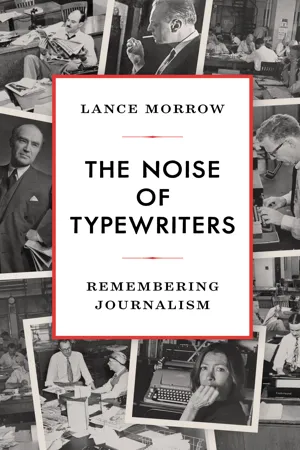
W.H. Auden famously wrote: "Poetry makes nothing happen." Journalism is a different matter. In a brilliant study that is, in part, a memoir of his 40 years as an essayist and critic at TIME magazine, Lance Morrow returns to the Age of Typewriters and to the 20th century's extraordinary cast of characters—statesmen and dictators, saints and heroes, liars and monsters, and the reporters, editors, and publishers who interpreted their deeds. He shows how journalism has touched the history of the last 100 years, has shaped it, distorted it, and often proved decisive in its outcomes.Lord Beaverbrook called journalism "the black art." Morrow considers the case of Walter Duranty, the New York Times' Moscow correspondent who published a Pulitzer Prize-winning series praising Stalin just at the moment when Stalin imposed mass starvation upon the people of Ukraine and the North Caucasus in order to enforce the collectivization of Soviet agriculture. Millions died.John Hersey's Hiroshima, on the other hand, has been all but sanctified—called the 20th century's greatest piece of journalism. Was it? Morrow examines the complex moral politics of Hersey's reporting, which the New Yorker first published in 1946. The Noise of Typewriters is, among other things, an intensely personal study of an age that has all but vanished. Morrow is the son of two journalists who got their start covering Roosevelt and Truman. When Morrow and Carl Bernstein were young, they worked together as dictation typists at the Washington Star (a newspaper now extinct). Bernstein had dedicated Chasing History, his memoir of those days, to Morrow. It was Morrow's friend and editor Walter Isaacson—biographer of Leonardo Da Vinci, Albert Einstein, and Steve Jobs—who taught Morrow how to use a computer when the machines were first introduced at TIME.Here are striking profiles of Henry Luce, TIME 's founder, and of Dorothy Thompson, Claud Cockburn, Edgar Snow, Joseph and Stewart Alsop, Joan Didion, Norman Mailer, Otto Friedrich, Michael Herr, and other notable figures in a golden age of print journalism that ended with the coming of television, computers, and social media. The Noise of Typewriters is the vivid portrait of an era.
- 200 pages
- English
- ePUB (mobile friendly)
- Available on iOS & Android
eBook - ePub
About this book
Information
Subtopic
Journalist BiographiesTable of contents
- Cover
- Title Page
- Copyright
- Dedication
- Contents
- Introduction
- Chapter 1
- Chapter 2
- Chapter 3
- Chapter 4
- Chapter 5
- Chapter 6
- Chapter 7
- Chapter 8
- Chapter 9
- Chapter 10
- Chapter 11
- Chapter 12
- Chapter 13
- Chapter 14
- Chapter 15
- Chapter 16
- Chapter 17
- Chapter 18
- Chapter 19
- Chapter 20
- Chapter 21
- Chapter 22
- Chapter 23
- Chapter 24
- Chapter 25
- Chapter 26
- Chapter 27
- Chapter 28
- Chapter 29
- Chapter 30
- Chapter 31
- Acknowledgments
- Index
- Image Credits
Trusted by 375,005 students
Access to over 1.5 million titles for a fair monthly price.
Study more efficiently using our study tools.
Frequently asked questions
Yes, you can cancel anytime from the Subscription tab in your account settings on the Perlego website. Your subscription will stay active until the end of your current billing period. Learn how to cancel your subscription
No, books cannot be downloaded as external files, such as PDFs, for use outside of Perlego. However, you can download books within the Perlego app for offline reading on mobile or tablet. Learn how to download books offline
Perlego offers two plans: Essential and Complete
- Essential is ideal for learners and professionals who enjoy exploring a wide range of subjects. Access the Essential Library with 800,000+ trusted titles and best-sellers across business, personal growth, and the humanities. Includes unlimited reading time and Standard Read Aloud voice.
- Complete: Perfect for advanced learners and researchers needing full, unrestricted access. Unlock 1.5M+ books across hundreds of subjects, including academic and specialized titles. The Complete Plan also includes advanced features like Premium Read Aloud and Research Assistant.
We are an online textbook subscription service, where you can get access to an entire online library for less than the price of a single book per month. With over 1.5 million books across 990+ topics, we’ve got you covered! Learn about our mission
Look out for the read-aloud symbol on your next book to see if you can listen to it. The read-aloud tool reads text aloud for you, highlighting the text as it is being read. You can pause it, speed it up and slow it down. Learn more about Read Aloud
Yes! You can use the Perlego app on both iOS and Android devices to read anytime, anywhere — even offline. Perfect for commutes or when you’re on the go.
Please note we cannot support devices running on iOS 13 and Android 7 or earlier. Learn more about using the app
Please note we cannot support devices running on iOS 13 and Android 7 or earlier. Learn more about using the app
Yes, you can access The Noise of Typewriters by Lance Morrow in PDF and/or ePUB format, as well as other popular books in Media & Performing Arts & Journalist Biographies. We have over 1.5 million books available in our catalogue for you to explore.