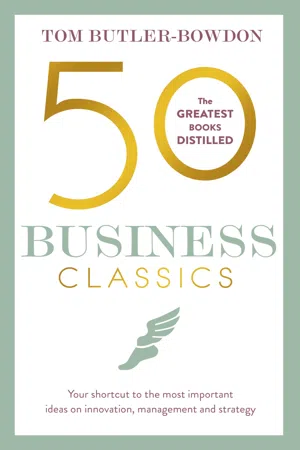
What do great enterprises have in common? What sort of person starts them? A single idea can help you find the next big thing, but it takes time to trawl through hundreds of business books to find inspiration. With insightful commentaries on the landmark writings of old and new, 50 Business Classics presents the great entrepreneur stories, the best management thinking and the proven ideas on strategy, innovation and marketing - in one volume. 50 Business Classics presents the key ideas from classic texts such as My Years with General Motors and Michael Gerber's The E-Myth Revisited to contemporary business lessons from the rise of tech giants like Google, Apple and Amazon. It contains revealing biographies of luminaries like Steve Jobs and Warren Buffett, as well as lesser-known stories including creation of publishing giant Penguin and Chinese behemoth Alibaba. Here you'll find the texts and ideas that matter in:
· Entrepreneurship
· Leadership
· Management
· Strategy
· Business history
· Personal development
· Technology and innovation Summarising the smartest thinking for today's professional success, 50 Business Classics provides inspiration and insights for entrepreneurs, executives and students of business and management alike.
eBook - ePub
50 Business Classics
Your shortcut to the most important ideas on innovation, management, and strategy
- 320 pages
- English
- ePUB (mobile friendly)
- Available on iOS & Android
eBook - ePub
50 Business Classics
Your shortcut to the most important ideas on innovation, management, and strategy
About this book
Information
1880
The Art of Money Getting
“The foundation of success in life is good health: that is the substratum of fortune; it is also the basis of happiness. A person cannot accumulate a fortune very well when he is sick.”
“We are all, no doubt, born for a wise purpose. There is as much diversity in our brains as in our countenances. Some are born natural mechanics, while some have great aversion to machinery … Unless a man enters upon the vocation intended for him by nature, and best suited to his peculiar genius, he cannot succeed.”
“The possession of a perfect knowledge of your business is an absolute necessity in order to insure success.”
In a nutshell
There are no shortcuts to wealth, aside from right vocation, good character, and perseverance—and don’t forget to advertise.
In a similar vein
Andrew Carnegie The Gospel of Wealth
Ron Chernow Titan: The Life of John D. Rockefeller Sr.
CHAPTER 1
P. T. Barnum
P. T. Barnum was possibly the greatest showman who ever lived, famous for his circuses and museums of “curiosities.” His shows transformed nineteenth-century commercial entertainment, and he was considered a master of promotion whose ideas are still studied by marketers today. Modern audiences have learned about Barnum’s dramatic life through Hugh Jackman’s brilliant portrayal in the film The Greatest Showman (2017).
Barnum’s autobiography tells his colorful story, but it is The Art of Money Getting, or Golden Rules for Making Money that offers a recipe book for success in business. Consistent with a great marketer, the title is a slight exaggeration of the content. There are, in fact, no detailed ideas or techniques for getting rich. Instead, the author provides 20 rules for personal advance and the development of good character that, indirectly, will make a person’s financial rise almost inevitable. Contrary to the image of Barnum as an over-the-top impresario, the book is actually a solid business ethics primer.
Health, wealth, and happiness
Barnum draws attention to something which is, on the face of it, obvious, yet is so often overlooked: you need to have good health in order to be successful. The pursuit of riches requires gusto, and poor health saps that. The successful person therefore, if they wish to remain so, ignores the laws of health at their peril.
Barnum, who once smoked ten to fifteen cigars a day, goes on the offensive against the “filthy weed” tobacco. Its effects on the taste buds closes the smoker off to the simple pleasures of life, like delicious fruit; all they can think of is their next wad to put under their tongue or puff. But he reserves his greatest attack for alcohol: “To make money, requires a clear brain. If the brain is muddled, and his judgment warped by intoxicating drinks, it is impossible for him to carry on business successfully. How many good opportunities have passed, never to return, while a man was sipping a ‘social glass,’ with his friend!”
Recalling the phrase, “wine is a mocker,” Barnum notes the way alcohol initially flatters the drinker into feeling omnipotent, then drains them of vital energy. Apart from this is the sheer amount of time that is wasted by the drinker when they could be studying and developing real opportunities.
Choose the right career
Barnum notes at the beginning that, in a country like the United States, where there is “more land than people,” money can be made by anyone who properly applies themselves. There is room for good people in any vocation. But you have to make sure you choose the right vocation.
Ahead of his time in emphasizing the importance of choosing a career that you love, Barnum goes as far as saying that selecting a vocation on the basis that it was “congenial to [your] tastes” was the surest way to success for a young person. We are all born for some purpose, he opines, and the fact of the extraordinary differences between us suggests that people were made to do some things and not others:
“Unless a man enters upon the vocation intended for him by nature, and best suited to his peculiar genius, he cannot succeed. I am glad to believe that the majority of persons do find their right vocation. Yet we see many who have mistaken their calling, from the blacksmith … to the clergyman. You will see, for instance, that extraordinary linguist the ‘learned blacksmith,’ who ought to have been a teacher of languages; and you may have seen lawyers, doctors and clergymen who were better fitted by nature for the anvil or the lapstone.”
… then the right location
Yet Barnum goes further than the now hackneyed exhortation to “do the work you love” in his even more practical tip about where you do it:
“You might conduct a hotel like clock-work, and provide satisfactorily for five hundred guests every day; yet, if you should locate your house in a small village where there is no railroad communication or public travel, the location would be your ruin.”
He refers to a man he met running a museum of curiosities in London. The gentleman was good at what he did, but was not attracting much custom. Barnum suggested he move to the United States where his show would find more enthusiastic audiences. The man duly did, working first for two years in Barnum’s New York Museum and then establishing his own “traveling show business.” Some years later, Barnum reported, the man was rich, “simply because he selected the right vocation and also secured the proper location.”
Stick to your business, master your field
Too many people scatter their powers. Barnum notes that “A constant hammering on one nail will generally drive it home at last.” When you are focused on one thing only, you will soon see ways that it can be improved and made more valuable. While it is tempting to have many irons in the fire, a lot of fortunes have passed people by because they cast themselves too wide and not deep.
No one succeeds, Barnum asserts, without knowing their field inside out. His reflection on nineteenth-century countrymen could be applied to people in any time and place:
“As a nation, Americans are too superficial—they are striving to get rich quickly, and do not generally do their business as substantially and thoroughly as they should, but whoever excels all others in his own line, if his habits are good and his integrity undoubted, cannot fail to secure abundant patronage, and the wealth that naturally follows.”
“Be both cautious and bold”
The founding member of the Rothschild banking family had this as a maxim. At first glance a paradox, it simply means to be very careful in the making of your plans, but once made do not hold back on their execution.
Learn your own lessons
It may be convenient to be given or to borrow a load of money to start a business, but as Barnum notes, “Money is good for nothing unless you know the value of it by experience.” John Jacob Astor noted that it was more difficult for him to make his first thousand dollars than it was to accrue all his succeeding millions. But the lessons learned in creating the initial capital—self-denial, industry, perseverance, and patience—were priceless. Even in Barnum’s time most successful businesspeople were self-made, and the same is true today. Do not depend on or wait for other people’s capital, particularly inheritances. If anything, this “easy money” will hold you back.
If it’s good, tell people about it
You would expect the greatest showman of his time to advise promoting your wares, but what he says is just common sense:
“When you get an article which you know is going to please your customers, and that when they have tried it, they will feel they have got their money’s worth, then let the fact be known that you have got it. Be careful to advertise it in some shape or other because it is evident that if a man has ever so good an article for sale, and nobody knows it, it will bring him no return.”
Avoid the unlucky
Barnum mentions the Rothschild family’s maxim, “Never have anything to do with an unlucky man or place.” There is always a reason why a person is unlucky, even if they are honest or intelligent; it may not be evident, but there will always be some defect that has held them back from success.
Read a good newspaper
He who does not read newspapers, Barnum says, is “cut off from his species.” Even in Barnum’s time there was rapid daily advance in terms of technologies and changes to industries. To succeed in any field you have to know what is happening in it.
Final comments
Though the examples given are typical of the pen of a nineteenth-century American, with glowing mentions of the rich and famous of his day, The Art of Money Getting is remarkably relevant today for anyone wanting to make the most of their talents and chances in life.
Some of the points may seem obvious, but it does not hurt to be reminded of them, especially the idea that personal virtue is the foundation of wealth. Without honesty and reputation, fortunes can disappear overnight; with these things, an enterprise or a service can create prosperity for all involved. Barnum himself saw both “struggles and triumphs” in his career, but he never actually uttered the remark famously attributed to him, “There is a sucker born every minute” (it was a competitor). If this really had been his attitude, according to his own rules he would not have become so well established or wealthy. It should not be a surprise that the Rothschilds are mentioned twice in the book, a family who built a fortune not on “taking advantage,” but on trust.
The Art of Money Getting is short because it was essentially a speech Barnum often gave on the speaker’s circuit. It is in the public domain and can be downloaded free from the internet.
P. T. Barnum
Phineas Taylor Barnum was born in Bethel, Connecticut, in 1810, the oldest of five children. His father ran an inn and a store. Barnum displayed early business sense, and by 12 had done well from selling lottery tickets. However, at 15 his father died, and for the next few years he had to try his hand at a range of enterprises. One of his early ventures was a newspaper, the Herald of Freedom, which attracted several libel suits.
After moving to New York City in 1834, he discovered his calling in the “show business.” He established a popular show whose main draw was Joice Heth, an ex-slave who was promoted as being 161 years old and the nurse to a baby George Washington. In 1841 he bought an existing museum that became Barnum’s American Museum; its natural history exhibits, memorabilia, and oddities, including the midget General Tom Thumb and the Feejee Mermaid, entertained and educated millions. It burned to the ground in 1865. A new museum was built three years later, but was also razed by fire.
Barnum was 60 by the time he moved into the circus business. His Grand Traveling Museum, Menagerie, Caravan, and Circus (also known as the Greatest Show on Earth), which covered five acres, toured America. He is also remembered for bringing Swedish opera star Jenny Lind to the country. Despite paying her $1,000 a night, Barnum made a large profit on the tour.
In later years Barnum turned to politics, getting elected to the Connecticut legislature in 1865 and serving two terms, fighting unsuccessfully for a seat in Congress, and becoming mayor of Bridgeport, Connecticut in 1875. He died in 1891.
Barnum wrote several books, including The Life of P. T. Barnum: Written by Himself (1854, with later revisions), The Humbugs of the World (1865), and Struggles and Triumphs (1869). He intentionally put his autobiography into the public domain, and by the end of the nineteenth century it was second only to the New Testament in terms of copies in print.
1998
Losing My Virginity
“You’re trying to create something that is original, that stands out from the crowd, that will last and, hopefully, serve some useful purpose. Above all, you want to create something you are proud of. That has always been my philosophy of business. I can honestly say that I have never gone into any business to make money.”
“I may be a businessman, in that I set up and run companies for profit, but, when I try to plan ahead and dream up new products and new companies, I’m an idealist.”
In a nutshell
Don’t be afraid to be different. On entering any new field or an in...
Table of contents
- Cover
- Title Page
- Copyright
- Praise for 50 Business Classics
- Contents
- Introduction
- 1 P. T. Barnum – The Art of Money Getting (1880)
- 2 Richard Branson – Losing My Virginity (1998)
- 3 Andrew Carnegie – The Gospel of Wealth (1899)
- 4 Alfred Chandler – The Visible Hand (1977)
- 5 Ron Chernow – Titan: The Life of John D. Rockefeller, Sr. (1998)
- 6 Clayton Christensen – The Innovator’s Dilemma (1997)
- 7 Duncan Clark – Alibaba: The House That Jack Ma Built (2016)
- 8 Jim Collins – Great by Choice (2011)
- 9 W. Edwards Deming – Out of the Crisis (1982)
- 10 Peter Drucker – The Effective Executive (1967)
- 11 Roger Fisher, William Ury & Bruce Patton – Getting To Yes (2011)
- 12 Martin Ford – Rise of the Robots (2015)
- 13 Michael E. Gerber – The E-Myth Revisited (2001)
- 14 Conrad Hilton – Be My Guest (1957)
- 15 Ben Horowitz – The Hard Thing About Hard Things (2014)
- 16 Walter Isaacson – Steve Jobs (2011)
- 17 Josh Kaufman – The Personal MBA (2010)
- 18 Guy Kawasaki – The Art of the Start (2004)
- 19 John Kay – Obliquity (2010)
- 20 Stuart Kells – Penguin and the Lane Brothers (2015)
- 21 W. Chan Kim & Renée Mauborgne – Blue Ocean Strategy (2005)
- 22 Phil Knight – Shoe Dog (2016)
- 23 Richard Koch & Greg Lockwood – Simplify (2016)
- 24 Terry Leahy – Management in Ten Words (2012)
- 25 Patrick Lencioni – The Five Dysfunctions of a Team (2002)
- 26 Marc Levinson – The Box (2006)
- 27 Theodore Levitt – Marketing Myopia (1960)
- 28 Stanley McChrystal – Team of Teams (2015)
- 29 Douglas McGregor – The Human Side of Enterprise (1960)
- 30 Geoffrey A. Moore – Crossing the Chasm (1991)
- 31 Tom Rath & Barry Conchie – Strengths Based Leadership (2008)
- 32 Al Ries & Jack Trout – Positioning (1981)
- 33 Eric Ries – The Lean Startup (2011)
- 34 Sheryl Sandberg – Lean In (2013)
- 35 Eric Schmidt & Jonathan Rosenberg – How Google Works (2015)
- 36 Alice Schroeder – The Snowball: Warren Buffett and the Business of Life (2008)
- 37 Howard Schultz – Pour Your Heart Into It (1997)
- 38 Peter Senge – The Fifth Discipline (1990)
- 39 Simon Sinek – Start With Why (2009)
- 40 Seema Singh – Mythbreaker: Kiran Mazumdar-Shaw and the Story of Indian Biotech (2016)
- 41 Alfred P. Sloan – My Years with General Motors (1963)
- 42 Brad Stone – The Everything Store: Jeff Bezos and the Age of Amazon (2013)
- 43 Matthew Syed – Black Box Thinking (2015)
- 44 Frederick Winslow Taylor – The Principles of Scientific Management (1911)
- 45 Peter Thiel – Zero To One (2014)
- 46 Robert Townsend – Up the Organization (1970)
- 47 Donald Trump – The Art of the Deal (1987)
- 48 Ashlee Vance – Elon Musk (2015)
- 49 Jack Welch – Jack: Straight from the Gut (2001)
- 50 James P. Womack, Daniel T. Jones & Daniel Roos – The Machine that Changed the World (1990)
- 50 More Business Classics
- Credits
- Acknowledgments
- About the Author
Trusted by 375,005 students
Access to over 1.5 million titles for a fair monthly price.
Study more efficiently using our study tools.
Frequently asked questions
Yes, you can cancel anytime from the Subscription tab in your account settings on the Perlego website. Your subscription will stay active until the end of your current billing period. Learn how to cancel your subscription
No, books cannot be downloaded as external files, such as PDFs, for use outside of Perlego. However, you can download books within the Perlego app for offline reading on mobile or tablet. Learn how to download books offline
Perlego offers two plans: Essential and Complete
- Essential is ideal for learners and professionals who enjoy exploring a wide range of subjects. Access the Essential Library with 800,000+ trusted titles and best-sellers across business, personal growth, and the humanities. Includes unlimited reading time and Standard Read Aloud voice.
- Complete: Perfect for advanced learners and researchers needing full, unrestricted access. Unlock 1.5M+ books across hundreds of subjects, including academic and specialized titles. The Complete Plan also includes advanced features like Premium Read Aloud and Research Assistant.
We are an online textbook subscription service, where you can get access to an entire online library for less than the price of a single book per month. With over 1.5 million books across 990+ topics, we’ve got you covered! Learn about our mission
Look out for the read-aloud symbol on your next book to see if you can listen to it. The read-aloud tool reads text aloud for you, highlighting the text as it is being read. You can pause it, speed it up and slow it down. Learn more about Read Aloud
Yes! You can use the Perlego app on both iOS and Android devices to read anytime, anywhere — even offline. Perfect for commutes or when you’re on the go.
Please note we cannot support devices running on iOS 13 and Android 7 or earlier. Learn more about using the app
Please note we cannot support devices running on iOS 13 and Android 7 or earlier. Learn more about using the app
Yes, you can access 50 Business Classics by Tom Butler Bowdon in PDF and/or ePUB format, as well as other popular books in Business & Business Education. We have over 1.5 million books available in our catalogue for you to explore.