WINNER - SILVER MEDAL, AXIOM BUSINESS BOOK AWARDS 2018
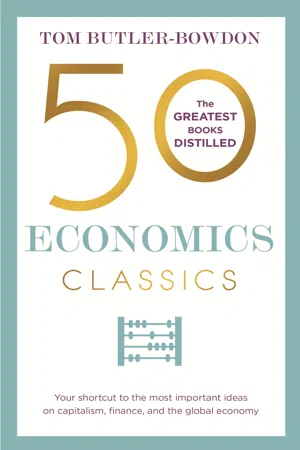
'Something of a modern classic in its own right.' E&T magazine Economics drives the modern world and shapes our lives, but few of us feel we have time to engage with the breadth of ideas in the subject. 50 Economics Classics is the smart person's guide to two centuries of discussion of finance, capitalism and the global economy. From Adam Smith's Wealth of Nations to Thomas Piketty's bestseller Capital in the Twenty-First Century, here are the great reads, seminal ideas and famous texts, clarified and illuminated for all. EXPLORE the ideas of some of the greatest thinkers in economics: Milton Friedman on economic freedom - J. K. Galbraith on 1929 - Friedrich Hayek on knowledge - Jane Jacobs on cities - J. M. Keynes on depressions - Thomas Malthus on population - Karl Marx on capital - David Ricardo on free trade - Joseph Schumpeter's 'creative destruction' - Adam Smith's 'invisible hand' - Max Weber's 'spirit of capitalism' GAIN the insights and research of contemporary economists and commentators: William Baumol on entrepreneurs - Gary Becker on human capital - Diane Coyle on GDP - Naomi Klein on neoliberalism - Paul Krugman on inequality - Deirdre McCloskey on ideas - Dambisa Moyo on aid - Thomas Piketty on wealth concentration - Amartya Sen on food security - Joseph Stiglitz on the euro - Richard Thaler on behavioral economics - Michael Lewis on the 2007-08 crisis - Dani Rodrik on globalization - Robert Shiller on asset bubbles DISCOVER the truth behind the headlines in these landmark bestsellers and works of economic history: Lords of Finance - The Second Machine Age - The Little Book of Common Sense Investing - 23 Things They Don't Tell You About Capitalism - The Ascent of Money - The Intelligent Investor - The Rise and Fall of American Growth - Freakonomics - The Competitive Advantage of Nations - The Mystery of Capital - Small is Beautiful - The Theory of the Leisure Class
eBook - ePub
50 Economics Classics
Your shortcut to the most important ideas on capitalism, finance, and the global economy
- 368 pages
- English
- ePUB (mobile friendly)
- Available on iOS & Android
eBook - ePub
50 Economics Classics
Your shortcut to the most important ideas on capitalism, finance, and the global economy
About this book
Information
2009
Lords of Finance
“More than anything else, more even than the belief in free trade or the ideology of low taxation and small government, the gold standard was the economic totem of the age. Gold was the lifeblood of the financial system. It was the anchor for most currencies, provided the foundation for banks, and in a time of war or panic, served as a store of safety. For the growing middle classes of the world, who provided so much of the savings, the gold standard was more than simply an ingenious system for regulating the issue of currency. It served to reinforce all those Victorian values of economy and prudence … Among bankers, whether in London or New York, Paris or Berlin, it was revered with an almost religious fervor, as a gift of providence, a code of behaviour transcending time and place.”
In a nutshell
Fixed ideas in economics can have disastrous results. The world hung onto the gold standard long after it had stopped being a means to create stability and growth.
In a similar vein
J. K. Galbraith The Great Crash 1929
John Maynard Keynes The General Theory of Employment, Interest and Money
Michael Lewis The Big Short
Hyman Minsky Stabilizing an Unstable Economy
Joseph Stiglitz The Euro
CHAPTER 1
Liaquat Ahamed
In 2010, chairman of the US Federal Reserve Bank, Ben Bernanke, was asked by the Financial Crisis Inquiry Commission what books he would recommend to understand the crisis. He mentioned just one, Lords of Finance, a new work of economic history which would win a Pulitzer Prize in the same year.
Its investment manager author, Liaquat Ahamed, first had the idea for the book when reading a 1999 Time story, “The Committee to Save the World,” on the successful efforts of Alan Greenspan, then Federal Reserve chairman, Robert Rubin, President Clinton’s Treasury Secretary, and Lawrence Summers, Rubin’s deputy, in committing billions of dollars of public funds to head off the Asian financial crisis, which threatened to bring down the global economy.
A similar story, he realized, could be told about the heads of the world’s four main central banks in the 1920s: Montagu Norman of the Bank of England, Benjamin Strong of the New York Federal Reserve Bank, Hjalmar Schacht of the German Reichsbank, and Émile Moreau of the Banque de France. A bit like Greenspan in the 1990s and 2000s, the men were considered sages, their every utterance waited on. Yet these “lords of finance,” who had been charged with reconstructing the financial world after World War One, ended up contributing to the greatest peacetime collapse of the global economy: the Great Depression. When Greenspan’s very loose monetary policies were held responsible by many for contributing to the Great Recession of 2008–2010, Ahamed’s book suddenly seemed very relevant.
Ahamed’s deeply researched portraits of the main actors in the interwar economic drama and their foibles breathes real fascination into what may otherwise have been a straightforward economic history. It shows how too much faith in individual bankers, and their adherence to outdated ideas (in this case, the “financial prudence” of the gold standard), carried massive risks.
Golden goose or barbarous relic?
Montagu Norman, the most famous of the central bankers between the wars, had a “rigid, almost theological belief” in the gold standard as being fundamental to global order and prosperity. If a nation was on the gold standard, its government could only issue amounts of currency for which there were corresponding amounts of gold in the national vaults, and all paper currency could in theory be redeemed in actual gold. The gold standard was a positive development in the history of finance, since it brought discipline to governments; they could not simply print money to pay for their debts.
When the world economy was in full steam before World War One, the gold standard had seemed to work well, facilitating trade and growth. The war changed everything. Apart from the human tragedy, the belligerents had indebted themselves to the tune of $200 billion, an astonishing 50 percent of their GDPs. The Paris Peace Conference had forced a crippling reparations bill on Germany of around 100 percent of its pre-War domestic output, and its only option to stay afloat seemed to be to print money. This had a cataclysmic result. By 1923, the German Reichsmark had become essentially worthless, and prices were doubling every couple of days. The middle classes found their lifetime savings wiped out; after the political revolution of the overthrow of the Prussian empire, now the social order collapsed.
There was a consensus among horrified central bankers that, to regain the stability and financial prudence of the pre-World War One era, the world must return to the gold standard as quickly as possible. In the way of this was the mountain of paper currency issued by the central banks during the war. There were essentially only two ways to restore the balance between the value of gold reserves and the total money supply: deflation (by contracting the amount of currency in circulation); or devaluation (formally reducing the value of domestic currency in relation to gold).
In Britain, Chancellor of the Exchequer Winston Churchill, against his better judgement, chose deflation, fixing the pound to gold at the same price as the pre-war level. However, lacking large enough reserves of gold and not being able to compete internationally with other countries because its currency was too high, Britain’s economy floundered for much of the 1920s, with high interest rates and unemployment. France, on the other hand, which had chosen devaluation and set the franc at a relatively low exchange rate in relation to gold, enjoyed continuous economic growth, with its gold reserves and international exports increasing. Meanwhile, the large amounts of money that America had lent to European powers to finance the war meant that repayments and gold began flowing into its coffers.
Because all nations were connected via the gold standard, the success of one nation (such as France, whose devaluation effectively meant it was exporting unemployment to Britain and Germany) could impact badly on another. Rather than bringing increasing prosperity for all, a return to the gold standard created a zero-sum game in which one country did well at another’s expense, increasing hostility. Yet only a few at the time, most notably John Maynard Keynes, were willing to attack the gold standard. Keynes described the standard as a “barbarous relic” and a “fetish” that hamstrung the world economy between the wars. But he failed to persuade the British authorities that a complex modern economy could create credit without gold’s backing.
This apparent “umbrella of stability,” Ahamed argues, “proved to be a straitjacket.” It would take an array of currency crises and a Great Depression for the paradigm to finally change.
Hurtling towards disaster
By the end of 1926, the four central bankers had begun to worry about an overheating US stock market, excessive foreign borrowing by Germany, recession in Britain, and an increasingly dysfunctional gold standard. To alleviate matters, Strong’s New York Fed cut interest rates by half a percent to 3.5 percent. Following the cut, gold started flowing back to Europe. But from February 1928, Strong, realizing it might have been a mistake, had the Fed raise its rates to 5 percent. America began attracting the world’s gold again, and Britain felt compelled to raise its own interest rates to stop the gold haemorrhage. This rate rise dampened demand, creating even more unemployment. Germany, already in recession, had to raise its rates to 7.5 percent, and other European countries followed.
Meanwhile in America, in a period of 15 months in 1928 and 1929, the stock market almost doubled, far outstripping the underlying value of its component companies. When the crash came in the fall of 1929, close to half of the value of the US stock market evaporated, and it could have gone further were it not for drastic interest rate cuts by the Fed and injections of liquidity by it and a consortium of banks. But the Fed eased its interventions too soon, and so a second downward lurch began in the real economy, which some had hoped might be protected from the market collapse. Meanwhile, the European markets also dropped, but not by as much, as the general public had not bought stocks to the same extent as in America.
Keeping to the gold standard had a perverse effect, Ahamed writes, in that international capital flows increasingly went to those countries which already had plenty of gold (America and France), and less to those with little (Britain and Germany). This winner-takes-all situation was hardly healthy for a world trying to get out of Depression, particularly since European countries had to pay for their US debts in gold, not currency.
Sinking into the mire
In 1931, with increasingly depleted gold reserves, Britain was finally forced off the gold standard. Though the reputation of the Bank of England was diminished, the actual result was a drop in the pound by 30 percent within a couple of months, giving Britain a hope of being competitive in trade again. Many other countries, including Canada, India, and the Scandinavian countries, followed.
1931 was the year, Ahamed says, when a severe recession around the world turned into The Great Depression. The currency problems created by trying to adhere to the gold standard led to runs on the banks, in Europe as well as America, and a vicious cycle of deflationary psychology in consumption and investment set in. In America the following year, investment halved, industrial production dropped by a quarter, prices fell 10 percent, and unemployment hit 20 percent. The stock market’s low of 41 points in 1932 was an astonishing 90 percent beneath what it had been at its peak in 1929. When a journalist asked Keynes if there had been anything like this in history he replied, “Yes. It was called the Dark Ages, and it lasted four hundred years.”
When Franklin D. Roosevelt replaced Herbert Hoover as US president at the start of 1933, the New York Times reported that Washington was like “a beleaguered capital in wartime.” Twenty-eight states had shut down their banking systems, and a quarter of all banks had gone under in the previous three years. With precipitous drops in house prices, half of all people with mortgages had defaulted. The steel mills that had not shut down were operating at 12 percent capacity. Car plants had gone from making 20,000 vehicles a day to two thousand. “In the richest nation in the world,” Ahamed writes, “34 million men, women and children out of a total population of 120 million had no apparent source of income.” It seemed that Marx had been right when he foretold that capitalism would collapse amid increasingly extreme cycles of boom and bust.
Dumping orthodoxy, embracing prosperity
One of Roosevelt’s first acts was to proclaim a five-day cross-America bank shutdown, and suspend all exports of gold. His Emergency Banking Act allowed solvent banks to gradually reopen, and provisions were made for the Treasury, via the Fed, to guarantee deposits in those banks. The law also moved the dollar away from being backed by gold; a variety of assets were now redeemable against it.
Roosevelt’s package of measures increased confidence overnight. People took the cash from under their mattresses and put it back into banks, and the stock market rebounded. Roosevelt began a Keynesian stimulus program that got some of America working again. Against the advice of economists and bankers, Roosevelt believed that the key to recovery was getting prices rising. To this end, he accepted an amendment to the Agricultural Adjustments Act providing for a “temporary” leaving of the gold standard, with the capacity to issue $3 billion in US dollars without the backing of gold, and the scope to devalue the dollar against gold by up to 50 percent.
“Breaking with the dead hand of the gold standard was the key to economic revival,” Ahamed writes. All countries that did so—Britain in 1931, the US in 1933, France in 1935, and eventually Germany, still haunted by the spectre of hyperinflation—got their economies back on track. The Allies virtually gave up on getting reparations out of Germany; these in the end only totalled $4 billion, rather than the $32 billion originally sought, and its economy shot ahead (with significant thanks to rearmament).
But if the gold standard was no good, what could replace it? After World War Two, Keynes worked to create a system based on strong but not rigid rules which would allow countries to shape their own domestic economies by having “pegged [to the US dollar] but adjustable” exchange rates. The purpose, Ahamed says, was “to avoid the need for the sort of straitjacket policies of the twenties and thirties when Germany and Britain had been forced to hike interest rates and create mass unemployment to protect currency values that were in any case unsustainable.” The new system was designed to again give countries some control over their own destiny, yet still facilitate international trade.
Final comments
Though it is hard to believe now, at the time no one really questioned the gold standard. Hoover, Churchill, Lenin, and Mussolini all believed in it, and in the 1920s and 1930s it seemed the one thing, perhaps the only thing, linking nations in the world economy. Yet the self-regulating market beloved of classical economists (of which the gold standard was the most powerful symbol), rather than leading to a promised land of prosperity and peace, brought countries to their knees and invited horrifying shifts from extreme liberalism to its antithesis, fascism. One of Ahamed’s themes involves the dark effects of enforcing large sovereign debt repayments, as the Allies tried to do with Germany after World War One. Hitler’s rise demonstrated the fact that what may seem financially prudent can be politically very dumb.
What is today’s “gold standard,” that is, the institution that looks good on paper but has in fact caused untold misery? In The Euro, Joseph Stiglitz argues that the European currency has been a financial straitjacket that has condemned whole nations to economic failure. As with the gold standard, it became a mark of prestige to join the euro, and a disaster to leave it. Stiglitz believes history will be kinder to nations who insist on keeping their currency independent.
Liaquat Ahamed
Born in Kenya in 1952, Ahamed was sent abroad for his education: private school in England followed by degrees in economics at Cambridge University and then Harvard.
In the 1980s he was an economist at the World Bank, before starting a career in investment banking with Fischer, Francis, Trees & Watts, a New York firm, rising to Chief Executive. He currently advises hedge funds, is a director of an insurance company, and is a trustee of the Brookings Institution, a think tank.
Lords of Finance won the Financial Times/Goldman Sachs Business Book of the Year award and the 2010 Pulitzer Prize for History. Ahamed’s other book is Money and Tough Love: Inside the IMF (2014).
2010
The Microtheory of Innovative ...
Table of contents
- Cover
- Praise for 50 Economics Classics
- About the Author
- Title Page
- Copyright
- Contents
- Introduction
- 1 Liaquat Ahamed – Lords of Finance (2009)
- 2 William J. Baumol – The Microtheory of Innovative Entrepreneurship (2010)
- 3 Gary Becker – Human Capital (1964)
- 4 John C. Bogle – The Little Book of Common Sense Investing (2007)
- 5 Eric Brynjolfsson & Andrew McAfee – The Second Machine Age (2014)
- 6 Ha-Joon Chang – 23 Things They Don’t Tell You About Capitalism (2011)
- 7 Ronald Coase – The Firm, the Market, and the Law (1988)
- 8 Diane Coyle – GDP: A Brief But Affectionate History (2014)
- 9 Peter Drucker – Innovation and Entrepreneurship (1985)
- 10 Niall Ferguson – The Ascent of Money (2008)
- 11 Milton Friedman – Capitalism and Freedom (1962)
- 12 J. K. Galbraith – The Great Crash 1929 (1955)
- 13 Henry George – Progress and Poverty (1879)
- 14 Robert J. Gordon – The Rise and Fall of American Growth (2016)
- 15 Benjamin Graham – The Intelligent Investor (1949)
- 16 Friedrich Hayek – The Use of Knowledge in Society (1945)
- 17 Albert O. Hirschman – Exit, Voice, and Loyalty (1970)
- 18 Jane Jacobs – The Economy of Cities (1968)
- 19 John Maynard Keynes – The General Theory of Employment, Interest, and Money (1936)
- 20 Naomi Klein – The Shock Doctrine (2007)
- 21 Paul Krugman – The Conscience of a Liberal (2007)
- 22 Steven D. Levitt & Stephen J. Dubner – Freakonomics (2005)
- 23 Michael Lewis – The Big Short (2010)
- 24 Deirdre McCloskey – Bourgeois Equality (2016)
- 25 Thomas Malthus – An Essay on the Principle of Population (1798)
- 26 Alfred Marshall – Principles of Economics (1890)
- 27 Karl Marx – Capital (1867)
- 28 Hyman Minsky – Stabilizing an Unstable Economy (1986)
- 29 Ludwig von Mises – Human Action (1949)
- 30 Dambisa Moyo – Dead Aid (2010)
- 31 Elinor Ostrom – Governing the Commons (1990)
- 32 Thomas Piketty – Capital in the Twenty-First Century (2014)
- 33 Karl Polanyi – The Great Transformation (1944)
- 34 Michael E. Porter – The Competitive Advantage of Nations (1990)
- 35 Ayn Rand – Capitalism: The Unknown Ideal (1966)
- 36 David Ricardo – Principles of Political Economy and Taxation (1817)
- 37 Dani Rodrik – The Globalization Paradox (2011)
- 38 Paul Samuelson & William Nordhaus – Economics (1948)
- 39 E. F. Schumacher – Small Is Beautiful (1973)
- 40 Joseph Schumpeter – Capitalism, Socialism, and Democracy (1942)
- 41 Thomas C. Schelling – Micromotives and Macrobehavior (1978)
- 42 Amartya Sen – Poverty and Famines (1981)
- 43 Robert J. Shiller – Irrational Exuberance (2000)
- 44 Julian Simon – The Ultimate Resource 2 (1996)
- 45 Adam Smith – The Wealth of Nations (1776)
- 46 Hernando de Soto – The Mystery of Capital (2000)
- 47 Joseph Stiglitz – The Euro (2016)
- 48 Richard Thaler – Misbehaving: The Making of Behavioral Economics (2015)
- 49 Thorstein Veblen – The Theory of the Leisure Class (1899)
- 50 Max Weber – The Protestant Ethic and the Spirit of Capitalism (1904)
- 50 More Economics Classics
- Chronological List
- Credits
- Acknowledgements
Trusted by 375,005 students
Access to over 1.5 million titles for a fair monthly price.
Study more efficiently using our study tools.
Frequently asked questions
Yes, you can cancel anytime from the Subscription tab in your account settings on the Perlego website. Your subscription will stay active until the end of your current billing period. Learn how to cancel your subscription
No, books cannot be downloaded as external files, such as PDFs, for use outside of Perlego. However, you can download books within the Perlego app for offline reading on mobile or tablet. Learn how to download books offline
Perlego offers two plans: Essential and Complete
- Essential is ideal for learners and professionals who enjoy exploring a wide range of subjects. Access the Essential Library with 800,000+ trusted titles and best-sellers across business, personal growth, and the humanities. Includes unlimited reading time and Standard Read Aloud voice.
- Complete: Perfect for advanced learners and researchers needing full, unrestricted access. Unlock 1.5M+ books across hundreds of subjects, including academic and specialized titles. The Complete Plan also includes advanced features like Premium Read Aloud and Research Assistant.
We are an online textbook subscription service, where you can get access to an entire online library for less than the price of a single book per month. With over 1.5 million books across 990+ topics, we’ve got you covered! Learn about our mission
Look out for the read-aloud symbol on your next book to see if you can listen to it. The read-aloud tool reads text aloud for you, highlighting the text as it is being read. You can pause it, speed it up and slow it down. Learn more about Read Aloud
Yes! You can use the Perlego app on both iOS and Android devices to read anytime, anywhere — even offline. Perfect for commutes or when you’re on the go.
Please note we cannot support devices running on iOS 13 and Android 7 or earlier. Learn more about using the app
Please note we cannot support devices running on iOS 13 and Android 7 or earlier. Learn more about using the app
Yes, you can access 50 Economics Classics by Tom Butler Bowdon in PDF and/or ePUB format, as well as other popular books in Economics & Business General. We have over 1.5 million books available in our catalogue for you to explore.