For over 2000 years, philosophy has been our best guide to the experience of being human, and the true nature of reality. From Aristotle, Plato, Epicurus, Confucius, Cicero and Heraclitus in ancient times to 17th century rationalists Descartes, Leibniz and Spinoza, from 20th-century greats Jean-Paul Sartre, Jean Baudrillard and Simone de Beauvoir to contemporary thinkers Michael Sandel, Peter Singer and Slavoj Zizek, 50 Philosophy Classics explores key writings that have shaped the discipline and had an impact on the real world. Philosophy can no longer be confined to academia, and 50 Philosophy Classics shows how powerful it can be as a tool for opening our minds and helping us think. Whether you are fascinated or daunted by the big questions of how to think, how to be, how to act and how to see, this is the perfect introduction to some of humanity's greatest minds and their landmark books.
eBook - ePub
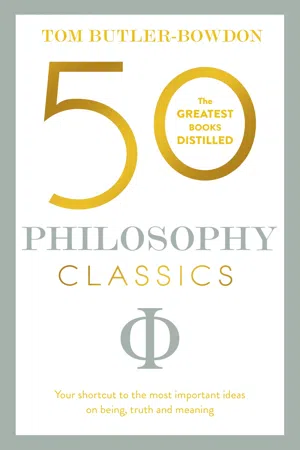
50 Philosophy Classics
Thinking, Being, Acting Seeing - Profound Insights and Powerful Thinking from Fifty Key Books
- 336 pages
- English
- ePUB (mobile friendly)
- Available on iOS & Android
eBook - ePub
50 Philosophy Classics
Thinking, Being, Acting Seeing - Profound Insights and Powerful Thinking from Fifty Key Books
About this book
Information
Topic
PhilosophySubtopic
History & Theory of PhilosophyIntroduction
“Philosophy is at once the most sublime and the most trivial of human pursuits. It works in the minutest crannies and it opens out the widest vistas. It ‘bakes no bread,’ as has been said, but it can inspire our souls with courage; and repugnant as its manners, its doubting and challenging, its quibbling and dialectics, often are to common people, no one of us can get along without the far-flashing beams of light it sends over the world’s perspectives.”
William James, Pragmatism
William James, Pragmatism
The word philosophy comes from the Greek philo (love) and sophia (wisdom). Both as a discipline and as a personal outlook, philosophy is about the desire to think, exist, act, and see in better ways – to get at the truth of things.
The Oxford English Dictionary defines philosophy as “the use of reason and argument in seeking truth and knowledge of reality, especially of the causes and nature of things and of the principles governing existence, the material universe, perception of physical phenomena and human behaviour.” In other words, philosophy is high-level thinking to establish what is true or real, given the limits of human thought and senses, and the implications of this for how we act.
While philosophy has multiple strands, its focus on what we can really know is perhaps its most salient feature. The discipline’s constant questioning of assumptions has annoyed many, even its own practitioners – “Philosophers have raised a dust and then complain they cannot see,” George Berkeley said – yet in our age, with its seemingly increasing extremes and uncertainty, philosophy’s focus on what can be known comes into its own. Indeed, as Nassim Nicholas Taleb points out in The Black Swan, it is what we do not know that matters, because it is always the unforeseen that changes our world, both personal and public.
Perhaps the greatest divide in philosophy is between those who believe that all our information must come from the senses (the empirical, materialist view) and those who believe that truth can be arrived at through abstract reasoning (the rationalists and idealists). The first camp has a long lineage, from the second-century skeptic Sextus Empiricus to the Englishman Francis Bacon and Scottish Enlightenment thinker David Hume, and to the twentieth-century “logical positivists,” including A.J. Ayer and philosopher of science Karl Popper. The second camp counts among its number Plato (his theory of nonphysical “Forms” that undergird the universe), Descartes (his famous separation of mind and matter), and Kant (who resurrected the idea of “moral law” in modern philosophy). The purpose of this book is not to tell you who is “right,” but to lay out some of the ideas and theories of note to help you make up your own mind.
As William James observed in Pragmatism, philosophers like to believe that they are erecting impartial and accurate systems to explain human action and the universe, when in fact philosophies are expressions of personal biases and outlooks. Philosophy is made by philosophers – imperfect people offering their version of the truth. Yet this is what makes it interesting, and this book, as well as describing some of the key philosophical theories, also tries to give a sense of the people who devised them. To what extent was their thinking simply a projection of their own minds, or did they get to the heart of something universal?
Since I have already written books on the classic writings in psychology, spirituality, and personal development, the most valid question for me was what philosophy provides that these fields do not. After all, because it has an experimental methodology, many believe that psychology is a more trustworthy discipline when it comes to human questions. However, as Wittgenstein noted in Philosophical Investigations, scientific method can sometimes hide a lack of conceptual depth. What is reality? What does it mean to be a human? What is the meaning of life? Philosophy is the only real “meta” discipline, Nietzsche claimed, made to consider the totality of things. While it might be said that theology and spirituality are designed for such questions, they lack the neutrality that is needed for a real discipline open to all-comers.
This is not to say that philosophy is “scientific.” Bertrand Russell noted that it is the business of science to know more facts, while the work of philosophy is to establish valid conceptions and laws through which science can be seen. Rather than science enveloping philosophy (a belief of the physicist Stephen Hawking), it is philosophy that can help put raw data and scientific theories into a larger context. Science is after all a very human project, and if it is the attempt to make our theories fit nature, then it is human nature with which we first have to contend. To know what we are looking at, we must be aware of the lens through which we view it; that is, how we see the world. We know, for instance, that the old Newtonian perspective on the universe, with its focus on matter, no longer copes with the strange, fluid reality that quantum physics suggests. Philosophy is well equipped to look at these uncertainties because of its focus on objectivity and consciousness itself. The twentieth-century particle physicist David Bohm had to turn to philosophy to explain the movement of electrons under his microscope. It was not possible to construe the world in terms of mind looking at matter, he concluded; rather, consciousness is at least as important an element in the working of the universe as is matter itself. In this book I look at these and other fascinating matters in more depth.
In addition to the primary meaning given above, the Oxford English Dictionary defines philosophy as “a personal rule of life.”
We all have such a philosophy and it shapes everything we do. Our larger outlook on the world is usually the most interesting and important thing about us, expressing “our more or less dumb sense of what life honestly and deeply means,” as William James wrote in Pragmatism. Far from being the preserve of lofty professors, our philosophy is practical; we could barely operate without one. As G.K. Chesterton wrote:
“for a landlady considering a lodger, it is important to know his income, but still more important to know his philosophy … for a general about to fight an enemy, it is important to know the enemy’s numbers, but still more important to know the enemy’s philosophy … the question is not whether the theory of the cosmos affects matters, but whether, in the long run, anything else affects them.”
There is, of course, a difference between a personal philosophy and philosophy as a discipline. This book seeks to bridge the two. It is not about what a particular philosophy says or means in isolation, but what it may mean to me or you – whether it can increase the quality of our lives, guide our actions in the world, or shed light on our place in the universe.
Whether it is Aristotle or Epicurus providing recipes for a fulfilled and happy life or Plato outlining the ideal society, the ideas of these ancient thinkers remain powerful, if only because in over 2,000 years humans have not changed much. Philosophy is resurgent because the big questions never go away, and it provides ready-made concepts for addressing them. The brilliance of philosophy is that despite its lack of objectivity, it still has the power to send “far-flashing beams of light” over the world, allowing us to see things anew.
Not only does philosophy give us a framework for seeing all other knowledge, on a more personal and exciting level it offers us fresh and often liberating ways of thinking, being, acting, and being.
THINKING
The limits of our knowledge, the sense of self
Philosophy is first about how to think and, given the human propensity to get things wrong, this often means questioning the bases of our knowledge. Descartes went to some lengths to show how easily the mind could be misled by data from the senses, and from this wondered how anything could be said truly to exist. Yet from this position of extreme doubt he made his breakthrough: surely, if he had the ability to be deceived in his thinking, there had to be an “I” that was experiencing the deception. He wrote:
“I thereby concluded that I was a substance, of which the whole essence or nature consists in thinking, and which, in order to exist, needs no place and depends on no material thing.”
Even if we are constantly deceived about what we perceive to be fact, it cannot be doubted that we perceive. We are, first and foremost, “thinking things.” Consciousness is our essence, and what we are conscious of the most is ourselves: what we are thinking, how we are doing, what we will do next, what we know. As Descartes put it, “I am thinking, therefore I am.”
David Hume and John Locke believed that the only knowledge we could trust was that derived directly from our senses, and Hume took this a step further by suggesting that human beings are simply a bundle of thoughts, impressions, and feelings, which at any one time provide a sense of being an “I,” even if that identity lacks a solid core. Far from possessing an immortal soul, we are more like a constantly moving banquet of experiences and perceptions, and therefore certainty and knowledge remain elusive. Contemporary philosopher Julian Baggini supports Hume’s bundle theory, drawing on neuroscience to show that our sense of self cannot be located in any particular part of the brain or nervous system. Rather, many parts work together to create the feeling of an autonomous, free-willing self. This may be a grand “ego trick” or an illusion, but it makes life manageable.
Philosophy is associated with the quest for self-knowledge, but Iris Murdoch is another who has questioned the idea that there is some eternal core to us that we must be on a mission to reveal. She writes in The Sovereignty of Good:
“‘Self-knowledge’, in the sense of a minute understanding of one’s own machinery, seems to me, except at a fairly simple level, usually a delusion … Self is as hard to see justly as other things, and when clear vision has been achieved, self is a correspondingly smaller and less interesting object.”
On the other hand, Murdoch says, this lack of self-solidity should not stop us making efforts to improve ourselves. It is natural and right for us to strive to be perfect, even if we are beset by deficiencies of perception and lack of courage.
In his Essays, Michel de Montaigne provided a forensic examination of the self using his own prejudices and weaknesses as the subject matter, and came to the conclusion that the self is a mystery: human knowledge is limited to such an extent that we barely know anything about ourselves, let alone the world at large. We are continually thinking, but rather than the rational beings we suppose ourselves to be, we are a mass of prejudices, quirks, and vanities.
Human fallibility is a rich vein to tap, and some recent writings give special insights into this area. Daniel Kahneman won a Nobel Prize for his work into the biases and mistakes we make in everyday thinking. In Thinking, Fast and Slow, he argues that we are a “machine for jumping to conclusions,” wired more to keep alive and respond to threats than to perceive accurately. Nassim Nicholas Taleb also takes up this theme, noting that we believe we understand more of what’s going on in the world than we actually do; we often wrongly ascribe meaning to events after they’ve happened, creating a story; and we overvalue facts, statistics, and categories, which make us feel comfortable that we can predict the future. Our shock at unexpected events shows just how illusory is this feeling that we are in control. And yet, we wouldn’t attempt half the things we do if we had a more accurate picture of what we can achieve in a certain timeframe. Seen this way, error is not a defect of the human condition, but part of its eventual glory. Indeed, as Kahneman notes, the focus on human errors “does not denigrate human intelligence, any more than the attention to diseases in medical texts denies good health. Most of us are healthy most of the time, and most of our judgements and actions are appropriate most of the time.”
On that same positive note, even arch-empiricist Karl Popper (The Logic of Scientific Discovery), who also mistrusted the senses and proposed an extremely difficult standard for the acceptance of any scientific truth, argued that it is humankind’s role and privilege to theorize about the laws that may govern the universe. We may be physiologically set up to get things wrong much of the time, but nevertheless our ability to think in a vaguely logical way – to use an older term, reason – makes us unique in the animal world.
BEING
Chances for happiness and a meaningful life, free will, and autonomy
Philosophers since ancient times have suggested that happiness results from moving away from the self, either throwing ourselves into causes or work important to us, or loosening the bands of the ego through appreciating nature, through love, or via spiritual practice.
For Epicurus, virtue made for a pleasant and happy life, because doing the right thing naturally puts our mind at rest. Instead of being anguished about the consequences of our bad actions, we are liberated to enjoy a simple life of friends, philosophy, nature, and small comforts.
Aristotle believed that happiness comes from expressing what we have rationally decided is good for us over the longer term, such as service to the community. Everything in nature is built with an end or purpose in mind, and what is unique to humans is the ability to act according to our reason and preselected virtues. A happy person is one who is stable through their cultivation of virtue, who makes the vagaries of fortune irrelevant. “Activities in accord with virtue control happiness,” Aristotle said. Happiness is therefore not pleasure, but a by-product of a meaningful life, and meaning tends to come from striving and self-discipline.
Bertrand Russell noted almost the same in his very personal The Conquest of Happiness. Effort, even more than actual success, he wrote, is an essential ingredient of happiness; a person who is able to gratify all whims without effort feels that attainment of desires does not make for happiness. A focus on the self is a cause of unhappiness, while joy comes from directing our interests outward, throwing ourselves into life.
Leibniz was parodied by Voltaire for suggesting that the world we live in is “the best of all possible worlds,” but his real point was more subtle. The best possible world is not the one specifically designed for human happiness. Human beings are driven by self-interest and are not aware of the good result of everything that happens. We see matters in terms of cause and effect, but our appreciation of the relationship between them is naturally limited. Only a supreme being has the overview of how everything knits together, Leibniz argued, and our role is to trust in this benevolence of intention. The world we live in is the best possible world, he famously said, even if it appears to contain a great deal of evil, because “an imperfection in the part may be required for a greater perfection in the whole.”
But what if you believe, as the existentialists did, that the universe has no purpose or meaning? Sartre’s answer was to live “authentically,” choosing your own destiny instead of blindly accepting society’s rules or the moral “laws” of the day. He wrote: “Man is condemned to be free; because once thrown into the world, he is responsible for everything he does.” From such an unpromising premise, Sartre developed a philosophy of freedom that did not depend on any God, attracting a whole generation keen to live in their own way.
This outlook assumes that we are autonomous beings with free will – but are we? Spinoza, Schopenhauer, and Montaigne, among others, argued that we are the subject of causes and larger forces of which we can be only dimly aware. Sam Harris’s Free Will informs us of research suggesting that free will is an illusion: our actions are the product of brain states, which are themselves the result of prior causes, which in turn are generated by a universe over which we have zero control. We only feel like we have free will because our brains are set up to give this happy illusion. Where does this leave us? Harris’s crucial point is that, wherever they come from, we still have conscious intentions, and life is about trying to have these fulfilled. On a purely rational or scientific level, this is the “meaning” of life.
Heidegger argued that it is impossible for us not to find our existence meaningful. I love, I act, I have an impact – this is the nature of my being. Beyond this, there is the astonishing fact of having consciousness. Why do I have it to this advanced level, when a sheep or a rock does not? A human being is “thrown” into the world, Heidegger said, into a particular place, time, and situation not of their choosing, and life is about making sense of this “fall” into space and time. We feel some responsibility to do something with our lives, and fortunately we come equipped with the capacities for speech and action, which give us the opportunity to reveal something of ourselves. A good life is one in which we seize what possibilities we have and make something out of them. Given our rich raw materials of consciousness and environment, life is inherently meaningful.
Hannah Arendt noted that while nature may be an inexorable process of living and dying, humanity was given a way out of this through the ability to act. “Men, though they must die, are not born in order to die but in order to begin,” she wrote in The Human Condition. Other animals can only behave according to their programmed survival instincts and impulses, but human beings can go beyond our selfish biological needs to bring something new into being whose value may be recognized in a social and public way. Our deeds are never quite predictable, and every birth carries with it the possibility of a changed world. In short, we matter.
ACTING
Power and its use, liberty and justice, fairness and ethics
“Act only according to that maxim by which you can at the same time will that it should become a universal law.”
Immanuel Kant’s “categorical imperative” says that individual actions are to be judged according to whether we would be pleased if everyone in society took the same action. People should never be seen as means to an end. Although this principle is espoused by the world’s religions, Kant ...
Table of contents
- Cover Page
- Praise for 50 Philosophy Classics
- About the Author
- Title Page
- Copyright Page
- Contents
- Introduction
- The Human Condition (1958)
- Nicomachean Ethics (4th century BC)
- Language, Truth and Logic (1936)
- The Ego Trick (2011)
- Simulacra and Simulation (1981)
- The Second Sex (1949)
- Principles of Morals and Legislation (1789)
- Creative Evolution (1907)
- Wholeness and the Implicate Order (1980)
- Understanding Power (2002)
- On Duties (44 BC)
- Analects (5th century BC)
- Meditations on First Philosophy (1641)
- Fate (1860)
- Letters (3rd century BC)
- The Order of Things (1966)
- On Bullshit (2005)
- Free Will (2012)
- Phenomenology of Spirit (1807)
- Being and Time (1927)
- Fragments (6th century AD)
- An Enquiry Concerning Human Understanding (1748)
- Pragmatism (1907)
- Thinking, Fast and Slow (2011)
- Critique of Pure Reason (1781)
- Fear and Trembling (1843)
- Naming and Necessity (1972)
- The Structure of Scientific Revolutions (1962)
- Theodicy (1710)
- Essay Concerning Human Understanding (1689)
- The Prince (1513)
- The Medium Is the Massage (1967)
- On Liberty (1859)
- Essays (1580)
- The Sovereignty of Good (1970)
- Beyond Good and Evil (1886)
- Pensées (1660)
- The Republic (4th century BC)
- The Logic of Scientific Discovery (1934)
- A Theory of Justice (1971)
- The Social Contract (1762)
- The Conquest of Happiness (1930)
- Justice (2009)
- Being and Nothingness (1943)
- The World as Will and Representation (1818)
- The Life You Can Save (2009)
- Ethics (1677)
- The Black Swan (2007)
- Philosophical Investigations (1953)
- Living in the End Times (2010)
- 50 More Philosophy Classics
- Glossary
- Credits
- Acknowledgments
Trusted by 375,005 students
Access to over 1.5 million titles for a fair monthly price.
Study more efficiently using our study tools.
Frequently asked questions
Yes, you can cancel anytime from the Subscription tab in your account settings on the Perlego website. Your subscription will stay active until the end of your current billing period. Learn how to cancel your subscription
No, books cannot be downloaded as external files, such as PDFs, for use outside of Perlego. However, you can download books within the Perlego app for offline reading on mobile or tablet. Learn how to download books offline
Perlego offers two plans: Essential and Complete
- Essential is ideal for learners and professionals who enjoy exploring a wide range of subjects. Access the Essential Library with 800,000+ trusted titles and best-sellers across business, personal growth, and the humanities. Includes unlimited reading time and Standard Read Aloud voice.
- Complete: Perfect for advanced learners and researchers needing full, unrestricted access. Unlock 1.5M+ books across hundreds of subjects, including academic and specialized titles. The Complete Plan also includes advanced features like Premium Read Aloud and Research Assistant.
We are an online textbook subscription service, where you can get access to an entire online library for less than the price of a single book per month. With over 1.5 million books across 990+ topics, we’ve got you covered! Learn about our mission
Look out for the read-aloud symbol on your next book to see if you can listen to it. The read-aloud tool reads text aloud for you, highlighting the text as it is being read. You can pause it, speed it up and slow it down. Learn more about Read Aloud
Yes! You can use the Perlego app on both iOS and Android devices to read anytime, anywhere — even offline. Perfect for commutes or when you’re on the go.
Please note we cannot support devices running on iOS 13 and Android 7 or earlier. Learn more about using the app
Please note we cannot support devices running on iOS 13 and Android 7 or earlier. Learn more about using the app
Yes, you can access 50 Philosophy Classics by Tom Butler Bowdon in PDF and/or ePUB format, as well as other popular books in Philosophy & History & Theory of Philosophy. We have over 1.5 million books available in our catalogue for you to explore.