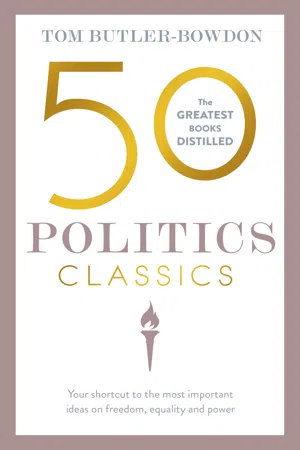
Whether you consider yourself to be conservative, liberal, socialist, or Marxist, 50 Politics Classics gives you greater understanding of the key ideas that matter in our politically charged times. From Abraham Lincoln to Nelson Mandela, from Mary Wollstonecraft to George Orwell, 50 Politics Classics distills the essence of the books, pamphlets, and speeches of the major leaders and great thinkers that drive real-world change. Spanning 2, 500 years, left and right, thinkers and doers, Tom Butler-Bowdon's new book covers activists, war strategists, visionary leaders, economists, philosophers of freedom, feminists, conservatives and environmentalists, from ancient philosophical texts right up to contemporary classics such as The Spirit Level and No Logo.
eBook - ePub
50 Politics Classics
Your shortcut to the most important ideas on freedom, equality, and power
- 336 pages
- English
- ePUB (mobile friendly)
- Available on iOS & Android
eBook - ePub
50 Politics Classics
Your shortcut to the most important ideas on freedom, equality, and power
About this book
Information
Topic
PhilosophySubtopic
Political Philosophy1948
Essays on Freedom and Power
“History is not a web woven with innocent hands. Among all the causes which degrade and demoralize men, power is the most constant and the most active.”
“The most certain test by which we judge whether a country is really free is the amount of security enjoyed by minorities.”
“Liberty is not a means to a higher political end. It is itself the highest political end.”
In a nutshell
Politics must rest on a moral foundation that accords
freedom to people for the sake of it.
freedom to people for the sake of it.
In a similar vein
Isaiah Berlin Two Concepts of Liberty (p 60)
Francis Fukuyama The End of History and the Last Man (p 104)
Alexis de Tocqueville Democracy in America (p 292)
Francis Fukuyama The End of History and the Last Man (p 104)
Alexis de Tocqueville Democracy in America (p 292)
CHAPTER 1
Lord Acton
You may not have heard of Lord Acton, but you will certainly have heard some of his words. In 1877 Mandell Creighton published his History of the Popes, and in a private letter Acton, a well-known campaigner against “papal infallibility,” tells Creighton that he could have been a lot harder on papal power grabs and rampant Vatican corruption, not to mention the siring of illegitimate children. He writes:
“I cannot accept your canon that we are to judge Pope and King unlike other men, with a favourable presumption that they did no wrong. If there is any presumption it is the other way, against the holders of power, increasing as the power increases. Power tends to corrupt and absolute power corrupts absolutely.”
He continues:
“Great men are almost always bad men, even when they exercise influence not authority: still more when you add the tendency or the certainty of corruption by authority. There is no worse heresy than that the office sanctifies the holder of it.”
Thus, the famous “power corrupts” line must be seen within the context of papal infallibility, which Acton vigorously opposed at the First Vatican Council in 1870. As a staunch Catholic, he believed that the moral laws of the Church were perfect, but that human beings certainly were not. To stay in power a good person may need to become bad, and their potential for badness grows in line with the extent of their power.
Though he published no books in his lifetime, Acton worked for years on a history of liberty that would trace the slow emergence of freedom from classical times through to the modern world. He never completed it, and his collected essays were published only after his death. Indeed, Acton’s view of history as a morality tale in which liberty and truth unfold over time was unfashionable during his lifetime; according to biographer Gertrude Himmelfarb, it was only during the Second World War that his unyielding moral outlook came into its own and was seen as a prophetic warning against totalitarianism.
The history of freedom
As a historian, Acton is distinguished by three factors: a cosmopolitan view (we must range across countries and cultures to extract universal truths instead of sticking to national histories); a trust in empirical research (he was a keen visitor to European archives); and the judgment of history according to timeless moral standards, preferably Christian ones (“The short triumph of Athenian liberty, and its quick decline,” he writes, “belong to an age which possessed no fixed standard of right and wrong.”)
Acton follows a Liberal/Whig approach, viewing history as the progress of increasing freedom. There is a “constancy of progress… in the direction of organised and assured freedom,” he writes; moreover, this is “the characteristic fact of modern history.” Like de Tocqueville, he believes that Providence works through history, slowly ensuring that the good triumphs over ignorance and evil. This, he admits, goes against the modern view of historians such as Ranke and Carlyle that there is no pattern or direction to events.
Still, Acton qualifies this approach by saying that “the wisdom of divine rule appears not in the perfection but in the improvement of the world.” He has no illusions about the virtual impossibility of achieving a perfect society, knowing that political liberty means freedom of action. The moment a ruler or state tries to achieve perfection, or “one view” of how things should be, is when things start to go bad. Instead, he describes liberty as “the delicate fruit of a mature civilization,” and notes that “at all times sincere friends of freedom have been rare.” It takes a long time for freedom to become rooted in institutions, and even then it is prey to subversion and corruption.
Yet if freedom is always fragile, Acton notes, it is also true that absolutism and tyranny never last. No power group can ever attain implicit obedience for long. Power continually has to justify itself, and often it has a hard time doing so. In direct contrast, societies where “there has been long and arduous experience, a rampart of tried conviction and accumulated knowledge, where there is a fair level of general morality, education, courage, and self-restraint” do after a time have a certain strength and resilience. It is the absolutist regimes, so powerful looking, that are as fragile as an egg.
Liberty and absolutism
Acton defines liberty as “the assurance that every man shall be protected in doing what he believes his duty against the influence of authority and majorities, custom and opinion.” Freer societies, he says, can be distinguished by universal representation, the absence of slavery, the sway of public opinion, and also, crucially, “the security of the weaker groups and the liberty of conscience, which, effectually secured, secures the rest.” Despite being wealthy and well connected, Acton was also part of a minority group that had long been discriminated against: he was a Catholic in largely Protestant England, and as a young man was rejected from Cambridge University because of his faith. Unsurprisingly, for Acton freedom of worship is the foundation of political freedom. And on freedom he is clear, giving us another of his famous statements: “Liberty is not a means to a higher political end. It is itself the highest political end.”
The history of liberty, Acton says, is the history of “the deliverance of man… from the power of man.” He is pleased to admit that much of the progress had happened in England, which had always been relatively tolerant and less lustful of power than other nations. Yet no nation should ever rest on its political or institutional laurels, and we only need think of Greece and Rome to be reminded of that. Indeed, the history of liberty is far from finished; it is high maintenance and its growth is never certain.
Liberty and democracy
Acton characterizes medieval Europe as a fight between an emerging democratic outlook and an entrenched aristocracy determined to hold on to its social and economic power. States were not as strong as they are now; their authority was restricted by powerful classes and associations. Over time, though, church and state combined in power to balance the aristocracy, and this came with its own corruption and abuses. It took someone of the fiber of Martin Luther to challenge the paradigm, and a kind of consensus developed on the right blend between liberty and good governance. Rudimentary democracy with limited suffrage became established, along with the principle of no taxation without representation or consent; and although serfdom remained, slavery itself disappeared.
In an essay on Erskine May’s Democracy in Europe, Acton spells out his view on the difference between liberty and democracy. We should not forget, he says, that democracies have allowed the slave trade to flourish, and many of the most religiously intolerant societies have been democracies. Moreover, a tyranny of the majority could be as bad as a tyranny of one: “democracy, like monarchy, is salutary within limits and fatal in excess.” We saw this in the Terror that followed the French Revolution, and it happened centuries before in Athens, where the voting populace believed that nothing could stop the mighty city-state and it grew drunk on power. By the time it saw the error of its ways, Acton says, it was too late to save the Republic.
The framers of the American constitution, Acton notes, combined the French revolutionary insistence on popular sovereignty with some of the caution of the English parliament. The final result was a system of wise checks and balances that ranged from an independent judiciary to an empowered executive, from a clear separation of church and state to a Second Chamber – and underlying it all the federalism that would ensure a central government that was strong enough to get things done, but whose power would be balanced by the states. “It was democracy in its highest perfection,” Acton writes, “armed and vigilant, less against aristocracy and monarchy than against its own weakness and excess.”
In contrast to the fierce hatred of the Ancien Régime that brought on the events in Paris in 1789, the defining aspects of American independence were moderation and people’s simple desire to get on in life. Property ownership and monetary wealth became the new arbiters of social standing. What mattered was equality of opportunity rather than actual equality, in contrast to the French revolutionaries’ lust for wealth distribution, an equality “drenched in blood,” as Acton puts it. One of his most important points is that there are no obvious links between liberty, democracy, and equality. There are tradeoffs to be made, and his conviction was that liberty was the most crucial of the three. What was a democracy worth if it did not enshrine and protect personal liberties? And how could one justify redistribution if it meant violence and theft from the rich?
Final comments
Acton scholar Josef Altholz opined in a lengthy entry in the Oxford National Dictionary of Biography that Acton’s life “was largely a failure.” Acton was indeed a failed politician, a poor manager of his inherited estates (he had to go into debt to service them, and sold his library under duress), and, despite his legendary learning, completed no books. His insistence that successful societies must have a moral, Christian backbone would seem to reduce his relevance to the twenty-first century even further.
Yet Acton’s bigger ideas on freedom, democracy, and power can still inspire and guide. One of his great insights is that democracies end up having to choose between the sovereignty of the people (which can simply become the “rule of the mob”) and the rule of law. The latter, he felt, always provides a much stronger framework of liberties. It is too easy to put liberty and democracy together as if they are simply the same, but Acton reminds us that individual liberties can easily be trampled on by the force of an apparent “popular will.” A democracy with full suffrage is not worth much if individuals are not protected by a solid constitution and laws that vouch for their individual freedom to believe what they want and associate with whom they wish.
Acton’s final message is that we who live in democratic systems should never be complacent. Democracy is desirable to the extent that it enhances and preserves liberty. If it does not achieve this, casting a vote in a ballot box is a hollow act.
Lord Acton
John Emerich Edward Dalberg-Acton was born in 1834 in Naples, a former sovereign state of which his grandfather had been prime minister. He was the only child of Sir Ferdinand Acton and Marie Louise Pelline de Dalberg, of a German noble family. After his father died, his mother took him to live in England where she married Liberal politician Lord Leveson, second Earl Granville, who became foreign secretary under William Gladstone.
Cosmopolitan from birth, as a boy Acton could speak Italian, German, French, and English fluently. (Himmelfarb notes that as an adult, “he chatted in English with his children, in German with his Bavarian-born wife… in French with his sister-in-law, and in Italian with his mother-in-law.”) After being schooled in Paris and at the Catholic Oscott College in England, he tried unsuccessfully to gain entry to Cambridge. The renowned Catholic historian Ignaz von Döllinger then became his tutor, and instilled in him an aversion to any kind of religious or state absolutism.
In his late teens and early 20s Acton met eminent people across Europe and the US, including Pope Pius ix, and attended the coronation of Tsar Alexander ii of Russia. In 1857 he settled at the Acton family seat in Aldenham in Shropshire, where he built up his great library. He began to enter the political arena, but was only partially successful. However, he would later become an adviser and confidant to Gladstone. Acton became influential through his editorship of The Rambler, an organ of English liberal Catholicism, which became the Home and Foreign Review. Under pressure from Rome Acton folded the Review and turned to historical research into religious persecution.
In 1865 Acton married his cousin, the Countess Maria Anna Ludomilla Euphrosina. In 1869 he was created Baron Acton on Gladstone’s recommendation, becoming one of the first Catholic peers. In 1872 he received an honorary doctorate of philosophy from Munich University, followed by honorary degrees from Cambridge (1889) and Oxford (1891). In 1892 he was made regius professor of modern history at Trinity College, Cambridge, giving popular lectures on the French Revolution and other areas. He was appointed editor of the Cambridge Modern History, but he had a paralyzing stroke in 1901. After being moved to his wife’s family home in Tegernsee, Bavaria, Acton died the following year.
2012
Why Nations Fail
“While economic institutions are critical for determining whether a country is poor or prosperous, it is politics and political institutions that determine what economic institutions a country has.”
“Inclusive economic institutions that enforce property rights, create a level playing field, and encourage investments in new technologies and skills are more conducive to economic growth than extractive economic institutions that are structured to extract resources from the many by the few and that fail to protect property rights or provide incentives for economic activity.”
“Chinese growth, as it has unfolded so far, is just another form of growth under extractive political institutions, unlikely to translate into sustained economic development.”
In a nutshell
The poorest countries in the world have something in common: failed political institutions. Without the stability and transparency that good government brings, the incentive to create wealth disappears.
In a similar vein
Lord Acton Essays on Freedom and Power (p 20)
John Micklethwait & Adrian Wooldridge The Fourth Revolution (p 196)
Mancur Olson The Rise and Decline of Nations (p 226)
Karl Popper The Open Society and Its Enemies (p 248)
John Micklethwait & Adrian Wooldridge The Fourth Revolution (p 196)
Mancur Olson The Rise and Decline of Nations (p 226)
Karl Popper The Open Society and Its Enemies (p 248)
CHAPTER 2
Daron Acemoglu & James A. Robinson
What do people in poor countries desire most? Why Nations Fail: The Origins of Power, Prosperity, and Poverty begins with quotes from some of the young protesters who helped bring down the Mubarak regime in Egypt, with the aim of trying to untangle what they were after. For instance, software engineer and blogger Wael Khalil, one of the movement’s leaders, made a list of 12 things that he wanted to change. Rather than issues such as higher wages and lower prices, all his demands were political. Egypt’s economic malaise was a direct result of an elite’s monopolization of politics and political institutions. If this did not change, nothing else would—including the economy.
Putting politics first might seem obvious, note Acemoglu (economics, MIT) and Robinson (political science, Harvard), but professors and pundits usually put forward other explanations for a country’s failure. In Egypt’s case these would include geography—its lack of water and arable land has inevitably held it back, compared to more verdant places; culture—Egyptians are seen as lacking the work ethic to succeed, and the people’s Islamic beliefs are inimical to economic success; and bad decision-making by its leaders—if the country had been better managed and ruled, it would be much better off by now.
The protesters have it right, Acemoglu and Robinson argue, and the experts are wrong. Whether it is Egypt, Sierra Leone, Zimbabwe, or North Korea, the poorest countries have much in common. They have elites who have seized political power and looted nearly all the wealth, drying up opportunities for advancement and prosperity for the mass of people. By contrast, successful, rich countries tend to have political rights that are broadly distributed, governments accountable to citizens, and economic opportunities open to all. The key difference between rich and poor countries, Why Nations Fail argues, is that their institutions offer different incentives for individuals and businesses. These incentives are provided by economic institutions, but they rest on political laws and rules.
History is important. The reason that nations like Britain, Fran...
Table of contents
- Cover Page
- Praise for the 50 Classics Series
- About the Author
- Title Page
- Copyright Page
- Contents
- Introduction
- 1 Lord Acton Essays on Freedom and Power (1948)
- 2 Daron Acemoglu & James A. Robinson Why Nations Fail: The Origins of Power, Prosperity, and Poverty (2012)
- 3 Saul Alinsky Rules for Radicals: A Pragmatic Primer for Realistic Radicals (1971)
- 4 Graham T. Allison & Philip Zelikow Essence of Decision: Explaining the Cuban Missile Crisis (1971/1999)
- 5 Norman Angell The Great Illusion: A Study of the Relation of Military Power to National Advantage (1910)
- 6 Hannah Arendt The Origins of Totalitarianism (1951)
- 7 Aristotle Politics (4th century BCE)
- 8 Isaiah Berlin Two Concepts of Liberty (1958)
- 9 Edward Bernays Propaganda (1928)
- 10 Carl Bernstein & Bob Woodward All the President’s Men (1974)
- 11 Edmund Burke Reflections on the Revolution in France (1790)
- 12 Rachel Carson Silent Spring (1962)
- 13 Winston Churchill The Gathering Storm (1948)
- 14 Carl von Clausewitz On War (1832)
- 15 Francis Fukuyama The End of History and the Last Man (1992)
- 16 Mohandas K. Gandhi An Autobiography: The Story of My Experiments with Truth (1927–29)
- 17 Emma Goldman Anarchism and Other Essays (1910)
- 18 Alexander Hamilton, John Jay, & James Madison The Federalist Papers (1788)
- 19 F.A. Hayek The Road to Serfdom (1944)
- 20 Thomas Hobbes Leviathan, or the Matter, Forme and Power of a Common Wealth Ecclesiasticall and Civil (1651)
- 21 Samuel P. Huntington The Clash of Civilizations and the Remaking of World Order (1996)
- 22 Paul Kennedy The Rise and Fall of the Great Powers (1987)
- 23 Martin Luther King (edited by Clayborne Carson) The Autobiography of Martin Luther King, Jr. (1998)
- 24 Naomi Klein No Logo: Taking Aim at the Brand Bullies (1999)
- 25 Abraham Lincoln The Gettysburg Address (1863)
- 26 John Locke Two Treatises of Government (1689)
- 27 Niccolò Machiavelli Discourses on Livy (1531)
- 28 Nelson Mandela Long Walk to Freedom (1995)
- 29 Karl Marx & Friedrich Engels The Communist Manifesto (1848)
- 30 Mencius The Mencius (3rd century BCE)
- 31 John Micklethwait & Adrian Wooldridge The Fourth Revolution: The Global Race to Reinvent the State (2014)
- 32 John Stuart Mill The Subjection of Women (1869)
- 33 Hans Morgenthau Politics Among Nations: The Struggle for Power and Peace (1948)
- 34 Robert Nozick Anarchy, State, and Utopia (1974)
- 35 Joseph S. Nye The Future of Power (2011)
- 36 Mancur Olson The Rise and Decline of Nations: Economic Growth, Stagflation, and Social Rigidities (1982)
- 37 George Orwell Animal Farm (1945)
- 38 Thomas Paine Common Sense (1776)
- 39 Plato Crito (4th century BCE)
- 40 Karl Popper The Open Society and Its Enemies (1945)
- 41 Jean-Jacques Rousseau Discourse on the Origins and Basis of Inequality Among Men (1755)
- 42 Upton Sinclair The Jungle (1906)
- 43 Aleksandr Solzhenitsyn The Gulag Archipelago, 1918–56 (1974)
- 44 Sun Yat-sen Three Principles of the People (1924)
- 45 Margaret Thatcher The Autobiography (2013)
- 46 Henry David Thoreau Civil Disobedience (1849)
- 47 Alexis de Tocqueville Democracy in America (1835)
- 48 Richard Wilkinson & Kate Pickett The Spirit Level: Why Equality Is Better for Everyone (2009)
- 49 Mary Wollstonecraft A Vindication of the Rights of Woman (1792)
- 50 Fareed Zakaria The Post-American World (2008)
- 50 More Politics Classics
- Credits
- Acknowledgments
Trusted by 375,005 students
Access to over 1.5 million titles for a fair monthly price.
Study more efficiently using our study tools.
Frequently asked questions
Yes, you can cancel anytime from the Subscription tab in your account settings on the Perlego website. Your subscription will stay active until the end of your current billing period. Learn how to cancel your subscription
No, books cannot be downloaded as external files, such as PDFs, for use outside of Perlego. However, you can download books within the Perlego app for offline reading on mobile or tablet. Learn how to download books offline
We are an online textbook subscription service, where you can get access to an entire online library for less than the price of a single book per month. With over 1.5 million books across 990+ topics, we’ve got you covered! Learn about our mission
Look out for the read-aloud symbol on your next book to see if you can listen to it. The read-aloud tool reads text aloud for you, highlighting the text as it is being read. You can pause it, speed it up and slow it down. Learn more about Read Aloud
Yes! You can use the Perlego app on both iOS and Android devices to read anytime, anywhere — even offline. Perfect for commutes or when you’re on the go.
Please note we cannot support devices running on iOS 13 and Android 7 or earlier. Learn more about using the app
Please note we cannot support devices running on iOS 13 and Android 7 or earlier. Learn more about using the app
Yes, you can access 50 Politics Classics by Tom Butler Bowdon in PDF and/or ePUB format, as well as other popular books in Philosophy & Political Philosophy. We have over 1.5 million books available in our catalogue for you to explore.