Thousands of books have been written offering the 'secrets' to personal fulfillment and happiness: how to walk The Road Less Traveled, Win Friends and Influence People, or Awaken the Giant Within. But which are the all-time classics? Which ones really can change your life?Bringing you the essential ideas, insights and techniques from 50 legendary works from Lao-Tzu to Benjamin Franklin to Paulo Coelho, 50 Self-Help Classics is a unique guide to the great works of life transformation.
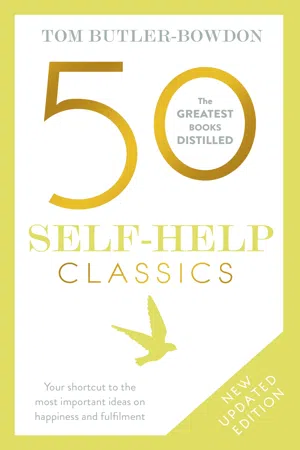
eBook - ePub
50 Self-Help Classics
50 Inspirational Books to Transform Your Life from Timeless Sages to Contemporary Gurus
- 320 pages
- English
- ePUB (mobile friendly)
- Available on iOS & Android
eBook - ePub
50 Self-Help Classics
50 Inspirational Books to Transform Your Life from Timeless Sages to Contemporary Gurus
About this book
Information
Topic
Desarrollo personalSubtopic
Superación personalAs a Man Thinketh
1902
“Of all the beautiful truths pertaining to the soul that have been restored and brought to light in this age, none is more gladdening or fruitful of divine promise and confidence than this—that you are the master of your thought, the molder of your character, and the maker and shaper of your condition, environment and destiny.”
“Good thoughts and actions can never produce bad results; bad thoughts and actions can never produce good results … We understand this law in the natural world, and work with it; but few understand it in the mental and moral world—although its operation there is just as simple and undeviating—and they, therefore, do not cooperate with it.”
“Law, not confusion, is the dominating principle in the universe; justice, not injustice, is the soul and substance of life; and righteousness, not corruption, is the molding and moving force in the spiritual government of the world. This being so, we have to but right ourselves to find that the universe is right.”
In a nutshell
We don’t attract what we want, but what we are. Only by changing your thoughts will you change your life.
In a similar vein
Joseph Murphy, The Power of Your Subconscious Mind (p248)
Florence Scovell Shinn, The Game of Life and How to Play It (p272)
CHAPTER 1
James Allen
With its theme that “mind is the master weaver,” creating our inner character and outer circumstances, As a Man Thinketh is an in-depth exploration of the central idea of self-help writing. James Allen’s contribution was to take an assumption we all share—that because we are not robots we therefore control our thoughts—and reveal its fallacy. Because most of us believe that mind is separate from matter, we think that thoughts can be hidden and made powerless; this allows us to think one way and act another. However, Allen believed that the unconscious mind generates as much action as the conscious mind, and while we may be able to sustain the illusion of control through the conscious mind alone, in reality we are continually faced with a question: “Why cannot I make myself do this or achieve that?”
In noting that desire and will are sabotaged by the presence of thoughts that do not accord with desire, Allen was led to the startling conclusion: “We do not attract what we want, but what we are.” Achievement happens because you as a person embody the external achievement; you don’t “get” success but become it. There is no gap between mind and matter.
We are the sum of our thoughts
The logic of the book is unassailable: Noble thoughts make a noble person, negative thoughts hammer out a miserable one. To a person mired in negativity, the world looks as if it is made of confusion and fear. On the other hand, Allen noted, when we curtail our negative and destructive thoughts, “All the world softens towards us, and is ready to help us.”
We attract not only what we love, but also what we fear. His explanation for why this happens is simple: Those thoughts that receive our attention, good or bad, go into the unconscious to become the fuel for later events in the real world. As Emerson commented, “A person is what he thinks about all day long.”
Our circumstances are us
Part of the fame of Allen’s book is its contention that “Circumstances do not make a person, they reveal him.” This seems an exceedingly heartless comment, a justification for neglect of those in need, and a rationalization of exploitation and abuse, of the superiority of those at the top of the pile and the inferiority of those at the bottom.
This, however, would be a knee-jerk reaction to a subtle argument. Each set of circumstances, however bad, offers a unique opportunity for growth. If circumstances always determined the life and prospects of people, then humanity would never have progressed. In fact, circumstances seem to be designed to bring out the best in us, and if we make the decision that we have been “wronged” then we are unlikely to begin a conscious effort to escape from our situation. Nevertheless, as any biographer knows, a person’s early life and its conditions are often the greatest gift to an individual.
The sobering aspect of Allen’s book is that we have no one else to blame for our present condition except ourselves. The upside is the possibilities contained in knowing that everything is up to us; where before we were experts in the array and fearsomeness of limitations, now we become connoisseurs of what is possible.
Change your world by changing your mind
While Allen did not deny that poverty can happen to a person or a people, what he tried to make clear is that defensive actions such as blaming the perpetrator will only run the wheels further into the rut. What measures us, what reveals us, is how we use those circumstances as an aid or spur to progress. A successful person or community, in short, is one who is most efficient at processing failure.
Allen observed, “Most of us are anxious to improve our circumstances, but are unwilling to improve ourselves—and we therefore remain bound.” Prosperity and happiness cannot happen when the old self is still stuck in its old ways. People are nearly always the unconscious cause of their own lack of prosperity.
Tranquillity = success
The influence of Buddhism on Allen’s thought is obvious in his emphasis on “right thinking,” but it is also apparent in his suggestion that the best path to success is calmness of mind. People who are calm, relaxed, and purposeful appear as if that is their natural state, but nearly always it is the fruit of self-control.
These people have advanced knowledge of how thought works, coming from years of literally “thinking about thought.” According to Allen, they have a magnet-like attraction because they are not swept up by every little wind of happenstance. We turn to them because they are masters of themselves. “Tempest-tossed” souls battle to gain success, but success avoids the unstable.
Final comments
Some 100 years after its first publication, As a Man Thinketh continues to get rave reviews from readers. The plain prose and absence of hype are appealing within a genre that contains sensational claims and personalities, and the fact that we know so little about the author makes the work somehow more intriguing.
To bring its message to a wider audience, two updated versions of the work that correct the gender specificity of the original have been published: As You Think, edited by Marc Allen (no relation), and As a Woman Thinketh, edited by Dorothy Hulst.
James Allen
Allen was born in Leicester, England, in 1864. At 15 he was forced to leave school and go out to work; his father, who had left for the United States following the failure of the family business, had been robbed and murdered. Allen was employed with several British manufacturing firms until 1902, when he began to write full time. Moving to Ilfracombe on the south-west coast of England, he settled down to a quiet life of reading, writing, gardening, and meditation.
As a Man Thinketh was the second of 19 books that Allen wrote in a decade. Although considered his best work, it was only published at his wife’s urging. Other books include From Poverty to Power, Byways of Blessedness, The Life Triumphant and Eight Pillars of Prosperity. Allen died in 1912.
Meditations
2nd century
“Begin each day by telling yourself: Today I shall be meeting with interference, ingratitude, insolence, disloyalty, ill-will and selfishness—all of them due to the offenders’ ignorance of what is good or evil. But for my part I have long perceived the nature of good and its nobility, the nature of evil and its meanness, and also the nature of the culprit himself, who is my brother (not in the physical sense, but as a fellow-creature similarly endowed with reason and a share of the divine); therefore none of those things can injure me, for nobody can implicate me in what is degrading.”
“Love nothing but that which comes to you woven in the pattern of your destiny. For what could more aptly fit your needs?”
“Everything—a horse, a vine—is created for some duty. This is nothing to wonder at: even the sun-god himself will tell you, ‘This is a work I am here to do,’ and so will all the other sky-dwellers. For what task, then, were you yourself created? For pleasure? Can such a thought be tolerated?”
In a nutshell
Don’t get caught up in trivia or pettiness; appreciate your life within a larger context.
In a similar vein
Boethius, The Consolation of Philosophy (p34)
Richard Carlson, Don’t Sweat the Small Stuff (p78)
CHAPTER 2
Marcus Aurelius
Marcus Aurelius Antoninus was emperor of Rome from 161AD until his death 19 years later. By the time he came to power, Rome was under threat: constant warring with “barbarians” on the frontier, disease brought back by soldiers, pestilence, and even earthquakes. Try to imagine the President of the United States being so philosophical in the midst of such crises. Yet despite the circumstances, after his death Marcus Aurelius would come to be idealized by the Romans as the perfect emperor, a genuine philosopher-king who provided the last real nobility of rule before the savagery of his son Commodus’ reign and the anarchy of the third century.
A student of Stoic philosophy, Marcus Aurelius refused to be made miserable by the difficulties of life. Stoicism was a Greek school of thought originating around 300BC. In simple terms, it taught that submission to the law of the universe was how human beings should live, and emphasized duty, avoidance of pleasure, reason, and fearlessness of death. Stoics would also have full responsibility for their actions, independence of mind, and pursue the greater good over their own. The emperor would have been comfortable with today’s United Nations and other world bodies that stand for cooperative effort: Stoics had an international outlook and believed in universal brotherhood.
As well as the world, the thoughts of the Stoics spanned time, as this excerpt from the Meditations demonstrates:
“All things fade into the storied past, and in a little while are shrouded in oblivion. Even to men whose lives were a blaze of glory this comes to pass; as to the rest, the breath is hardly out of them before, in Homer’s words, they are ‘lost to sight alike and hearsay’. What, after all, is immortal fame? An empty, hollow thing. To what, then, must we aspire? This, and this alone: the just thought, the unselfish act, the tongue that utters no falsehood, the temper that greets each passing event as something predestined, expected, and emanating from the One source and origin.”
This was written over 19 centuries ago, yet it is somehow even more relevant when we know how ancient it is. Marcus Aurelius’ life itself bears the statement out; not many now will have cause to remember his skill or otherwise as a leader, but his Meditations, quiet thoughts written by firelight in the midst of campaigns, live on in hearts and minds.
The Meditations are alive with perceptiveness about the basic unity of all things in the universe, including its people. They tell us that the effort to see through another’s eyes is nothing less than an expansion of one’s world—and a unifying of it. To despise, avoid, or judge a person is simply an obstruction of Nature’s law. The realization that to move human relations to a higher level we must do the opposite of these things formed the basis of the emperor’s thought.
On every page of the Meditations is this theme of accepting things and people how they are, not how we would like them to be. There is sadness in this view, as the following brief comment suggests: “You may break your heart, but men still go ...
Table of contents
- Cover
- Title Page
- Copyright
- Contents
- Preface
- Acknowledgments
- Introduction
- 1 James Allen – As a Man Thinketh (1902)
- 2 Marcus Aurelius – Meditations (2nd century)
- 3 The Bhagavad-Gita
- 4 The Bible
- 5 Robert Bly – Iron John (1990)
- 6 Boethius – The Consolation of Philosophy (6th century)
- 7 Alain de Botton – How Proust Can Change Your Life (1997)
- 8 William Bridges – Transitions: Making Sense of Life’s Changes (1980)
- 9 David Brooks – The Road to Character (2015)
- 10 Brené Brown – Daring Greatly (2012)
- 11 David D. Burns – Feeling Good: The New Mood Therapy (1980)
- 12 Joseph Campbell with Bill Moyers – The Power of Myth (1987)
- 13 Richard Carlson – Don’t Sweat the Small Stuff … and It’s All Small Stuff (1997)
- 14 Dale Carnegie – How to Win Friends and Influence People (1936)
- 15 Deepak Chopra – The Seven Spiritual Laws of Success (1994)
- 16 Clayton Christensen – How Will You Measure Your Life? (2012)
- 17 Paulo Coelho – The Alchemist (1993)
- 18 Stephen Covey – The 7 Habits of Highly Effective People (1989)
- 19 Mihaly Csikszentmihalyi – Flow: The Psychology of Optimal Experience (1990)
- 20 The Dalai Lama & Howard C. Cutler – The Art of Happiness: A Handbook for Living (1998)
- 21 The Dhammapada (Buddha’s teachings)
- 22 Charles Duhigg – The Power of Habit (2011)
- 23 Wayne Dyer – Real Magic: Creating Miracles in Everyday Life (1992)
- 24 Ralph Waldo Emerson – Self-Reliance (1841)
- 25 Clarissa Pinkola Estés – Women Who Run with the Wolves (1992)
- 26 Viktor Frankl – Man’s Search for Meaning (1959)
- 27 Benjamin Franklin – Autobiography (1790)
- 28 Shakti Gawain – Creative Visualization (1978)
- 29 Daniel Goleman – Emotional Intelligence: Why It Can Matter More than IQ (1995)
- 30 John Gray – Men Are from Mars, Women Are from Venus (1992)
- 31 Louise Hay – You Can Heal Your Life (1984)
- 32 James Hillman – The Soul’s Code: In Search of Character and Calling (1996)
- 33 Susan Jeffers – Feel the Fear and Do It Anyway (1987)
- 34 Richard Koch – The 80/20 Principle: The Secret of Achieving More with Less (1998)
- 35 Marie Kondo – The Life-Changing Magic of Tidying Up (2014)
- 36 Ellen J. Langer – Mindfulness: Choice and Control in Everyday Life (1989)
- 37 Lao Tzu – Tao Te Ching (5th–3rd century BC)
- 38 Maxwell Maltz – Psycho-Cybernetics (1960)
- 39 Abraham Maslow – Motivation and Personality (1954)
- 40 Thomas Moore – Care of the Soul: A Guide for Cultivating Depth and Sacredness in Everyday Life (1992)
- 41 Joseph Murphy – The Power of Your Subconscious Mind (1963)
- 42 Norman Vincent Peale – The Power of Positive Thinking (1952)
- 43 M. Scott Peck – The Road Less Traveled (1978)
- 44 Anthony Robbins – Awaken the Giant Within (1991)
- 45 Florence Scovell Shinn – The Game of Life and How to Play It (1925)
- 46 Martin Seligman – Learned Optimism (1991)
- 47 Samuel Smiles – Self-Help (1859)
- 48 Pierre Teilhard de Chardin – The Phenomenon of Man (1955)
- 49 Henry David Thoreau – Walden (1854)
- 50 Marianne Williamson – A Return to Love (1994)
- 50 More Classics
- Chronological List of Titles
- Credits
- About the Author
Trusted by 375,005 students
Access to over 1.5 million titles for a fair monthly price.
Study more efficiently using our study tools.
Frequently asked questions
Yes, you can cancel anytime from the Subscription tab in your account settings on the Perlego website. Your subscription will stay active until the end of your current billing period. Learn how to cancel your subscription
No, books cannot be downloaded as external files, such as PDFs, for use outside of Perlego. However, you can download books within the Perlego app for offline reading on mobile or tablet. Learn how to download books offline
Perlego offers two plans: Essential and Complete
- Essential is ideal for learners and professionals who enjoy exploring a wide range of subjects. Access the Essential Library with 800,000+ trusted titles and best-sellers across business, personal growth, and the humanities. Includes unlimited reading time and Standard Read Aloud voice.
- Complete: Perfect for advanced learners and researchers needing full, unrestricted access. Unlock 1.5M+ books across hundreds of subjects, including academic and specialized titles. The Complete Plan also includes advanced features like Premium Read Aloud and Research Assistant.
We are an online textbook subscription service, where you can get access to an entire online library for less than the price of a single book per month. With over 1.5 million books across 990+ topics, we’ve got you covered! Learn about our mission
Look out for the read-aloud symbol on your next book to see if you can listen to it. The read-aloud tool reads text aloud for you, highlighting the text as it is being read. You can pause it, speed it up and slow it down. Learn more about Read Aloud
Yes! You can use the Perlego app on both iOS and Android devices to read anytime, anywhere — even offline. Perfect for commutes or when you’re on the go.
Please note we cannot support devices running on iOS 13 and Android 7 or earlier. Learn more about using the app
Please note we cannot support devices running on iOS 13 and Android 7 or earlier. Learn more about using the app
Yes, you can access 50 Self-Help Classics by Tom Butler Bowdon in PDF and/or ePUB format, as well as other popular books in Desarrollo personal & Superación personal. We have over 1.5 million books available in our catalogue for you to explore.