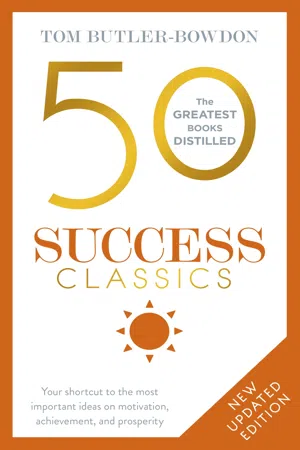
Millions of us are drawn each year to find the one great book that will capture our imagination and inspire us to chart a course to personal and professional fulfillment. 50 Success Classics is the first and only 'bite-sized' guide to the books that have helped legions of readers unleash their potential and discover the secrets of success. Mapping the road to prosperity, motivation, leadership and life success, 50 Success Classics summarizes each work's key ideas to make clear how these timeless insights and techniques can inform, inspire and illuminate a path to authentic achievement. Following his recent bestseller 50 Self-Help Classics, Tom Butler-Bowden presents this wide-ranging selection of enduring works in the literary and the legendary: pioneering thinkers, philosophers and powerful leaders who have shown us how to Think and Grow Rich, acquire The 7 Habits of Highly Effective People, become The One-Minute Manager, solve the challenging puzzle of Who Moved My Cheese? and discover The Art of Wordly Wisdom. From the inspirational rags-to-riches stories of such entrepreneurs as Andrew Carnegie, Warren Buffet and Sam Walton to the leadership lessons of Sir Ernest Shackleton, Eleanor Roosevelt, Abraham Lincoln and Nelson Mandela, 50 Success Classics goes back to the basics to find the classic books on staying true to ourselves and fulfilling our potential. Practical yet philosophical, sensible yet stimulating, the 50 all-time classics span biography and business, psychology and ancient philosophy, exploring the rich and fertile ground of books that have helped millions of people achieve success in their work and personal lives.
eBook - ePub
50 Success Classics
Winning Wisdom For Work & Life From 50 Landmark Books
- 352 pages
- English
- ePUB (mobile friendly)
- Available on iOS & Android
eBook - ePub
About this book
Information
Topic
Personal DevelopmentSubtopic
Personal Success1867
Ragged Dick
“But Dick was too sensible not to know that there was something more than money needed to win a respectable position in the world. He felt that he was very ignorant. Of reading and writing he knew only the rudiments, and that, with a slight acquaintance with arithmetic, was all he did know of books. Dick knew he must study hard, and he dreaded it. He looked upon learning as attended with greater difficulties than it really possesses. But Dick had good pluck. He meant to learn, nevertheless, and resolved to buy a book with his first spare earnings.”
“‘I hope, my lad,’ Mr Whitney said, ‘you will prosper and rise in the world. You know in this free country poverty is no bar to a man’s advancement.’”
In a nutshell
Whatever you do, you will be more successful if you do it with honesty, fairness, and to the best of your ability.
In a similar vein
Andrew Carnegie The Autobiography of Andrew Carnegie (p. 56)
Russell H. Conwell Acres of Diamonds (p. 80)
Benjamin Franklin The Way to Wealth (p. 104)
Orison Swett Marden Pushing to the Front (p. 242)
Samuel Smiles Self-Help (50SHC)
CHAPTER 1
Horatio Alger
The New York City of the mid-nineteenth century was an awful place for many of its inhabitants. Areas such as Five Points (the setting for the movie Gangs of New York) were dangerous and filthy, filled with abandoned or neglected children. Many slept outside at night, and most wore badly fitting, ragged clothes. During the day they hawked matches, sold newspapers, shined shoes, or picked pockets in order to get money to eat. The authorities did little to alleviate the situation, and in one celebrated incident a street urchin found naked was represented in a court case by the Society for the Prevention of Cruelty to Animals.
Horatio Alger, the chronicler of this world to a public who may have preferred not to know that it existed, was not himself a New Yorker, having been brought up in middle-class comfort in Massachusetts with a private school education followed by Harvard (see Rychard Fink’s introduction to the 1962 edition).
Though he had had some writing published, Ragged Dick, or Street Life in New York with the Boot-Blacks was his first bestseller, setting the template for scores of poor-boy-makes-good novels that had a massive influence on young Americans (Groucho Marx and Ernest Hemingway were among those said to have devoured Alger’s work). Here we will look at the outline of the story and Alger’s significant place in the success literature.
The story
At a time when Central Park was still “a rough tract of land” lined with workers’ huts, there was a bootblack known as Ragged Dick. With his mother dead and his father gone to sea, Dick spends his days shining boots for businessmen, his evenings (if he has some spare coins) watching cheap plays at the Old Bowery theater, and his nights in doorways wrapped up in newspapers. If he’s flush he will stay at the Newsboys Lodging House for six cents a night and buy a meal at a café.
After an unexpected windfall, Dick rents a squalid room that to him seems impossibly luxurious. In return for tutelage, he lets another boy, the once well-cared-for and well-read Henry Fosdick, share his room. This two-person self-improvement society is perfect for both. Dick gets an “edoocation” and Fosdick a place out of the cold. Though they must live through a series of adventures, the boys find a way to succeed.
The tale is a page-turner, and the reader delights in Dick’s joy at such simple things as a new suit of clothes, opening a bank account, and eating a piece of steak. As Alger makes clear, Dick, who by the end of the short book has become Dick Hunter Esq., is very likeable. He has pluck and wit to balance his earnest strivings to be “spectable” and, despite first-hand experience of the best rogues and swindlers the city has to offer, is a perennial optimist.
Following are some of Horatio Alger’s lessons of success as learned by the young Dick.
Make your own luck
Dick’s big break comes on a ferry crossing into Brooklyn. He sees a child fall over the side into the water and wastes no time before jumping in, somehow managing to pull the child to safety. The panicked father, who could not swim, is amazed to have his child alive and promises Dick any reward. Later, the man offers Dick a job in a counting house at $10 a week, many times his current earnings. A great stroke of luck? Not really, for Dick’s selflessness was the cause of this good fortune, and his diligence in self-education every night meant that he could be hired without the slightest whiff of charity.
Luck happens to those who greatly increase the chances of its occurrence.
Whatever you do, do it to your utmost
Life seems to require that, even if we don’t like what we are doing, we must do it to the best of our ability before we can move on to the next thing. Ragged Dick is only a bootblack, but he uses his “profession” to save money, meet a higher class of people, and generally better himself.
Become a reader
Dick meets the son of a wealthy man and shows him around the city for a day. Later, the boy’s father tells Dick that “in this country poverty is no bar to achievement” and relates his own rise from apprentice printer to successful businessman. He notes that there was one thing he took away from the printing office “which I value more than money.” When Dick asks what this was, the man replies:
“A taste for reading and study. During my leisure hours I improved myself by study, and acquired a large part of the knowledge which I now possess. Indeed, it was one of my books that first put me on the track of the invention, which I afterwards made. So you see, my lad, that my studious habits paid me in money, as well as in another way.”
Be a saver, but be generous
When Dick receives an unexpected sum of $5, he opens a bank account. The amount that builds gives him a great source of security and pride, as he no longer has to live hand-to-mouth. While delighted that he is now a “capitalist,” he is quick to help a friend in need. Fosdick, the boy with whom he shares his lodgings, wants to get an office job instead of shining shoes, so Dick purchases a suit of proper clothes for him. On another occasion he helps out a buddy whose mother is ill.
Never cheat, steal, or lie
Though temptations to do otherwise are often great, Dick has a personal code that “stealin’ is mean.” His sense of honor and fair play, which appears naive to “sophisticated” types, finally proves to be the source of his success. For someone who lives from day to day, his belief in “doing right” is remarkably farsighted. The character Mr. Whitney tells Dick: “Remember that your future position depends mainly upon yourself, and that it will be high or low as you choose to make it.”
Honesty, which seems “old-fashioned” to the fast crowd, is the basis of all enduring success, since it brings with it knowledge of the self.
Don’t drink or smoke
Long before medical evidence of its harm was available, Alger was calling smoking a “filthy habit” that gave no dignity to the smoker. Drinking, of course, was even worse. It was the enemy of frugality because you could blow your week’s savings in a night on the grog, and the enemy of industry because the inevitable hangovers affected your working day.
The temperance movement seems archaic today, but scores of lives would be better without even a moderate intake of alcohol. To Alger it sapped drive, pickled the independent mind, and eroded good character.
Final comments
Despite being rattling good yarns that really can inspire, the common view of Horatio Alger’s books is that they are quaint historical pieces with a simplistic message about striving and getting ahead. Yet success can be simple if you have the basic elements of personal character and aspiration, with some luck thrown in.
As Rychard Fink has noted, when Ragged Dick was written Herbert Spencer’s writings on “the survival of the fittest” had some influence in America. Yet Alger’s idea of success included a strong element of social responsibility or stewardship. You might make money, but ultimately it should be put back into society, as Andrew Carnegie did by funding public libraries. With his willingness to give to those in need, Alger makes Dick an example of compassionate capitalism.
Many of the villains in his books are rich boys who never had to make any effort to improve their character. Alger’s main point is that we should strive for success not just to get a fortune, but to gain tenacity, discipline, frugality, and optimism—qualities that cannot be bought.
Horatio Alger
Born in 1832 in Revere, Massachusetts, at 14 Alger was sent to boarding school by his father, a strict Unitarian minister, followed by entry to Harvard University at 16. He enjoyed his time there, coming tenth in his class of 62 and becoming proficient in Greek, Latin, French, and Italian.
Forbidden to marry his college sweetheart, the heartbroken Alger defied his father by stating his intention to become a writer. He agreed to go to divinity school, but just before graduation escaped to Paris with some friends and enjoyed its liberal atmosphere. Back in America he was ordained and became a church minister in Massachusetts, but left for New York at the suggestion of William T. Adams, editor of Student and Schoolmate. The weekly installments of Ragged Dick in this children’s monthly were wildly popular, and a hardback version became a bestseller. Alger was the toast of New York and sat on various boards and committees for improving the lot of street children. He lived for a number of years at the Newsboys Lodging House and died in 1899.
Alger’s other books (over 100) include Strive and Succeed; Struggling Upward; Bound to Rise; and From Canal Boy to President, about the life of assassinated President James Garfield.
1989
On Becoming a Leader
“Leaders have no interest in proving themselves, but an abiding interest in expressing themselves.”
“What is true for leaders is, for better or worse, true for each of us. Only when we know what we’re made of and what we want to make of it can we begin our lives—and we must do it despite an unwitting conspiracy of people and events against us.”
In a nutshell
True leadership arises in the full expression of a person’s unique potential.
In a similar vein
Abraham Lincoln (by Donald T. Phillips) Lincoln on Leadership (p. 230)
Eleanor Roosevelt (by Robin Gerber) Leadership the Eleanor Roosevelt Way (p. 272)
Ernest Shackleton (by Margot Morrell & Stephanie Capparell) Shackleton’s Way (p. 290)
CHAPTER 2
Warren Bennis
Bennis was a major figure in the academic study of leadership, but also popularized the subject through bestsellers. In 1985 he co-authored Leaders, based on observation and interviews with 90 of America’s leaders, ranging from astronaut Neil Armstrong to McDonald’s founder Ray Kroc. The book’s conclusion was that leadership is more crucial than we know, yet can be learned by anyone.
While ...
Table of contents
- Cover
- Title Page
- Copyright
- Praise for 50 Success Classics
- Contents
- Preface
- Acknowledgments
- Introduction
- 1 Horatio Alger – Ragged Dick, or Street Life in New York with the Boot-Blacks (1867)
- 2 Warren Bennis – On Becoming a Leader (1989)
- 3 Frank Bettger – How I Raised Myself from Failure to Success in Selling (1947)
- 4 Kenneth Blanchard & Spencer Johnson – The One Minute Manager (1981)
- 5 Edward Bok – The Americanization of Edward Bok: The Autobiography of a Dutch Boy Fifty Years After (1921)
- 6 Claude M. Bristol – The Magic of Believing (1948)
- 7 Warren Buffett (by Roger Lowenstein) – Buffett: The Making of an American Capitalist (1995)
- 8 Andrew Carnegie – The Autobiography of Andrew Carnegie (1920)
- 9 Chin-Ning Chu – Thick Face, Black Heart: The Asian Path to Thriving, Winning and Succeeding (1992)
- 10 George S. Clason – The Richest Man in Babylon (1926)
- 11 Jim Collins – Good to Great: Why Some Companies Make the Leap … and Others Don’t (2001)
- 12 Russell H. Conwell – Acres of Diamonds (1921)
- 13 Stephen R. Covey – The 7 Habits of Highly Effective People (1989)
- 14 Angela Duckworth – Grit: The Power of Passion and Perserverance (2016)
- 15 Henry Ford – My Life and Work (1922)
- 16 Benjamin Franklin – The Way to Wealth (1758)
- 17 W. Timothy Gallwey – The Inner Game of Tennis (1974)
- 18 Bill Gates (by James Wallace & Jim Erickson) – Hard Drive: Bill Gates and the Making of the Microsoft Empire (1992)
- 19 John Paul Getty – How to Be Rich (1961)
- 20 Les Giblin – How to Have Confidence and Power in Dealing with People (1956)
- 21 Malcolm Gladwell – Outliers: The Story of Success (2008)
- 22 Baltasar Gracian – The Art of Worldly Wisdom (1647)
- 23 Adam Grant – Give and Take (2013)
- 24 Earl G. Graves – How to Succeed in Business without Being White: Straight Talk on Making It in America (1997)
- 25 Darren Hardy – The Compound Effect (2010)
- 26 Napoleon Hill – Think and Grow Rich (1937)
- 27 Muriel James & Dorothy Jongeward – Born to Win: Transactional Analysis with Gestalt Experiments (1971)
- 28 Steve Jobs (by Brent Schlender & Rick Tetzeli) – Becoming Steve Jobs (2015)
- 29 Spencer Johnson – Who Moved My Cheese? An Amazing Way to Deal with Change in Your Work and in Your Life (1998)
- 30 Gary Keller – The One Thing (2013)
- 31 Robert Kiyosaki – Rich Dad, Poor Dad: What the Rich Teach Their Kids about Money … that the Poor and Middle Class Do Not! (1997)
- 32 Ray Kroc – Grinding It Out (1977)
- 33 David S. Landes – The Wealth and Poverty of Nations: Why Some Are So Rich and Some So Poor (1998)
- 34 Abraham Lincoln (by Donald T. Phillips)– Lincoln on Leadership: Executive Strategies for Tough Times (1992)
- 35 Nelson Mandela – Long Walk to Freedom (1994)
- 36 Orison Swett Marden – Pushing to the Front, or Success under Difficulties (1894)
- 37 J. W. Marriott Jr. – The Spirit to Serve: Marriott’s Way (1997)
- 38 Catherine Ponder – The Dynamic Laws of Prosperity (1962)
- 39 Cheryl Richardson – Take Time for Your Life: A Seven-Step Program for Creating the Life You Want (1998)
- 40 Anthony Robbins – Unlimited Power: The New Science of Personal Achievement (1986)
- 41 Eleanor Roosevelt (by Robin Gerber) – Leadership the Eleanor Roosevelt Way: Timeless Strategies from the First Lady of Courage (2002)
- 42 David J. Schwartz – The Magic of Thinking Big (1959)
- 43 Florence Scovel Shinn – The Secret Door to Success (1940)
- 44 Ernest Shackleton (by Margot Morrell & Stephanie Capparell) – Shackleton’s Way: Leadership Lessons from the Great Antarctic Explorer (2001)
- 45 Thomas J. Stanley – The Millionaire Mind (2000)
- 46 Brian Tracy – Maximum Achievement: Strategies and Skills that Will Unlock Your Hidden Powers to Succeed (1993)
- 47 Sun Tzu – The Art of War (4th century BCE)
- 48 Sam Walton – Made in America: My Story (1992)
- 49 Wallace D. Wattles – The Science of Getting Rich (1910)
- 50 John Whitmore – Coaching for Performance (1992)
- Chronological List of Titles
- Credits
- About the Author
Trusted by 375,005 students
Access to over 1.5 million titles for a fair monthly price.
Study more efficiently using our study tools.
Frequently asked questions
Yes, you can cancel anytime from the Subscription tab in your account settings on the Perlego website. Your subscription will stay active until the end of your current billing period. Learn how to cancel your subscription
No, books cannot be downloaded as external files, such as PDFs, for use outside of Perlego. However, you can download books within the Perlego app for offline reading on mobile or tablet. Learn how to download books offline
Perlego offers two plans: Essential and Complete
- Essential is ideal for learners and professionals who enjoy exploring a wide range of subjects. Access the Essential Library with 800,000+ trusted titles and best-sellers across business, personal growth, and the humanities. Includes unlimited reading time and Standard Read Aloud voice.
- Complete: Perfect for advanced learners and researchers needing full, unrestricted access. Unlock 1.5M+ books across hundreds of subjects, including academic and specialized titles. The Complete Plan also includes advanced features like Premium Read Aloud and Research Assistant.
We are an online textbook subscription service, where you can get access to an entire online library for less than the price of a single book per month. With over 1.5 million books across 990+ topics, we’ve got you covered! Learn about our mission
Look out for the read-aloud symbol on your next book to see if you can listen to it. The read-aloud tool reads text aloud for you, highlighting the text as it is being read. You can pause it, speed it up and slow it down. Learn more about Read Aloud
Yes! You can use the Perlego app on both iOS and Android devices to read anytime, anywhere — even offline. Perfect for commutes or when you’re on the go.
Please note we cannot support devices running on iOS 13 and Android 7 or earlier. Learn more about using the app
Please note we cannot support devices running on iOS 13 and Android 7 or earlier. Learn more about using the app
Yes, you can access 50 Success Classics by Tom Butler Bowdon in PDF and/or ePUB format, as well as other popular books in Personal Development & Personal Success. We have over 1.5 million books available in our catalogue for you to explore.