Looking for the formula that makes training relevant and transferable — and achieves sustainable results? Look no further than Action Reflection Learning. It's simple yet essential principles can make an unforgettable impact on your practice and revolutionize the way adult learners learn. Built on a solid foundation of adult learning theory and action learning methodology, this cutting-edge volume delivers a next-generation, multidisciplinary approach that will take your teaching and facilitating interventions to a new level of excellence.
eBook - ePub
Action Reflection Learning
Solving Real Business Problems by Connecting Learning with Earning
- 272 pages
- English
- ePUB (mobile friendly)
- Available on iOS & Android
eBook - ePub
Action Reflection Learning
Solving Real Business Problems by Connecting Learning with Earning
About this book
Information
Topic
CommerceSubtopic
Gestion des ressources humainesPART ONE
Adult Learning and
Action Reflection
Learning (ARL)
We begin this section with a full immersion into an everyday scene, a vignette in which learning and its challenges are presented as they happen in real life. We will come back to this vignette later, analyzing and making more meaning out of it. Bear with us.
Next, we share with you different perspectives and reflections about adult learning. What is it, how does it take place, and what are the best and the most efficient ways for learning to happen? What works and what does not? You will find a brief introduction into the origins of ARL, its evolution, and the main differences between it and traditional training. Not too much, just enough to get you ready to see how ARL is used in action.
PROLOGUE
A Learning
Story
Let’s look at Jack, a businessman in a real-life learning situation.
A bird’s warbling had roused Jack from sleep. For some time, the bird had been part of a dream, but then somehow it became more insistent, and he woke up. “What bird is that?” he wondered, in a mixture of anger and curiosity. “And why is it singing at night!?” Slowly, he half-opened an eye and noticed it was light outside. He grumpily turned to his night table to glance at the alarm clock.
Oh, no! It was 7:30! Jack jumped out of bed. Why hadn’t the alarm rung? His sister Rose had given him this new clock for his birthday, and last night he decided to replace his old one with this elegant new one. “Too many buttons,” he had thought, as he struggled to set it. What had happened to the old, simple alarm clocks? Life is getting more and more challenging. Cell phones have more features than he can handle. In the past few years, the techno-geist had multiplied: computer programs, the digital camera, the DVD player, the new iPod, the LCD projector, even the wireless laptop require technical expertise. And now alarm clocks! Is this progress? He wondered when his golf clubs would become programmed and electronic. Wouldn’t that be nice? They could jump out of the bag by sensing the distance to the green and the terrain. “That reminds me,” he thought, “I have to stop at the pro shop. I heard from Jimmy about this new driver they’re offering. He says his game has improved so much—and, in fact, I’ve seen it! That’s worth a little investment,” he mused, justifying the expenditure to himself.
“No time for coffee,” he thought, dressing hastily. As he walked out, he picked up the newspaper and glanced at the headlines. No time for news either—he’d get his update from the radio while driving. As a VP of marketing in a real estate business, he had to stay on top of the news. Trends in the economy, regulations for investors, immigration changes, oil prices, international crises, environmental campaigns, consumer prices—everything had an impact on his business. He recalled the problems he’d had a few years ago when he indulged himself with two weeks in Polynesia. He had seen so many advertisements for this earthly paradise, and after doing some research on the Internet, he gave himself the gift of a vacation of “total disconnect.” Hadn’t that been a wonderful experience! Except that because he hadn’t read the news for more than fourteen days, he’d missed the announcement of a major competitor opening its offices in town. His whole marketing campaign for the quarter would have been a total loss if he had not hurriedly changed it.
Actually, there had been some minor damage: He’d had a tough conversation with his boss, who blamed him for being irresponsible. That discussion lingered for a long time in his mind. He had hated it, because it resonated with the blame his father always laid on him. Is that karma? Maybe there was some truth in it, a pattern. But were those “real” vacations a sign of irresponsibility? After all, he had noticed the problem before it was too late. Alicia had mentioned the news in a casual water-cooler conversation. Talk about just-in-time!
Alicia. That reminded him to confirm with her his participation in the negotiation workshop. Alicia was in charge of training, and she had invited him to a two-day course on negotiation. He had been evasive for some weeks, as he really wasn’t very interested. Negotiation? What was so special that he had to invest two full days in it? He normally didn’t have problems getting what he wanted, one way or another. He liked to study the problem and be creative in finding attractive solutions—and he was proud of his friendly attitude, which was, in his opinion, the key to good negotiations. “That’s something I got from Mom!” he realized with a smile. Unlike his sister Rose, who was constantly in conflict with everyone around her. “We are so different,” he mused. If only she could take the course for him!
Alicia was a good colleague. She was always forwarding him information about events in the city, many of which he really enjoyed. “That’s not part of her job, after all. She’s in training, and the events she keeps mentioning are about networking gatherings or other community-related meetings.” He felt obligated to attend this negotiation course, in return for all the attention Alicia had paid him. “This is when I would need negotiation skills,” he said to himself with a laugh. “So I don’t have to waste two full days sitting in that course! Well, let’s just do it, and who knows, maybe I can get something out of it anyway.”
CHAPTER 1
A Different Approach
to Adult Learning
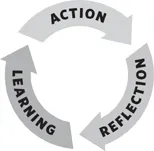
Adults mostly learn automatically through the experiences, realities, and needs of their daily lives. Action Reflection Learning (ARL) builds on this automatic learning and captures it through the reflective process, converting that tacit knowledge into conscious learning (see Figure 1). As we will see in the following chapters, ARL fits the pragmatic requirements of the business world, which demands learning that can be quickly applied and retained for later use.
FIGURE 1. The Action Reflection Learning (ARL) Cycle
According to Benjamin Bloom, learning can be categorized in three psychological domains:1

ARL integrates Bloom’s three domains into one methodology of learning.
Let’s return to our story of Jack, the adult learner. Glance at the story now and estimate the number of learning situations in which Jack has found himself. Now check your estimate against the actual number: seventeen. Surprised? You identified the negotiation course—that’s the traditional schooling method of learning. However, in this story, Jack is learning almost constantly in many other ways. He reports learning how to manipulate electronic devices. He experimented with the devices in his attempts to figure them out, using a trial-and-error method. He learns about golf—by listening to the advice of his friend and the pro shop and by imitating what he sees in the hope of improving his drive.
Jack also learns important information that affects his business, by reading newspapers and listening to the radio. He learns about vacation options from ads in the media and by active exploration on the Internet. He learns about how he is being perceived through conversations with his boss and his dad, and he increases his self-awareness through reflection and critical thinking. He extracts lessons from experience by looking back and reviewing events, establishing cause–effect connections that guide him in future situations, trying to avoid what didn’t work well. “Is it OK to disconnect during vacations?” he wonders. He learns peripherally by being with others and adopting behaviors, like the friendliness of his mom. He detects areas of ignorance by asking himself questions about birds; he learns about differences among individuals by reflecting on the puzzling behaviors of others, like his sister Rose. All this learning, without taking a course. Jack is learning continuously, most of the time without realizing he is learning.
Jack’s morning demonstrates the action foundation for ARL, where ARL reaches in to capture the learning that is happening.
THE TEACHER/CLASSROOM APPROACH
When most people think of learning, they think of something very different from what Jack experienced. What comes to mind is schooling in a formal classroom setting in which professors or experts teach an audience of students. Teachers present what they know in a more or less attractive way so that students can learn. Learning is frequently seen as a result of study—in other words, a result of paying focused attention to a specific topic in order to memorize it. This cognitive process of acquiring information includes listening, taking notes, asking questions, and reading. The information is stored, ready to be retrieved whenever we need to apply it.
The institutionalized schooling system, as Peter Vail notes, has been built on the assumption that there is good, valid objective knowledge and that expert individuals can share this knowledge and pass it on to the audience, who will in turn receive it, assimilate it, and use it at their convenience.2
In this paradigm, experts identify what needs to be “known,” then learning professionals define learning goals, the contents of the courses or training sessions that will lead to those goals, and the best methods for conveying those contents. Let’s say, for example, that experts identify the ability to coach as a key leadership skill. A learning goal could be that a person masters the art of coaching. The contents could be about communication, feedback, dynamics of change, or different types of questions. Methods could include lectures, role play, video recording, exercises, and so forth. When colleges and universities prepare syllabi for students or training professionals prepare programs for organizational audiences, they are establishing the goals, contents, and methods for the courses. Those professionals also decide how to evaluate the learning.
LEARNING OUTSIDE THE CLASSROOM
The teacher/classroom approach is not intrinsically bad. However, it is not the only approach to learning, and, depending on the individual or the circumstances, it may not be the best. Classroom learning tends to focus on the Cognitive Domain of learning without using the Affective or Psychomotor Domains.
Research on learning indicates that individuals have different learning styles and preferences.3 Those who prefer to learn facts and data are best suited for the traditional classroom setting. Those with pragmatic preferences, who want to know how they can use what is taught or why it is important, may have a more difficult time. Those who need to experience, to try out, to involve not only the mind but the feelings, the senses, the emotions, or the intuition also don’t fit easily into the traditional classroom learning approach.
Some experts who are exploring the learning experience from the learner’s perspective see classroom-style learning as ineffective, especially for business situations. They see students memorizing and repeating information, only to forget much of it shortly after the test. Graduation is an administrative step for an external purpose, such as getting the necessary credential for a job. Little attention may be given to how the information connects to the lives and realities of the students. This disconnect is what Jack, the protagonist in the story, anticipates from the negotiation course and why he is not enthusiastic about it.
John Dewey, one of the most influential educators and philosophers in American history, explored the process of adult learning and highlighted the importance of experience in guiding our present actions.4 Dewey believed that we make meaning by ...
Table of contents
- Cover Page
- Title Page
- Copyright Page
- Contents
- Figures and Tables
- Preface
- Acknowledgments
- About the Authors
- Part 1: Adult Learning and Action Reflection Learning (ARL)
- Part 2: The Learning in Action
- Part 3: The Learning Coach in Action
- Part 4: Reflecting on the Action
- Notes
- References
- Index
Trusted by 375,005 students
Access to over 1.5 million titles for a fair monthly price.
Study more efficiently using our study tools.
Frequently asked questions
Yes, you can cancel anytime from the Subscription tab in your account settings on the Perlego website. Your subscription will stay active until the end of your current billing period. Learn how to cancel your subscription
No, books cannot be downloaded as external files, such as PDFs, for use outside of Perlego. However, you can download books within the Perlego app for offline reading on mobile or tablet. Learn how to download books offline
Perlego offers two plans: Essential and Complete
- Essential is ideal for learners and professionals who enjoy exploring a wide range of subjects. Access the Essential Library with 800,000+ trusted titles and best-sellers across business, personal growth, and the humanities. Includes unlimited reading time and Standard Read Aloud voice.
- Complete: Perfect for advanced learners and researchers needing full, unrestricted access. Unlock 1.5M+ books across hundreds of subjects, including academic and specialized titles. The Complete Plan also includes advanced features like Premium Read Aloud and Research Assistant.
We are an online textbook subscription service, where you can get access to an entire online library for less than the price of a single book per month. With over 1.5 million books across 990+ topics, we’ve got you covered! Learn about our mission
Look out for the read-aloud symbol on your next book to see if you can listen to it. The read-aloud tool reads text aloud for you, highlighting the text as it is being read. You can pause it, speed it up and slow it down. Learn more about Read Aloud
Yes! You can use the Perlego app on both iOS and Android devices to read anytime, anywhere — even offline. Perfect for commutes or when you’re on the go.
Please note we cannot support devices running on iOS 13 and Android 7 or earlier. Learn more about using the app
Please note we cannot support devices running on iOS 13 and Android 7 or earlier. Learn more about using the app
Yes, you can access Action Reflection Learning by Isabel Rimanoczy,Joseph Turner in PDF and/or ePUB format, as well as other popular books in Commerce & Gestion des ressources humaines. We have over 1.5 million books available in our catalogue for you to explore.