If every person is unique, why do coaches use the same worn-out methods for everyone? Employees seeking performance improvement require a coaching approach tailored to meet their specific needs and preferences. In Adaptive Coaching, Second Edition, executive development experts Terry Bacon and Laurie Voss draw from over 2, 000 case studies of Fortune 500 employees to show how people prefer to be coached — and the powerful results coaches can achieve by being adaptable. This essential handbook offers the key tools and techniques that coaches require to identify clients' real needs, negotiate expectations, adapt to different working styles, and help clients change. Bacon and Voss also include numerous examples of coaching dialogues that illustrate how to initiate coaching sessions, build rapport, ask probing questions, give feedback, challenge clients, and effectively close coaching sessions. With four new chapters, Adaptive Coaching, Second Edition explores new coaching techniques for encouraging transformative change in your clients. It is the perfect companion to your creative, unique coaching sessions, teaching you to master the on-going and ever changing dialogue between coach and client.
eBook - ePub
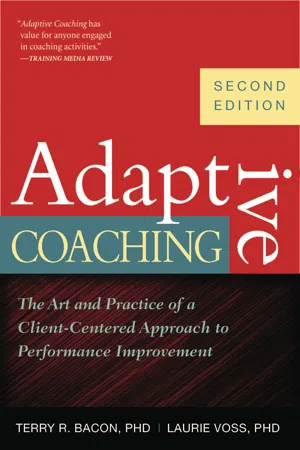
Adaptive Coaching
The Art and Practice of a Client-Centered Approach to Performance Improvement
- 368 pages
- English
- ePUB (mobile friendly)
- Available on iOS & Android
eBook - ePub
Adaptive Coaching
The Art and Practice of a Client-Centered Approach to Performance Improvement
About this book
Information
PART
1
ASSESSING CLIENTS’ NEEDS
The most effective coaches adapt their coaching style and approach to every client because every client is different. We became acutely aware of this fact in our research on coaching effectiveness. As we noted in the introduction, since 1996 we have surveyed thousands of coaches and tens of thousands of clients (the people receiving the coaching) in large and smaller corporations in a variety of industries and countries. From these surveys, we learned that different clients prefer to be coached in different ways. We also learned that coaches tend to coach the way they prefer to coach, rather than the way their clients prefer to be coached. The resulting misalignments in coaching preference mean that a large number of clients are frustrated with the coaching they are getting. In fact, nearly half of the clients we surveyed said that their coaching sessions with their current coaches had not had much positive impact on their work performance.
In the first part of this book, we discuss the foundations of adaptive coaching, namely, understanding the context in which coaching takes place, understanding clients’ expectations and negotiating a set of shared expectations, using the four primary sources of information to discover clients’ needs, triangulating among these sources to uncover the underlying issues that must be resolved for the client to make progress, and, finally, adapting to clients’ coaching style preferences.
The purpose of coaching is to help people change. If there is no change, then the coaching has not had any impact. However, coaching does not occur in a vacuum. To facilitate change, you must understand the context in which that change needs to occur, including people’s job situations, the organizations they work in, the urgency of their needs, their psychological readiness to change, their history with and expectations of coaching, and their view of and respect for the coach. Clients’ openness and willingness to change is shaped by this context. If you fail to understand it, you may use the wrong approach at the wrong time and focus on the wrong issues, which is a formula for failure.
To help clients change, you must not only consider the context in which they work; you must also uncover and address the root causes of their problems. But this raises an important issue: How is coaching different from therapy? In chapter 1, as we discuss the contexts of coaching, we also address this thorny question. In chapter 2, we describe an effective process for understanding clients’ expectations of coaching and then negotiating a set of shared expectations. To coach adaptively, you have to be transparent about how the coaching will occur, what you will focus on, how you will help clients, and so on. Surfacing their preferences and changing your approach accordingly is obviously a crucial part of being an adaptive coach. You have to start where your clients are and then continuously adapt to their needs or preferences.
Chapters 3 and 4 address the difficult challenge of discovering your clients’ real needs. In our coaching experience, we have found that the presenting problem, what clients say they need help with, is rarely the real one. To discover what clients really need, you have to explore all four points of what we call the needs compass: your own observations of clients, clients’ perceptions of themselves, others’ observations of clients, and clients’ work products and performance metrics. The client’s real needs emerge through a process of co-discovery in which all sources of information are explored within the context of the client’s life and work. Themes and patterns emerge as coaches triangulate from these different sources, and coaches use them to form and test hypotheses about the real issues.
Part 1 ends with a more detailed discussion of the taxonomy of coaching preferences introduced in chapter 1. In chapter 5, we describe the client comments and research findings that helped us distinguish between directive versus nondirective coaching, programmatic and circumstantial coaching, and specific and holistic coaching. This chapter includes suggestions for coaching clients who prefer each of the eight possible coaching styles.
1
The Contexts of Coaching
Take more time to explore the backgrounds of the people you coach and the situational constraints on their behavior.
Help the person being coached consider the culture and what will actually work in the organization rather than [taking] a pure view of what is best in a vacuum but may not fly in practice.
Find out the history of individual coachees (what they have done, what experiences they’ve had, what they’ve done well and not so well, what education they’ve had, and so on).
SUGGESTIONS TO COACHES FROM THE “COACHING EFFECTIVENESS SURVEY,” KORN/FERRY INTERNATIONAL
We have found, in our studies of coaching effectiveness, that the comments above are representative of how clients expect coaching to reflect the various personal and organizational contexts that define their work. It is, of course, impossible to coach anyone without knowing enough about the client to know which questions to ask, what avenues to follow, what suggestions make sense, and which options are appropriate and relevant for the client. Coaching without considering the context would be no more accurate or useful than following the astrological advice in the Sunday newspaper. This point seems self-evident, yet in the coaching world a debate has been raging for decades about the importance of context and the kind of background and personal information the coach should consider. On the opposite ends of this debate are well-known executive coaches like Marshall Goldsmith and psychiatrist Steven Berglas, an author who also acts as a management consultant and executive coach. It’s useful to view their opposing ideas as bookends in a debate that raises several important questions: What is coaching? How does the context of coaching influence its outcome? What are these contexts? How does coaching differ from therapy? And how important to the coaching process are a client’s past, a client’s feelings, influences on a client’s perceptions and behaviors, and motivations, past and present? The sharp differences between Goldsmith’s and Berglas’s views allow us to map out a reasonable middle ground for coaches who seek neither exclusion of the client’s perspective nor psychotherapeutic specialization.
THE COACH AS DIRECTOR
In a profile of Goldsmith in The New Yorker, we learn that Goldsmith “tells his clients that he doesn’t care about their past, doesn’t care how they feel, doesn’t care about their inner psyche—all he cares about is their future behavior. He provides them with a tightly structured program of things to do and a money-back guarantee that, if they do exactly what he tells them, they will get better” (MacFarquhar 2002, p. 120). Goldsmith’s metaphor of the outcome of coaching as “getting better” evokes a medical model of treatment in which the doctor diagnoses the illness and prescribes the proper treatment. This approach represents one bookend, emphasizing coaching as prescription and the coach as the director.
Other elements of Goldsmith’s approach are described as follows:
Goldsmith has turned against the notion of feedback in favor of a concept he calls “feedforward.” “How many of us have wasted much of our lives impressing our spouse, partner, or significant other with our near-photographic memory of their previous sins, which we document and share to help them improve?” he says. “Dysfunctional! Say, ‘I can’t change the past—all I can say is I’m sorry for what I did wrong.’ Ask for suggestions for the future. Don’t promise to do everything they suggest—leadership is not a popularity contest. But follow up on a regular basis, and you know what’s going to happen? You will get better.” (p. 115)
What is the ultimate aim of coaching? According to this profile, it is not about changing behavior:
Coaching, [Goldsmith] had recently realized, was not, ultimately, about changing his client’s behavior so much as changing perceptions of the client’s behavior. He had observed that his clients had to change a hundred percent to get ten percent credit, partly because people could be ungenerous, but mostly because they simply didn’t notice. And in leadership, as he liked to say, it doesn’t matter what you say—only what they hear. (p. 120)
Taken the wrong way, this could imply that real change is less important than impression management. Should clients really not worry about their own behavior and its consequences and effects on others but instead only about how they are perceived?
Finally, according to The New Yorker profile, Goldsmith’s approach to coaching is pragmatic and antipsychological: “Goldsmith… has no patience for the psychological approach. ‘My attitude is, it’s easier to get unf---ed up than it is to understand why you are f---ed up, so why don’t you just get un-f---ed up?’ he says” (p. 120). This approach suggests that clients don’t need insight; they just need direction (the right “tightly structured program of things to do”). And while it is certainly true that clients cannot change the past, it is equally true that they cannot escape it.
As portrayed in The New Yorker profile, Goldsmith represents one approach to coaching—the coach who disregards the client’s past, his psychological state, and apparently his perspective, as indicated in this quotation from the article: “There was one guy I coached who spent hours on ‘Marshall, you don’t understand, let me explain why I have these issues, let me explain my mother, my father.’ Whine, whine, whine. I tell clients, ‘Here’s a quarter—call someone who cares.’ They don’t need empathy. They need someone to look ’em in the eye and say, ‘If you want to change, do this’” (p. 120). In this view, change is as easy as receiving the right direction from a coach who can show clients the way. In the real world, argues Steven Berglas, things are more complex.
THE COACH AS PSYCHOTHERAPIST
In a Harvard Business Review essay, Berglas (2002) argues that “in an alarming number of situations, executive coaches who lack rigorous psychological training do more harm than good. By dint of their backgrounds and biases, they downplay or simply ignore deep-seated psychological problems they don’t understand. When an executive’s problems stem from undetected or ignored psychological difficulties, coaching can actually make a bad situation worse” (p. 87). Berglas exemplifies the opposite book-end from Goldsmith. He stresses a regimen of extensive psychological evaluation as a prelude to coaching and an in-depth coaching relationship that is in some ways difficult to distinguish from therapy. Berglas believes that today’s popularity of executive coaching reflects a desire for quick fixes. The problem, he argues, is that these quick fixes often don’t fix anything and may in fact do damage.
To achieve fast results, many popular executive coaches model their interventions after those used by sports coaches, employing techniques that reject out of hand any introspective process that can take time and cause “paralysis by analysis.” The idea that an executive coach can help employees improve performance quickly is a great selling point to CEOs, who put the bottom line first. Yet t...
Table of contents
- Cover Page
- Title Page
- Copyright Page
- Contents
- Acknowledgments
- About the Authors
- Introduction
- Part 1: Assessing Clients’ Needs
- Part 2: Practicing Adaptive Coaching
- Part 3: Driving Deep and Lasting Change
- Part 4: Becoming an Adaptive Coach
- References
- Resources for Adaptive Coaches
- Index
Trusted by 375,005 students
Access to over 1.5 million titles for a fair monthly price.
Study more efficiently using our study tools.
Frequently asked questions
Yes, you can cancel anytime from the Subscription tab in your account settings on the Perlego website. Your subscription will stay active until the end of your current billing period. Learn how to cancel your subscription
No, books cannot be downloaded as external files, such as PDFs, for use outside of Perlego. However, you can download books within the Perlego app for offline reading on mobile or tablet. Learn how to download books offline
We are an online textbook subscription service, where you can get access to an entire online library for less than the price of a single book per month. With over 1.5 million books across 990+ topics, we’ve got you covered! Learn about our mission
Look out for the read-aloud symbol on your next book to see if you can listen to it. The read-aloud tool reads text aloud for you, highlighting the text as it is being read. You can pause it, speed it up and slow it down. Learn more about Read Aloud
Yes! You can use the Perlego app on both iOS and Android devices to read anytime, anywhere — even offline. Perfect for commutes or when you’re on the go.
Please note we cannot support devices running on iOS 13 and Android 7 or earlier. Learn more about using the app
Please note we cannot support devices running on iOS 13 and Android 7 or earlier. Learn more about using the app
Yes, you can access Adaptive Coaching by Karen I. Spear,Terry R. Bacon in PDF and/or ePUB format, as well as other popular books in Business & Management. We have over 1.5 million books available in our catalogue for you to explore.