'A useful confidence-building tool for those whose key aim is to find their inner power' Edge Online Being more assertive just got easier
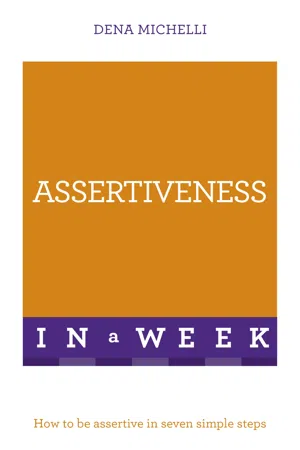
Much has been spoken about the assertive communication style, not all of it complimentary! Many people confuse it with being aggressive, bamboozling others into submission and getting what you want, despite what they want. However, assertive communication is not domineering; it's just a means of saying what you mean, meaning what you say and allowing others to do the same.Taking the decision to adopt assertive behaviour will mark the beginning of a new way of life: a way of life where you make your own decisions and choices without feeling guilty, and where you are in control, not those around you.By working through some simple steps, and by testing the techniques out in a 'safe' environment, you will soon become confident in your new-found powers of assertion. You will be able to command the respect of others, achieve your personal and professional goals and raise your self-esteem.The steps to assertive behaviour you will cover in this book are:
- Understand the different styles of communication and the effect they have.
- Identify your own style(s) of communication.
- Know your own worth and the worth of others.
- Be clear about your goals.
- Be prepared to learn from your successes and failures.
- Be flexible, and don't expect too much.
- Learn to listen.Each of the seven chapters in Assertiveness In A Week covers a different aspect of being assertive:
- Sunday: Preparing the foundations
- Monday: Creating winning scenarios
- Tuesday: Dealing with the 'negative'
- Wednesday: Creating a positive impression
- Thursday: Being assertive in public
- Friday: Body language
- Saturday: Personal power
- 128 pages
- English
- ePUB (mobile friendly)
- Available on iOS & Android
eBook - ePub
About this book
Information
Creating winning scenarios is the foundation stone for being assertive and being in charge of your own life. This does not mean that you always get your own way, but it does mean that you will be satisfied that you have represented yourself assertively and can live happily (or acceptingly!) with the outcome.
Today’s agenda is to bring you that little bit closer to being in control of your own life – asserting yourself in the way you choose. In order to achieve this, we will look at:
• ‘winning’ language
• positive affirmations
• creative visualization
• building self-esteem.

Those who are adept at turning on assertive behaviour are also quite able to observe their actions, talk themselves through their learning and test the effect of new behaviours. Self-knowledge is the key to taking control of our lives.
Observing, questioning and asking for feedback are vital if we are to succeed.
‘Winning’ language
‘Winning’ language is the language of assertive behaviour. It speaks more than mere words to those you communicate with and tells them that you are in control.
Those who recognize this quality in you will nonetheless be hard pressed to say exactly what it is that you are doing to give them this impression. Actually, it is a subtle combination of body language, mental attitude and verbal language.

It’s not what you say that counts; it’s the way that you say it.

The ‘winning’ qualities of an assertive communicator are:
• the use of ‘I’ statements
• direct, clear language
• an ability to demonstrate understanding and to empathize (‘active listening skills’)
• an ability to build rapport and maintain relationships
• good posture, voice and eye contact
• confidence in what they say – no self-effacing comments or profuse apologies!
Direct, clear language
Language can be a very inadequate and clumsy tool for communication. It can also be beautifully simple and, combined with reinforcing messages through the various physical channels of communication (body language), it can be extremely effective and evocative.
Here are some simple rules to help you practise assertive, ‘winning’, language:
• Set the scene by describing – very briefly – what you are referring to: ‘When you called a meeting last Friday, I…’
• Simplicity, clarity and brevity are key to assertive communication. Do not ramble; you will lose the attention of your audience. Make your point quickly.
• Take responsibility for what you are saying. This is done by using the first person. Here are two examples, one negative and one positive: ‘I am unhappy about the way this project is proceeding’; ‘I’m delighted with the outcome of this meeting.’
• Use repetition if you feel that your message isn’t getting across, but restructure your statement the second time.
• Use silence appropriately – it can say more than words. Don’t be afraid of it; try it out.
Active listening skills
Active listening ranks highly in the league table of communication skills. It enables you to empathize with your audience and build successful relationships. Stated simply, active listening is listening with curiosity; or listening as if you’ve never heard the other person speak before. When you do this, you will be able to meter your own communication more precisely because you will have homed in on what others are saying without making premature judgements, assumptions or jumping to conclusions.
Good listeners do several things. They…
• paraphrase – briefly summarize what has just been said
• ask ‘open’...
Table of contents
- Cover
- Title
- About the Author
- Contents
- Introduction
- Sunday: Preparing the foundations
- Monday: Creating winning scenarios
- Tuesday: Dealing with the ‘negative’
- Wednesday: Creating a positive impression
- Thursday: Being assertive in public
- Friday: Body language
- Saturday: Personal power
- 7 × 7
- Answers
- Copyright
Trusted by 375,005 students
Access to over 1.5 million titles for a fair monthly price.
Study more efficiently using our study tools.
Frequently asked questions
Yes, you can cancel anytime from the Subscription tab in your account settings on the Perlego website. Your subscription will stay active until the end of your current billing period. Learn how to cancel your subscription
No, books cannot be downloaded as external files, such as PDFs, for use outside of Perlego. However, you can download books within the Perlego app for offline reading on mobile or tablet. Learn how to download books offline
We are an online textbook subscription service, where you can get access to an entire online library for less than the price of a single book per month. With over 1.5 million books across 990+ topics, we’ve got you covered! Learn about our mission
Look out for the read-aloud symbol on your next book to see if you can listen to it. The read-aloud tool reads text aloud for you, highlighting the text as it is being read. You can pause it, speed it up and slow it down. Learn more about Read Aloud
Yes! You can use the Perlego app on both iOS and Android devices to read anytime, anywhere — even offline. Perfect for commutes or when you’re on the go.
Please note we cannot support devices running on iOS 13 and Android 7 or earlier. Learn more about using the app
Please note we cannot support devices running on iOS 13 and Android 7 or earlier. Learn more about using the app
Yes, you can access Assertiveness In A Week by Dena Michelli in PDF and/or ePUB format, as well as other popular books in Business & Business Skills. We have over 1.5 million books available in our catalogue for you to explore.