Logan Murray has successfully taught the techniques of stand-up comedy to thousands, and in this book he distills his years of experience into the essential skills for a great and enjoyable performance. He will help you find your own creative streak and your funny side, build the confidence to deliver, and explain the finer details of stagecraft, from dealing with hecklers to coping with props. There is a full guide to the practicalities, from finding gigs to securing an agent, with plenty of valuable hints, tips and advice. Drawing on Logan's years of teaching and his own successful stand-up career, with top tips from some of the most well-known people in the business, it is guaranteed to bring a smile to both your face and that of your future audience.
NOT GOT MUCH TIME?One, five and ten-minute introductions to key principles to get you started.
AUTHOR INSIGHTSLots of instant help with common problems and quick tips for success, based on the author's many years of experience.
TEST YOURSELFTests in the book and online to keep track of your progress.
EXTEND YOUR KNOWLEDGEExtra online articles at www.teachyourself.com to give you a richer understanding of stand-up comedy.
FIVE THINGS TO REMEMBERQuick refreshers to help you remember the key facts.
TRY THISInnovative exercises illustrate what you've learnt and how to use it.
eBook - ePub
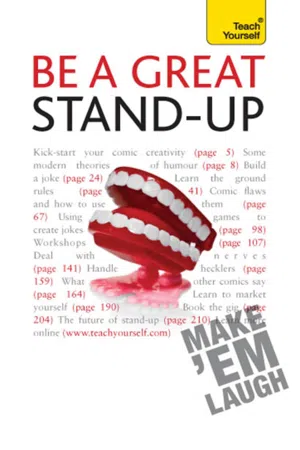
Be a Great Stand-up
How to master the art of stand up comedy and making people laugh
- 289 pages
- English
- ePUB (mobile friendly)
- Available on iOS & Android
eBook - ePub
About this book
Information
Subtopic
Creative WritingTheory
1
Where do jokes come from?
In this chapter you will learn:
- the mechanisms that lie underneath a joke
- how to kick-start your own comic creativity
- why your personal opinions matter most when you are writing jokes.
I rather like those books where each chapter begins with a quotation.
Ramsey Dukes
What is laughter? It seems to be a very pleasurable activity that we all share, yet find very hard to analyse. It is a phenomenon not completely under our control: laughter can strike when we least desire it (giggling in church); it is hard to fake a laugh (ask an actor), but it is possible – sometimes – to suppress it. Every attempt to describe this state falls short of the truth. Calling it a ‘semi-involuntary reflex triggered by diverse stimuli’, as many behavioural psychologists have, seems to be missing the point and will probably not get us invited to too many parties.
It’s a mystery. Trying to explain laughter is a bit like trying to describe time: we all experience it, but it is very hard to put into words. Perhaps it has something to do with a loss of control in safe conditions. Think of the expressions we use to describe the phenomenon: ‘I was on the floor’; ‘I nearly wet myself’; ‘I was crying with laughter’; ‘I fell out of my seat’. They all suggest a sanctioned loss of control.
Laughter acts like a balm to the body and the spirit. We feel all bright-eyed and bushy-tailed after a good laugh; our body pumps out endorphins and we feel more human. But we are really none the wiser in understanding the strange alchemy that goes on in our brain when someone makes us laugh. Luckily, no one expects comedians to know why we laugh; the public is only concerned whether we know how to make people laugh.
Perhaps we are on safer ground if we ask where the roots of comedy lie. But to address this, we need to broaden our remit and ask ourselves what fuels the act of creation.
Do we create funny ideas or do they come and find us?
Obviously, comedians are responsible for everything that comes out of their mouths – they are the creators. But are they the conscious creators? It seems to me that most of the jokes that I make already exist ‘out there’ in some strange realm of ideas, and that I travel towards them. Sometimes there is an awful lot of hard work involved in getting to that place, but that final leap of faith – that inspiration – seems to arrive from outside myself. Creativity comes from beyond our everyday conscious selves. Indeed, our everyday selves can often get in the way of being creative.
We are trained from an early age never to trust the first draft of anything. Instead of learning the ‘fun’ of language, we are taught to conjugate verbs and parse sentences. When painting we are expected to redraft the piece two or three times to make it technically better; we learn not to write how we speak, but to adopt a strange artificial ‘grown-up’ way of writing, full of bombastic phrases which no real adults use outside of a news report or a House of Commons debate. It all becomes a bit dry and dusty.
We are encouraged to learn by rote and disengage our creativity. If we are asked to be creative, we are encouraged to think that the process is hard, and to forget how much fun it was to play with ideas when we were younger.
The pity of it is that creativity and craft don’t have to be divorced from each other.
Most of us need to reconnect with our sense of play. We have to kill that little demon living on our shoulder telling us that what we’re doing isn’t good enough.
Practical creative games
Here are a few games that may help you start to rediscover your sense of playfulness. You’ll need at least one other person for some of them – certainly for the last one. The reasoning behind this is that the presence of another person will make you both try harder; also it gives you someone to react to. In all of these games, try to let yourself off the hook (they are supposed to be fun, after all) and don’t take charge! If you make your partner the boss and they make you the boss, then you won’t let your conscious self try to take control and mess it up.
Having said that, most of these group games could be tweaked into a solitary exercise, with a bit of thought, and it’s worth reading through them anyway as they may give you helpful ideas.
TV commentary
(This could be done alone or with other people.)
Turn down the television and supply the voices for the show. My personal favourites are old films and daytime makeover shows. Some people prefer soap opera or even adverts. Let your commentaries be opinionated.
Problem pages
(This could be done as a solitary exercise.)
Read aloud to your partner(s) the letters on a problem page. Try to add the occasional sentence or word that might exaggerate or alter the problem, perhaps taking it into a completely different area. Read out the answer and feel free to alter that too. Practise being flippant and learn to say the wrong thing at the wrong time. Be callous.
Letters written into local newspapers are also quite good sources for subversion.
Also, feel free to remember tried and tested group activities like charades. Anything that gets you out of your head and up on to your feet, showing how creative you actually are, is probably a good thing.
Timeless classics
(A solo writing game.)
Write the first paragraph of a famous book that you haven’t read and have only the barest passing knowledge of. But write it as if the author was obsessed with something incredibly minor, like teeth or shoes or door handles. How will that affect the text? For instance, what would War and Peace be like if Tolstoy had been scared of heights?
A liar’s biography
(A solo writing game.)
Write a biography about your glorious life and brilliant career as if you have a very weak grip on reality. For example, you may be delusional or borderline psychotic, self-serving or just a very bitter person. Be as detailed or as broad as you like.
One-word story
Two or more of you tell a story out loud, but you are each only allowed to give one word of the sentence. So if there were three people involved (A, B and C), it might look a little like this:
A: | I |
B: | woke |
C: | up |
A: | today |
B: | to |
C: | find |
A: | a |
B: | frog |
C: | on |
A: | my |
B: | pillow |
Make sure the story makes sense and that there are no jarring bits, such as one of you starting a new sentence before the old one is finished. Turn your brain off, listen to the other person (or people) and have fun. Eventually, try to get up to conversational speed, but start off slowly.
The seven ages of you
Choose a subtext and then write out your entire life in seven stages.
For example, as if you were fuelled by drinking habits:
Cheap beer
Wine
Expensive wine
Any wine
Gin
Rubbing alcohol
Embalming fluid.
Or if it was about the property ladder:
Living with Mum and Dad
Flat share with people you hate
Home share with partner you love
Divorce and living in a caravan
Inheriting the family home
Selling the family home for something more manageable
A wooden box.
If you prefer, try writing about the seven ages of specific famous people or a stereotypical profession.
Some modern theories of humour
Many people over the years have tried to come up with a universal theory of why we find things funny. Many of them are fascinating, but fail at being truly universal: at best they describe one type of humour.
With hindsight, we can recognize that these theories are embedded in their time; unduly influenced by the prejudices and concerns of their world. All writers fall prey to this, an example being Aristotle, who committed to paper the questionable idea that ‘women haven’t got souls’. (Do you think he wrote that after a particularly bitter break up?) This unquestioning cultural bias permeates everything, but is often only visible after the event – like costume drama films of the 1960s that give the heroine a beehive, or the hero a quiff. Only when viewed later do they stick out like a sore thumb. This is true with theories in comedy, which are as prone to fashion as anything else. So, having primed ourselves to be aware of cultural bias, let’s take a closer look.
HUMOUR AS A WEAPON
Charles Darwin popularized the general view that most aspects of civilized behaviour were nothing more than complicated versions of territorial behaviour common to most animals. Emotions, he suggested, were dangerous primal forces that had to be controlled by our self-made rituals. Beneath this polite, social facade lurked more ancient impulses.
Rather than physically attack someone (and possibly lose the fight), humour allowed the protagonist to symbolically kill his or her victim, or, if you prefer, to ‘put them down’. When a comedian uses a heckle put-down to shut up a noisy member of the audience, they are not so much trying to win a battle of wits as to re-establish the animal hierarchy. Like any would-be alpha male or female they are saying: ‘I’m in charge, listen to me!’
Humour, Darwin says, is all about dominance and control. The victims of our jokes are suffering the suppressed fury of our killer instinct.
Is his theory universal? It certainly chimes with the man who popularized Alfred Tennyson’s idea of ‘nature red in tooth and claw’, but it doesn’t explain how, if all jokes are predatory, we can find ourselves laughing at the absurd, or ourselves.
Where is the killer instinct in the following jokes?
What’s brown and sticky? A sti...
Table of contents
- Cover
- Title
- Copyright
- Acknowledgements
- Contents
- Meet the author
- Only got a minute?
- Only got five minutes?
- Only got ten minutes?
- Introduction
- Part one: Theory
- Part two: Practical sessions
- Appendix 1: group games
- Appendix 2: the fall and rise of stand-up comedy
- Taking it further
- Index
Trusted by 375,005 students
Access to over 1.5 million titles for a fair monthly price.
Study more efficiently using our study tools.
Frequently asked questions
Yes, you can cancel anytime from the Subscription tab in your account settings on the Perlego website. Your subscription will stay active until the end of your current billing period. Learn how to cancel your subscription
No, books cannot be downloaded as external files, such as PDFs, for use outside of Perlego. However, you can download books within the Perlego app for offline reading on mobile or tablet. Learn how to download books offline
Perlego offers two plans: Essential and Complete
- Essential is ideal for learners and professionals who enjoy exploring a wide range of subjects. Access the Essential Library with 800,000+ trusted titles and best-sellers across business, personal growth, and the humanities. Includes unlimited reading time and Standard Read Aloud voice.
- Complete: Perfect for advanced learners and researchers needing full, unrestricted access. Unlock 1.5M+ books across hundreds of subjects, including academic and specialized titles. The Complete Plan also includes advanced features like Premium Read Aloud and Research Assistant.
We are an online textbook subscription service, where you can get access to an entire online library for less than the price of a single book per month. With over 1.5 million books across 990+ topics, we’ve got you covered! Learn about our mission
Look out for the read-aloud symbol on your next book to see if you can listen to it. The read-aloud tool reads text aloud for you, highlighting the text as it is being read. You can pause it, speed it up and slow it down. Learn more about Read Aloud
Yes! You can use the Perlego app on both iOS and Android devices to read anytime, anywhere — even offline. Perfect for commutes or when you’re on the go.
Please note we cannot support devices running on iOS 13 and Android 7 or earlier. Learn more about using the app
Please note we cannot support devices running on iOS 13 and Android 7 or earlier. Learn more about using the app
Yes, you can access Be a Great Stand-up by Logan Murray in PDF and/or ePUB format, as well as other popular books in Media & Performing Arts & Creative Writing. We have over 1.5 million books available in our catalogue for you to explore.