* do you lack the confidence to say no?* do you feel that people sometimes take you for granted?* would you like strategies that will help you communicate your needs openly and calmly?
Teach yourself Assertiveness will help you if you're struggling to make yourself heard. It will show you how becoming more assertive can change every part of your life for the better, and give you techniques and strategies to make assertive behaviour a part of your life. You will learn how to give and receive criticism, make and receive compliments, cope with anger, fear and, most importantly, to say 'no' without feeling guilty.NOT GOT MUCH TIME?One, five and ten-minute introductions to key principles to get you started.
AUTHOR INSIGHTSLots of instant help with common problems and quick tips for success, based on the author's many years of experience.
TEST YOURSELFTests in the book and online to keep track of your progress.
EXTEND YOUR KNOWLEDGEExtra online articles at www.teachyourself.com to give you a richer understanding of asserting yourself.
THINGS TO REMEMBERQuick refreshers to help you remember the key facts.
TRY THISInnovative exercises illustrate what you've learnt and how to use it.
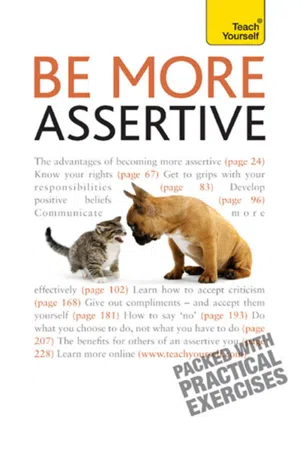
eBook - ePub
Be More Assertive
A guide to being composed, in control, and communicating with confidence
- 272 pages
- English
- ePUB (mobile friendly)
- Available on iOS & Android
eBook - ePub
Be More Assertive
A guide to being composed, in control, and communicating with confidence
About this book
Information
Topic
Personal DevelopmentSubtopic
Self Improvement1
Do you want to be assertive?
In this chapter you will learn:
- the pros and cons of assertive behaviour
- what it means to be assertive
- why assertiveness could work for you
- to understand your and other people’s behaviour
- to consider with whom you might want to be assertive – family, friends, colleagues
- the tools and strategies you might need to become more assertive.
Do you want to be assertive?
If you feel you’ve suffered years of being overlooked, pushed around, and having your ideas and needs ignored, ‘Do you want to be assertive?’ may seem like a silly question. Of course you’d like to be able to speak up and speak out! But if you’ve been finding it hard to make your voice heard, you do need to consider whether one of the reasons is that you have some reservations about being that assertive person. To choose assertiveness, you first have to consider what you feel is meant by being assertive. You then have to think what you might feel are the drawbacks, as well the advantages, of being assertive.
Being assertive doesn’t mean behaving like some of the people who might have led you to think ‘I really need to stand up for myself more!’ It does not mean always getting your own way; it does not mean always being in charge. Being assertive isn’t when your voice is always loudest or your demands always to the fore. Being assertive is not the same as being dominant, hectoring or bullying. You don’t have to be that sort of person to be more in control and more forward than you might be now.
THE DOWNSIDES OF BEING ASSERTIVE
But there are some downsides of being an assertive person. These may be what come to mind when you think of making changes and becoming more forward. And these may be what hold you back. If you are assertive, you:
- must make choices, and acknowledge that not making a choice and doing nothing is a choice in itself
- have to take responsibility for yourself and your choices and stand up and say ‘Yes, this is what I think and believe, and do’
- can’t make excuses or hide behind other people – you cannot say ‘I couldn’t help it’ or ‘They made me do it’ or ‘Everyone thinks…’ or ‘Of course, it’s not what I think…’
THE ADVANTAGES OF BEING ASSERTIVE
If you could be a more assertive person, what advantages might you enjoy? You could:
- express your opinions, and feel confident in knowing they are as good as anyone else’s
- express your feelings, and know you have as much right to have them as anyone else
- feel in control, and recognize that you have responsibility for your life and your decisions
- make choices, and acknowledge that you can do so
- get some of what you want, knowing that we can’t always have everything we desire or need but have a right to ask anyway
- have the right to refuse to do what you don’t want.
What is assertiveness?
We’ll look at why other people in your life may resist your becoming assertive, and how to help them see it is to their advantage too. But before we get to that, you need to face up to the resistance you yourself might have. At the same time as wanting to change and knowing you need to change, you could be sabotaging yourself. If I take this step, you may ask yourself, will I become confident? Will I become overconfident? Will I become downright bossy?
Insight
When you make changes to your life, you may come up against opposition. You might expect that from other people but be less prepared for the obstacles you, yourself, may put in your way. It’s as important to recognize and be prepared for your own objections as for those of others.
When you talk about wanting to be more assertive, what you might really mean is:
- How can I get people to listen to and take notice of me?
- How can I stand up to people who push me around?
- How can I have a little more control over my life in general or some situations in particular?
To achieve any of these, you don’t have to become that bossy person. Bossiness is hardly a helpful behaviour pattern and it’s certainly not what I would like to help you practise. But sometimes, words such as bossiness are used by people getting upset that you’re no longer a pushover, not because you are doing anything wrong.
Insight
When I was younger, I was often accused of being bossy. It took me many years to untangle what was really going on. Part of the accusation was because I can be overpowering, and I realized I had become that as a reaction. When you’re held down and ignored, sometimes you can come on a bit too strong to be heard at all. But most of it was simply because I was a woman willing to speak up. I wasn’t bossy – I was self-confident. You need to watch out for people wishing to cut you down to size, simply because it doesn’t suit them for you to be able to hold your own.
But rest assured – becoming assertive doesn’t mean you’re going to become someone you don’t recognize or can’t like. You also don’t have to blame or beat yourself up for finding it so hard. The fact is that assertiveness isn’t necessarily a natural behaviour for us.
Why is it often hard to be assertive?
Being assertive is not a natural response, either in human beings or in other members of the animal kingdom. What all of us have evolved to do in any situation where we feel uncertain or under threat is to go into the ‘fight or flight’ response. If you think you’re in danger, a primitive part of your brain tells you to act, at once. It says you should either step up and attack, or batten down the hatches and get out of there. And to make sure you do so as quickly and efficiently as possible, it floods your body with a cocktail of chemicals that enables you to see clearer, run faster, and fight harder. You feel a rush of adrenaline and your fists may clench, your breathing increases, your face flushes and the hairs on the back of your neck stand on end. You may want to wade in there and have it out. Or you may want to freeze and be as invisible as possible, or to run and hide.
Your primitive brain cannot distinguish between little threats and big ones or even real threats and imaginary ones. It’s not subtle but it is quick. The effects of the fight or flight impulse can overwhelm you even before you realize you’re feeling stressed. You’re flooded with the emotions triggered by that primitive and powerful brain. And this emotional flooding often makes rational thought not just hard but impossible. Instead of thinking things through, and acting in control, you find yourself being pushed to be either aggressive – ‘fight’, or submissive – ‘flight’.
Insight
The instant physical reaction to attack or flee may have worked very well when we were living in caves and any animal or stranger who came in sight was a genuine threat to our survival. It doesn’t work when the fight or flight reaction is triggered every time someone steps in front of you in the bus queue or when a friend or colleague or family member annoys you.
OVERCOMING INSTINCT
Being assertive means learning to overcome this instinctive and often inappropriate reaction. Clearly, when you step in front of a bus or when someone does seek to do violence to you or someone you love, you’ll be glad of that rush of strength and speed that allows you to react as is needed. But how often does that happen? Not nearly as often as we find the automatic response is triggered. And freezing or running away or hitting out with words or fists is more likely to get us into a miserable situation than save our lives. One reason to become assertive and to learn to overcome the fight or flight response is that assertive behaviour works so much better, whether at home or at work.
Insight
Whether in your job or in your family, what you want to be is someone who gives a good example, who listens and cares and brings out the best in yourself and those around you. Being someone who fights or flees does neither!
Assertive behaviour includes and involves other people, it does not dominate or exclude them. It helps you and those around you grow and develop. Dominating your work colleagues or your family or people you meet in everyday life is not a good management style in any circumstances. It tends to be based on short-term rewards and results – the dominant person has their way and feels they have done the right thing because it seems to work.
DOWNSIDES OF BEING DOMINANT
Being dominant can be beneficial for the person in the lead, but it fails completely to make effective use of the abilities and potential of everyone else. And in fact, it’s not much good for the leader either, in the long run. If you only ever get your way because you push, scream and shout yourself into that situation, you may never develop real skills – to assess situations and make the best decision, to lead and inspire others to have their say, to change and to adapt. The day someone else stands up and is a bigger bully than you, you’re lost. Use this method in families and you may lose out dramatically. A partner may put up with it for years, and then suddenly opt out. Children may vote with their feet, getting as far away from you as they can as soon as they are able. And even if people stay physically close, you may find they absent themselves emotionally, avoiding intimacy with you.
DOWNSIDES OF BEING PASSIVE
But it’s a mistake to think that taking the apparently easy line and not standing up for yourself is any better. Being passive is not a good style to live by, either. Again, it has short-term rewards and results – you may feel it works for you because you keep your head down, stay out of the line of fire, have an easy life with little conflict because you always give in. But constantly buckling under isn’t good for you or for the people around you. It means never getting your own needs met and that can lead to buried anger and seething frustration. It means that neither you nor anyone else you encounter has the important chance to learn how to compromise and negotiate – you always step aside for them and let them have what they want.
Using the fight or the flight option is the result of a similar condition – that of having low self-esteem and low self-confidence. You can see how that works with anyone who backs down and seeks to hide or flee, can’t you? You may not feel you have the right to make your feelings known, you may feel you don’t have the skills to stand up for yourself, you may believe that your views and your needs are not as important as anyone else’s.
But in fact, a similar belief also often fuels those who bully their way through life.
Insight
Those who throw their weight about are usually very insecure people. They dominate because they don’t have the confidence to allow other people to have responsibility and influence. And when we back off and allow a person who is bullying to get their own way, the behaviour persists because we’re rewarding it.
You may think someone behaves like this because they want to and like it. Often, they simply do it because it works and because once they’ve started to behave this way, everyone around them reinforces the behaviour by letting them get away with it.
WHY DO WE BEHAVE THIS WAY?
Early childhood experiences play an important part in creating this sort of pattern of behaviour. When children only get attention if and when they scream for it or insist on it they learn that’s the way to behave. If they find from experience that when they play quietly or ask nicely they are ignored but when they fight and have tantrums and act up they get noticed, then that’s the way they will go on behaving. Bullies are victims as well as aggressors. And although it’s a tough challenge for anyone on the receiving end of their behaviour to see them in a positive light, they actually deserve sympathy and help to change to more positive ways...
Table of contents
- Cover
- Title
- Copyright
- Dedication
- Acknowledgements
- Contents
- Meet the author
- Only got a minute?
- Introduction
- 1 Do you want to be assertive?
- 2 The tactics we use to get along
- 3 Knowing your rights
- 4 Responsibilities
- 5 Beliefs and values
- 6 Becoming assertive
- 7 Accepting and giving criticism
- 8 Accepting and giving compliments
- 9 Saying no
- 10 Getting caught
- 11 Anger and other feelings
- 12 Changing others by changing yourself
- Index
Trusted by 375,005 students
Access to over 1.5 million titles for a fair monthly price.
Study more efficiently using our study tools.
Frequently asked questions
Yes, you can cancel anytime from the Subscription tab in your account settings on the Perlego website. Your subscription will stay active until the end of your current billing period. Learn how to cancel your subscription
No, books cannot be downloaded as external files, such as PDFs, for use outside of Perlego. However, you can download books within the Perlego app for offline reading on mobile or tablet. Learn how to download books offline
Perlego offers two plans: Essential and Complete
- Essential is ideal for learners and professionals who enjoy exploring a wide range of subjects. Access the Essential Library with 800,000+ trusted titles and best-sellers across business, personal growth, and the humanities. Includes unlimited reading time and Standard Read Aloud voice.
- Complete: Perfect for advanced learners and researchers needing full, unrestricted access. Unlock 1.5M+ books across hundreds of subjects, including academic and specialized titles. The Complete Plan also includes advanced features like Premium Read Aloud and Research Assistant.
We are an online textbook subscription service, where you can get access to an entire online library for less than the price of a single book per month. With over 1.5 million books across 990+ topics, we’ve got you covered! Learn about our mission
Look out for the read-aloud symbol on your next book to see if you can listen to it. The read-aloud tool reads text aloud for you, highlighting the text as it is being read. You can pause it, speed it up and slow it down. Learn more about Read Aloud
Yes! You can use the Perlego app on both iOS and Android devices to read anytime, anywhere — even offline. Perfect for commutes or when you’re on the go.
Please note we cannot support devices running on iOS 13 and Android 7 or earlier. Learn more about using the app
Please note we cannot support devices running on iOS 13 and Android 7 or earlier. Learn more about using the app
Yes, you can access Be More Assertive by Suzie Hayman in PDF and/or ePUB format, as well as other popular books in Personal Development & Self Improvement. We have over 1.5 million books available in our catalogue for you to explore.