A TOOLKIT FOR IMPROVING YOUR SELF ESTEEM WITH CBT Healthy self esteem does not mean thinking you are the best at everything - it means being comfortable with yourself even when you are not. It is accepting yourself, with all your strengths and weaknesses, while still taking opportunities for self-development. Having healthy self esteem means you are well equipped to cope with the challenges life throws at you and perform to your full potential. Beat Low Self-Esteem with CBT will provide you with the skills you need to overcome a lack of self-esteem, making it easier for you to deal with tough times and leaving you a happier and more confident person. A complete program for changing your idea of yourself, it works on every aspect of your self-confidence, providing exercises to accompany each stage and short-term 'personal assignments' that will give you long-term benefits and lasting results. ABOUT THE SERIES
People have been learning with Teach Yourself since 1938. With a vast range of practical, how-to guides covering language learning, lifestyle, hobbies, business, psychology and self-help, there's a Teach Yourself book for whatever you want to do. Join more than 60 million people who have reached their goals with Teach Yourself, and never stop learning.
eBook - ePub
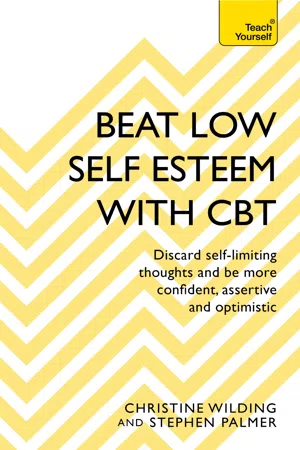
Beat Low Self-Esteem With CBT
How to improve your confidence, self esteem and motivation
- 256 pages
- English
- ePUB (mobile friendly)
- Available on iOS & Android
eBook - ePub
Beat Low Self-Esteem With CBT
How to improve your confidence, self esteem and motivation
About this book
Information
Topic
Crescita personale1

Great self-esteem: what is it?
In this chapter you will learn:
• what self-esteem – or lack of it – is
• the possible origins of your own low self-esteem
• how your ‘Personal Fault Finder’ deceives you
• the value of self-acceptance
• how to set goals to improve your self-esteem.

What is self-esteem?
What do we mean when we talk about self-esteem? You will probably agree that it includes some, or all, of the following:
• the ability to enjoy life to the full
• the ability to cope with life’s ups and downs
• feeling good about ourselves
• feeling that others, in general, like us
• having a positive attitude
• having good social skills
• the willingness to give new things a go
• the willingness to take risks
• the ability to make difficult decisions
• the ability to achieve life goals.
Self-esteem can best be described as having confidence in your own abilities and values. It does not mean thinking that you are the best at everything, but feeling comfortable with yourself even when you are not. It is accepting yourself, with all your strengths and weaknesses, while still taking opportunities for self-development.
In simple terms therefore, self-esteem means having trust and faith in yourself. Before you can do this however, you need to like and value yourself. You also need to be able to accept yourself as you are. The ‘catch 22’ situation here is that if your self-esteem is low then these are tall orders.
A MEASUREMENT
Self-esteem is, in essence, a measurement. We rate ourselves against a variety of criteria, and the result is an estimate of our personal view of our value or worth. The problem is that we tend to rate ourselves very inaccurately and very harshly. This in turn leads to low self-esteem, since based on our negative perceptions, we continue to undervalue ourselves. Worse is to come – once a person believes something to be true, he or she will start to act as if it were. The person will start to gather evidence to support this erroneous belief, while at the same time discounting evidence that fails to support it, thus strengthening the negative view of his or her personal value.
Insight
This is the self-esteem trap. Many of us fall into it. We measure our self-esteem through subjectively rating ourselves – usually harshly and negatively. We need to be aware that this can lead us to live with low self-esteem based on unhelpful information and reasoning – not truths or facts.
Exercise
Think about a time when you felt really confident – perhaps you had done something well, or someone had praised you.
• Did you need a particular achievement to give you this positive feeling?
• Can you remember having such a feeling without having excelled at anything special or receiving any particular positive input?
Childhood origins
Where does our low self-esteem come from? Are we born with it? Is it genetic? Do we learn it? Have life events simply conspired against us so that we feel everything we do goes wrong, and we never get that lucky ‘break’ that would give our confidence a boost?
Most people suffer from some element of low self-esteem. Problems usually develop when our self-esteem plummets so low that it starts preventing us from doing things: ‘I’m not trying for the job promotion – I’ll never get it anyway’ or ‘I didn’t invite so-and-so to go out with me – they would be sure to say no, and then I’d feel even worse about myself’.
Where does this come from? Finally, a chance to blame the parents! Parents often feel that criticism encourages their child to be aware of their weaknesses and therefore try harder to improve.
Parents may feel that their own views, built on knowledge and experience, are to be passed down to their offspring. So a child may learn that what they think is ‘wrong’ while what someone else (their parent) thinks is ‘right’. For example: a father who says ‘You idiot’ when his son makes an error will scarcely recollect saying it, while the child absorbs the idea that he is an ‘idiot’.
We can see how the low self-esteem habit can develop – and this is in caring and well-adjusted households. Now consider how many children grow up in households where they are regularly vilified, ridiculed and abused.
Then there is school to contend with. Woe betide you if you:
• wear glasses
• have red hair
• are slightly overweight or undersized
• wear the wrong make of trainers
• don’t belong to the right gang
• struggle with maths and are admonished by the teacher in front of your classmates
• are poor at sports and always come last in competitive events.
Can you begin to see how hard it is for any of us to grow up feeling particularly good about ourselves?
Insight
Low self-esteem tends to develop during our childhoods. Even where we have had a relatively happy time of it, we can still absorb, and carry with us into adulthood, negative thoughts about ourselves through parental criticism.
Think about the lessons you learned in your childhood. For example, if you are shy with strangers, think about the opportunities you had (or did not have) to talk to adults in such a way that you felt an ‘equal’ rather than simply a child. If you find it hard to stand up to people, think about how your parents reacted if you ‘rebelled’ in any way. Look at the characteristics you consider personal weaknesses, and see if you can find a point in your childhood where these ideas might have begun.
This may help you to understand how your low self-esteem gradually developed.
Adulthood: time to tackle low self-esteem
What we would like you to recognize is that the corrosive power of low self-esteem comes largely from external circumstances. This is natural.
A concept that will help you overcome this is self-acceptance. When you adopt the idea of self-acceptance, you begin to value yourself in spite of what others think. In the examples we gave you previously, low self-esteem has developed, in the main, due to the negative views and comments of significant others in our lives. If we can develop enough resilience to value ourselves in spite of what others may think, we will begin to feel much better about ourselves.
This is a journey to be learned in adulthood by most of us, and requires us to work to change the view that we have of ourselves that we have carried from childhood. In Chapter 2 you will learn exactly how to banish these negative thoughts that may have haunted you for a long time.
A WOBBLY BIKE
Self-esteem is a rickety bicycle in that it wobbles a great dea...
Table of contents
- Cover
- Title
- Dedication
- Contents
- Meet the authors
- Only got a minute?
- Only got five minutes?
- Only got ten minutes?
- Introduction
- 1 Great self-esteem: what is it?
- 2 Thinking your way out of low self-esteem
- 3 The perfection trap
- 4 Defeat low self-esteem by developing self-acceptance
- 5 ‘It’s not my fault: life is against me’
- 6 Increase your self-esteem through assertiveness
- 7 Act your way to good self-esteem
- 8 Body image
- 9 Becoming an optimist
- 10 Self-esteem and relationships
- 11 Developing emotional strength
- 12 Developing as a person to increase self-esteem
- Appendix A: professional assistance
- Appendix B: alcohol dependency and abusive relationships
- Taking it further
- References and further reading
- Copyright
Trusted by 375,005 students
Access to over 1.5 million titles for a fair monthly price.
Study more efficiently using our study tools.
Frequently asked questions
Yes, you can cancel anytime from the Subscription tab in your account settings on the Perlego website. Your subscription will stay active until the end of your current billing period. Learn how to cancel your subscription
No, books cannot be downloaded as external files, such as PDFs, for use outside of Perlego. However, you can download books within the Perlego app for offline reading on mobile or tablet. Learn how to download books offline
We are an online textbook subscription service, where you can get access to an entire online library for less than the price of a single book per month. With over 1.5 million books across 990+ topics, we’ve got you covered! Learn about our mission
Look out for the read-aloud symbol on your next book to see if you can listen to it. The read-aloud tool reads text aloud for you, highlighting the text as it is being read. You can pause it, speed it up and slow it down. Learn more about Read Aloud
Yes! You can use the Perlego app on both iOS and Android devices to read anytime, anywhere — even offline. Perfect for commutes or when you’re on the go.
Please note we cannot support devices running on iOS 13 and Android 7 or earlier. Learn more about using the app
Please note we cannot support devices running on iOS 13 and Android 7 or earlier. Learn more about using the app
Yes, you can access Beat Low Self-Esteem With CBT by Christine Wilding,Stephen Palmer in PDF and/or ePUB format, as well as other popular books in Crescita personale & Terapia cognitivo-comportamentale. We have over 1.5 million books available in our catalogue for you to explore.