Insomnia is responsible for a great deal of lost productivity, accidents and suffering. Ironically, the more you try to sleep, the worse the situation becomes - so the key is to stop gritting your teeth and attempting to wrestle your wakefulness to the ground. In Beating Insomnia, Dr Tim Cantopher will help you to achieve a calm acceptance of your sleeplessness in the short term, so you can focus on solving the problem in the longer term. Firstly, you need to manage the stress or anxiety that might be underpinning your insomnia, and much of the book will show you how to do practical strategies using relaxation exercises and mindfulness. It will also help you to keep a sleep diary, to tackle specific problems which might be interfering with your sleep, and will give you advice on when - and when not - to consider medication to help you sleep.By working at the strategies in this book your insomnia will improve significantly and you will experience more peaceful nights.
- 120 pages
- English
- ePUB (mobile friendly)
- Available on iOS & Android
eBook - ePub
Beating Insomnia
About this book
Information
Topic
MedicineSubtopic
Sleep Medicine1
Does insomnia matter?
Yes, it certainly does. It’s easy for those who sleep well to dismiss insomnia as a trivial gripe, but the truth is that it is one of the major afflictions of the modern world, being responsible for a great deal of lost productivity, accidents and suffering. About one in three of us report sleep problems and around one in ten complain of daytime symptoms as a result. There’s a lot of it about and it tends to become more of a problem as you get older.
The relationship between insomnia and disease is difficult to tease out, because illness leads to insomnia, but maybe the reverse is also true. Insomnia has been linked to anxiety, major depression, cognitive disturbance, high blood pressure, heart disease, diabetes and increased proneness to infections. However, stress, which predisposes to these conditions, also is a cause of insomnia, so the cause–effect link isn’t totally clear. Disease causes stress, which causes insomnia.
What is clear is that insomnia can cause great suffering. Being awake when others are asleep, as any insomniac will tell you, causes great stress, which in turn increases proneness to disease. What is also clear, though, is that one or a few nights of insomnia or poor sleep isn’t going to kill you or do you permanent harm, so long as you don’t drive or operate heavy machinery when sleep-deprived. This is a problem which you have time to resolve; whether you sleep well tonight or not isn’t as crucial as it feels. Whether you sleep adequately over the next few years is.
Sleeplessness is important and is worth fixing. Your sleep can be improved. This is going to need you to make some changes in your life, to learn techniques and to practise them regularly. You are going to need to be persistent and patient. Results may take some time to appear.
Above all, you are going to have to stop trying to sleep. Sleep improves over time through doing the right things, not by you gritting your teeth and wrestling your wakefulness to the ground. This is counter-intuitive to many of us. We were taught as children that if you try hard, you will succeed. It’s the effort which counts. This doesn’t work for sleep. It’s more like training a kitten – you can’t force it to do what you want; you just have to keep doing the same things consistently and you get there in the end.
Taking a phlegmatic view of insomnia is also difficult for exactly the reason I gave at the beginning of this chapter. It is important and we don’t tend to shrug our shoulders at things which have such major potential consequences. But we do need to achieve this calm acceptance of insomnia in the short term if we are to prevail in the long term. Top sports stars all know this principle. They all practise really hard and concentrate well, but then in the game they don’t strain too much or worry about the result, as they know that just makes them tense and impairs performance. The apparently effortless excellence of the champion comes from doing the right things over and over again in practice. That is how your insomnia will be overcome too.
So maybe chronic insomnia can cause health problems, but so what? There isn’t any point in worrying about what you can’t control. As I have explained, you can’t immediately control insomnia. But stress, now there’s a real worry. If it doesn’t sound too ridiculous, you should worry about the fact that you worry so much. The evidence that long-term anxiety causes a whole host of health problems is incontrovertible, as is the fact that it makes existing problems, such as pain, much worse. The causal link between anxiety and heart disease, strokes, bowel diseases, inflammatory conditions and some cancers is well established. Reducing our anxiety would improve our long-term health as clearly as exercise and good diet. It would also allow us to perform better in whatever we are doing. You are worrying about your insomnia impairing your work performance, risking your physical health and making yourself feel bad, when in truth your stressful lifestyle and tendency to worry have a far greater influence on these factors.
We can do something fairly quickly about stress and anxiety. This, in my opinion, is where you should start to deal with your insomnia. I will come to the details of how to manage anxiety later on, but I would suggest you go to Chapter 9 for the relaxation exercise (page 48) and the section on mindfulness (page 51) and start practising these strategies straight away. There is also no reason to delay looking critically at your lifestyle. The chances are that you are going to have to make some tough decisions and changes if you are going to start leading your life at a healthy level of arousal compatible with good sleep. Start thinking about these issues now. Why wait?
Incidentally, you will see the word ‘arousal’ crop up quite often in this book. I’m not referring to sexual arousal, but to how hot you are running. You could use the words ‘stress’, ‘tension’, ‘alertness’, ‘excitement’ or ‘enjoyment’, as they all refer to how switched on your nervous system is, depending on whether the experience is pleasant or unpleasant. Your body doesn’t know the difference and is unlikely to allow sleep whatever the reason for your high level of arousal.
So I want to emphasize this point: sleep is important, but not necessarily tonight. It is the ‘given’, held by so many of my patients, that ‘I must sleep well (now)’ which is the single most destructive factor against their sleeping. Here is the bad news: you probably won’t sleep well, not yet. There is no quick fix, other than medication (of which more in a later chapter) for insomnia. You need to come to terms with that as a starting point. If you have short-term insomnia, it is miserable for you but it isn’t disastrous. If you have long-term insomnia, it is a serious problem and quite disabling, but here is the good news: if you are realistic, patient and follow any advice given by your doctor and the advice in this book, there is a very good chance that your sleep will improve greatly over time.
Your doctor has an important role here. There are many different causes of insomnia (see Chapter 4), some easily treatable. If there are medical or other causes of your poor sleep, they need to be found and dealt with.
2
How sleep works
Stages of sleep
I introduced the concept of arousal in the previous chapter. Your level of arousal varies throughout the day and night. At the highest level of arousal, you are highly alert and, if you are a calm person, at your peak. If your peak levels are higher, you may be excited or stressed; even, if you are an anxious person, panicky. At the lowest level of arousal in your 24-hour cycle, you are deeply asleep.
The point here is that your graph of arousal through 24 hours will look very like mine, even if I’m as cool as a cucumber and a good sleeper while you may be an insomniac prone to worrying. Your graph is just shifted upwards throughout the day and night compared with mine (see Figure 2.1).
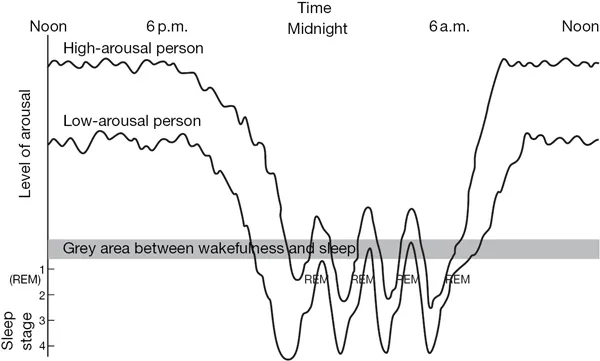
Figure 2.1 Arousal level over 24 hours in low- and high-arousal subjects
There is no clear division between wakefulness and sleep. Drowsiness shades into light sleep without a break. Through the night, the deepness of sleep varies, typically following a repeating pattern of around 90 minutes in length. There are five levels of sleep. At the beginning of the night, a person passes from drowsing, through level 1, to levels 2, 3 and so on, then the process is reversed with the level of sleep becoming lighter, even possibly emerging into wakefulness briefly, before the cycle begins again.
Stage 1 sleep typically lasts five to ten minutes. Muscles become relaxed and twitching or jerks sometimes occur. While the person is asleep, she may be vaguely aware of her surroundings, noises, voices and such like. It is this awareness which often persuades the light sleeper that she has been awake throughout the night, when objective observation reveals that she has been asleep much of the time. I call the grey area from drowsiness through stage 1 sleep ‘drowsing’.
Stage 2 typically lasts around 20 minutes in adults who sleep well. Movement slows to a stop, body temperature falls and the heart slows. Other metabolic functions also slow down and stay slowed for much of the night, though metabolic rate rises and falls to an extent with the depth of sleep.
Stages 3 and 4 are deep sleep and together usually last around 40 minutes. These are the phases of sleep which are probably the most restorative. It is hard to wake a person in these stages, and if you do he will be disorientated and sluggish.
Stage 5 sleep is where dreaming occurs. It is also called rapid eye movement (REM) sleep, for obvious reasons. It is actually a higher level of arousal than levels 2, 3 and 4 sleep, involving increased heart and breathing rates, and the sleeper may sometimes wake up during this phase. If she does so suddenly, it can be frightening for her, as muscles are temporarily paralysed and this inability to move may persist for ten seconds or so after waking occurs. This most commonly happens out of a frightening dream (night terror), making the experience all the more disconcerting. REM sleep is probably when information which has been put to one side for one reason or another during the day is processed and organized emotionally.
The crucial point of Figure 2.1 is this: if you are over-aroused, your sleep pattern is the same as mine; it’s just shifted upwards throughout the 24-hour cycle, because you are running too hot all the time. There is nothing especially wrong with your sleep; it’s just reflecting your over-arousal. If you are afraid of not sleeping, you will be anxious (over-aroused) and it is obvious from this graph that you won’t spend much time in the deeper, restorative stages.
The anatomy and physiology of sleep and circadian rhythms
Like any electrical device, which it is (just quite a complex one), the brain needs to be switched on in order to function. The switch is called the suprachiasmatic nucleus (SCN) and exists deep in the middle of the brain. It is switched on by light hitting the retina of the eye. By a circuitous route travelling via the upper spinal cord, it links with the pineal gland (Figure 2.2). This gland produces the hormone melatonin, the substance which turns on the sleep response by pushing arousal down. It is essentially our self-produced sedative. The SCN switches off production of melatonin by the pineal gland, thus switching the brain on into wakefulness. There is in fact a bit of a lag, with the rate of firing of the SCN being at its highest in the middle of the evening.
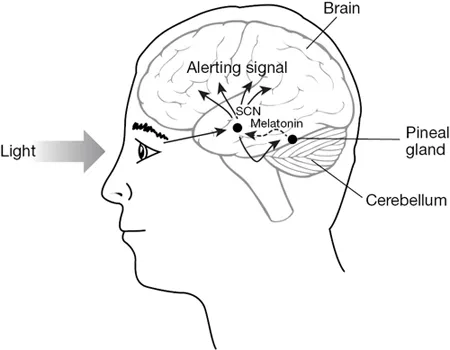
Figure 2.2 Brain structures involved in sleep
There are other factors which also affect the activity of the SCN, including the timing of meals, exercise, social activities and other routines, so that sleep patterns are not entirely dependent on light. Sleep–wake cycles are a product of all of the other regular routines and rhythms in our lives. This is our circadian rhythm.
Human beings have evolved to run on a 24-hour cycle, which is fortunate as that is how our world works. Not just sleep, but also body temperature and other metabolic functions vary depending on the time of day. All these functions are interrelated, so sleep rhythms are dependent on other body rhythms and vice versa. Our regular habits also affect our circadian rhythms. Interestingly, our internal body clock isn’t perfect. If a human is deprived of a day–night cycle of light and dark for an exten...
Table of contents
- 1 Does insomnia matter?
- 2 How sleep works
- 3 Why can’t I sleep? I: General
- 4 Why can’t I sleep? II: Illnesses and their treatment
- 5 Why am I over-aroused?
- 6 Some other problems which interfere with sleep
- 7 The sleep diary
- 8 How can I sleep better? I: Managing stress
- 9 How can I sleep better? II: Managing your mind
- 10 How can I sleep better? III: Specific non-pharmacological treatments
- 11 Pills and potions
- 12 Dealing with specific causes of insomnia
- 13 I still can’t sleep
- 14 So that’s it?
- Search terms
Trusted by 375,005 students
Access to over 1.5 million titles for a fair monthly price.
Study more efficiently using our study tools.
Frequently asked questions
Yes, you can cancel anytime from the Subscription tab in your account settings on the Perlego website. Your subscription will stay active until the end of your current billing period. Learn how to cancel your subscription
No, books cannot be downloaded as external files, such as PDFs, for use outside of Perlego. However, you can download books within the Perlego app for offline reading on mobile or tablet. Learn how to download books offline
Perlego offers two plans: Essential and Complete
- Essential is ideal for learners and professionals who enjoy exploring a wide range of subjects. Access the Essential Library with 800,000+ trusted titles and best-sellers across business, personal growth, and the humanities. Includes unlimited reading time and Standard Read Aloud voice.
- Complete: Perfect for advanced learners and researchers needing full, unrestricted access. Unlock 1.5M+ books across hundreds of subjects, including academic and specialized titles. The Complete Plan also includes advanced features like Premium Read Aloud and Research Assistant.
We are an online textbook subscription service, where you can get access to an entire online library for less than the price of a single book per month. With over 1.5 million books across 990+ topics, we’ve got you covered! Learn about our mission
Look out for the read-aloud symbol on your next book to see if you can listen to it. The read-aloud tool reads text aloud for you, highlighting the text as it is being read. You can pause it, speed it up and slow it down. Learn more about Read Aloud
Yes! You can use the Perlego app on both iOS and Android devices to read anytime, anywhere — even offline. Perfect for commutes or when you’re on the go.
Please note we cannot support devices running on iOS 13 and Android 7 or earlier. Learn more about using the app
Please note we cannot support devices running on iOS 13 and Android 7 or earlier. Learn more about using the app
Yes, you can access Beating Insomnia by Tim Cantopher in PDF and/or ePUB format, as well as other popular books in Medicine & Sleep Medicine. We have over 1.5 million books available in our catalogue for you to explore.