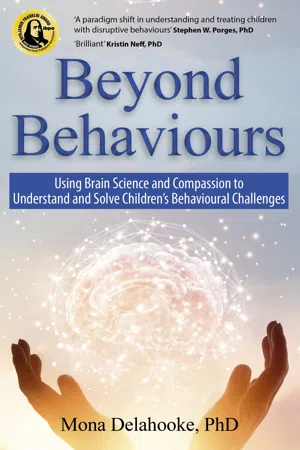
A PARADIGM SHIFT FOR CAREGIVERS THAT WILL REVOLUTIONIZE THE WAY YOU APPROACH, TREAT OR PARENT A CHILD WITH CHALLENGING OR EXPLOSIVE BEHAVIOURS. When you are confronted with a child who is troubled, disruptive, oppositional, defiant or angry - whether you are a parent or a teacher - it can be difficult to know the best way to support them. Traditional methods of 'shaping' a child's behaviour can often be at best ineffective, at worst distressing, for child and adult alike.Drawing on 30 years of experience, internationally known paediatric psychologist Dr Mona Delahooke describes these troubled behaviours as the 'tip of the iceberg', important signals that point to deeper, individual differences in the child that we need to understand and address before we can resolve behavioural challenges. Using the very latest neuroscientific research Beyond Behaviours makes the case that many children who can't seem to behave simply don't have the developmental capacity to do so - yet. This book uses neuroscientific findings to help you deconstruct behaviour challenges, and to discover their cause and triggers for your child. It will show you how to apply this knowledge across a variety of behaviour spectrums, from children diagnosed with autism or other forms of neurodiversity, to those who might have been exposed to toxic stress or trauma during their early years. There are practical strategies to implement at every stage, backed up by impactful worksheets and charts, with a strong emphasis not on 'managing' behaviour, but instead on helping children and families build positive experiences to counteract the stress and pressure felt by everybody when you're working, or living, with a child who has behavioural challenges. Accessible, practical, warmly supportive and steeped in research and clinical expertise, Beyond Behaviours offers a break-through book which guides us - parents and caregivers alike - to the realisation that the most important tool in our toolkit is always our connection with the child standing in front of us.
eBook - ePub
Beyond Behaviours
Using Brain Science and Compassion to Understand and Solve Children's Behavioural Challenges
- 320 pages
- English
- ePUB (mobile friendly)
- Available on iOS & Android
eBook - ePub
Beyond Behaviours
Using Brain Science and Compassion to Understand and Solve Children's Behavioural Challenges
About this book
Information
PART ONE
Understanding Behaviours
1.
Revealing the Hidden, Adaptive Benefits of Behaviours

“One looks back with appreciation to the brilliant teachers, but with gratitude to those who touched our human feeling.”
Carl Jung
By the time Stuart hit second grade, his teachers had pegged him as a “problem child.” They knew he came from a loving home and could discern right from wrong, but he frequently started fights and had outbursts that caused classroom disruptions. Stuart had a number of professionals in his life trying to help him, including school counselors, a private therapist, and a developmental pediatrician.
His parents and team were relieved when Stuart controlled his behaviours, sometimes for days, or even weeks, but then—seemingly out of nowhere—he would explode with anger at a peer, sibling, teacher, or one of his parents. His difficulties only deepened with time and eventually a psychiatrist offered a diagnosis: Oppositional Defiant Disorder. His parents sent him to a series of special schools and even residential treatment centers, but despite elaborate efforts by many people, he made only modest progress.
In my work as a child psychologist, I encounter “Stuarts” all the time, young people whom adults have diagnosed with disorders, disciplined for misbehaving, or judged for making bad choices. Parents and others send them to mental health professionals like me in the hope that we will help “cure” their problematic behaviours. What I have observed and experienced over many years is that all of us—parents, teachers, and other professionals—use a wide range of techniques and approaches that sometimes conflict with each other and often prove ineffective, leaving us frustrated and confused.
But there is hope. This book will present a new way of understanding behaviours and new and helpful approaches based on that understanding. Whether you are a therapist, an educator, a paraprofessional, or a parent, you will gain a new perspective on what behaviours are and why they arise. And I’ll offer tools you can utilize to improve the lives of children and their families. In this chapter, we’ll start by examining what’s wrong with the status quo. We’ll look at the three most common mistakes we all make in treating and managing behaviours. Then, once we have established the limitations of our current approaches, we’ll discuss a new way of framing and understanding behaviours and begin to lay out a helpful and enlightened approach based on current neuroscience.
What’s Wrong With the Status Quo?
Before we launch into our examination of a new approach to behavioural challenges, it’s important to understand why we fall short in the way we currently comprehend, evaluate, and treat them. Again and again, we make three significant mistakes: (1) we don’t pinpoint the behaviour’s correct etiology before we address it; (2) we use one-size-fits-all approaches instead of tailoring the treatment to the individual; and (3) we fail to use a developmental roadmap to ensure we’re using the right approach at the right time. Let’s examine each of these three shortcomings.
We Fail to Determine the Etiology of Behaviours Before We Try to Change Them
Timmy spent his early years in the foster care system and by the time he turned four he had been diagnosed with multiple psychiatric disorders. Prone to disagreeing, running away, and physically striking others, he had been placed in three different foster homes within a single year. His meltdowns would appear suddenly and seemingly without warning. At age eight, Timmy was so upset to learn that a beloved PE teacher had transferred to another campus that he refused all classwork, and then when a teacher asked him to line up for lunch, Timmy toppled a heavy desk.
His teachers tried to deal with these incidents with detailed behaviour plans designed to reward appropriate behaviours and offer consequences (such as withholding screen time) for maladaptive behaviours. But these efforts proved ineffective. Why? Because the plans were based on the assumption that Timmy had volitional control of his actions. He didn’t. His behaviours resulted from the difficulty he had staying emotionally regulated. At that stage, he simply wasn’t capable of changing his behaviour to earn a reward. Far from improving his behaviour, the plans only served to frustrate Timmy and negatively influence his emerging self-image.
What happened? Timmy’s teachers decided what to do about his behaviours before they fully understood what caused them. In our cognitive-centric environment, we often assume that a child has deliberately chosen how to behave—or misbehave. This reflects a predominant cultural bias that values punishment when children exhibit a certain range of “atypical” behaviours.
Case in point: The Center for American Progress analyzed data from the 2016 National Survey of Children’s Health (NSCH) and found that an estimated fifty thousand preschoolers were suspended from school at least once and seventeen thousand were estimated to have been expelled.1 The other cultural bias (sometimes referred to as implicit bias) that emerged from the survey is that male children of colour were consistently over-represented in these expulsion and suspension rates. These high numbers indicate a fundamental misunderstanding of the meanings of childhood challenging behaviours and solutions for them, as well as the continuing effects of racial bias on how we identify them.
What causes these misreadings? When we fail to recognize that many behaviours represent the body’s response to stress, not intentional misbehaviour, we expend effort on techniques designed to help children logically connect their thoughts, emotions, and behaviours when they simply can’t—yet. As we’ll discuss later, in addressing behaviours, sometimes we aim too high and sometimes too low. We aim too high when we assume that a child’s behaviour is the result of thoughtful intent when it’s actually a response to stress. We aim too low when we assume a child lacks certain abilities he actually does have. For example, neurodiverse children with sensory/movement differences might have complex thoughts and ideas they are unable to express or behaviours they are unable to inhibit because of the way their brains are wired.
When we see a behaviour that is problematic or confusing, the first question we should ask isn’t “How do we get rid of it?” but rather “What is this telling us about the child?”
The answer will provide valuable clues about what to do next. In Chapter 2, we will learn how to determine whether a behaviour is top down (controllable, intentional, or planned) or bottom up (reflexive, automatic, or a stress response), and what the implications of the answer are for our interactions, treatment tools, and techniques.
We Use One-Size-Fits-All Approaches
Anna, a fifth grader, struggled to get through nearly every school day. She often refused to go to school, and her father had to physically help her into the car and the classroom. Anxious and preoccupied, she bit her nails and picked at her skin until it bled. In response, her teacher developed a support plan. When the teacher noticed Anna picking at her skin, she would ask Anna to take a “sensory break,” when she was to walk around the periphery of the room in an effort to calm herself and shift to more positive behaviours. The teacher had found this to be an effective strategy for a previous student who had behavioural challenges.
But the strategy proved ineffective for Anna. When the teacher told her it was a good time for a sensory break, Anna felt that the teacher was singling her out and blaming her; she felt self-conscious walking around while her classmates watched. Anna was deeply embarrassed and confused about her own behaviours.
The teacher’s idea of a sensory break to help her relax certainly had merit—but not for this specific child. Why? Because it didn’t take into consideration Anna’s perception of the intervention and, further, it didn’t address the multiple underlying reasons for Anna’s emotional distress. In short, the plan failed to accurately and comprehensively address Anna’s individual differences.
That’s the problem with many paradigms and programs intended to help children with problematic behaviours: they utilize principles that are based on general notions about child development. Sometimes these programs are successful, but often they fail because they are not tailored to the unique needs of each child. Just as dishwashers have adjustable settings for temperature and time, each child has her own “settings,” the sensory, emotional, cognitive, and learning “settings” to which she responds best. It takes effort, but it’s important to discover which settings work best for each child, developing an appreciation for his or her individual differences.
Individual differences in this context include anything that affects how a person perceives the world through his or her body and mind.2 That includes everything we feel on a conscious or subconscious level—such as bodily and other sensations, thoughts, and feelings.3 These differences dynamically influence the relationship between children and caregivers, deeply affecting social and emotional development and the child’s behaviours, emotional regulation, and behavioural control. The key is for caregivers and providers to understand each child’s individual differences, including the child’s underlying needs, preferences, and inborn traits.4 Providing generic techniques, even if they are helpful to some children, is often insufficient for children who have difficulties with emotional and behavioural regulation, as it was for Anna. Decades ago, Drs. Stanley Greenspan and Serena Wieder proposed the thoughtful consideration of individual differences in child development and infant mental health treatment.5 When I studied their perspective in the 1990s, it transformed the way I practiced psychology (and parented my own children).
Understanding each child’s individual differences helps us tailor our relational and therapeutic approaches. Too often, we make assumptions about supportive techniques and environments without asking if they are tailored to the specific needs of the child. This idea of personalizing approaches is now popular in the medical field, and specifically in precision medicine, “an emerging approach for disease treatment and prevention that takes into account individual variability in genes, environment, and lifestyle for each person.”6 We can apply the principles of precision medicine to address the limitations inherent in one-size-fits all approaches. This complex approach can make all the difference in how we support children. In fact, the word that best describes the human brain/body connection is complex. If we don’t embrace this complexity, we can miss essential opportunities to help children where they need it the most.
Understanding each child’s individual differences helps us tailor...
Table of contents
- Cover
- Title Page
- About the Author
- Dedication
- Acknowledgments
- Table of Contents
- Introduction
- Part One: Understanding Behaviours
- Part Two: Solutions
- Part Three: Neurodiversity, Trauma, and Looking to the Future
- Resources
- Notes
- Copyright
Trusted by 375,005 students
Access to over 1.5 million titles for a fair monthly price.
Study more efficiently using our study tools.
Frequently asked questions
Yes, you can cancel anytime from the Subscription tab in your account settings on the Perlego website. Your subscription will stay active until the end of your current billing period. Learn how to cancel your subscription
No, books cannot be downloaded as external files, such as PDFs, for use outside of Perlego. However, you can download books within the Perlego app for offline reading on mobile or tablet. Learn how to download books offline
Perlego offers two plans: Essential and Complete
- Essential is ideal for learners and professionals who enjoy exploring a wide range of subjects. Access the Essential Library with 800,000+ trusted titles and best-sellers across business, personal growth, and the humanities. Includes unlimited reading time and Standard Read Aloud voice.
- Complete: Perfect for advanced learners and researchers needing full, unrestricted access. Unlock 1.5M+ books across hundreds of subjects, including academic and specialized titles. The Complete Plan also includes advanced features like Premium Read Aloud and Research Assistant.
We are an online textbook subscription service, where you can get access to an entire online library for less than the price of a single book per month. With over 1.5 million books across 990+ topics, we’ve got you covered! Learn about our mission
Look out for the read-aloud symbol on your next book to see if you can listen to it. The read-aloud tool reads text aloud for you, highlighting the text as it is being read. You can pause it, speed it up and slow it down. Learn more about Read Aloud
Yes! You can use the Perlego app on both iOS and Android devices to read anytime, anywhere — even offline. Perfect for commutes or when you’re on the go.
Please note we cannot support devices running on iOS 13 and Android 7 or earlier. Learn more about using the app
Please note we cannot support devices running on iOS 13 and Android 7 or earlier. Learn more about using the app
Yes, you can access Beyond Behaviours by Mona Delahooke in PDF and/or ePUB format, as well as other popular books in Psychology & Inclusive Education. We have over 1.5 million books available in our catalogue for you to explore.