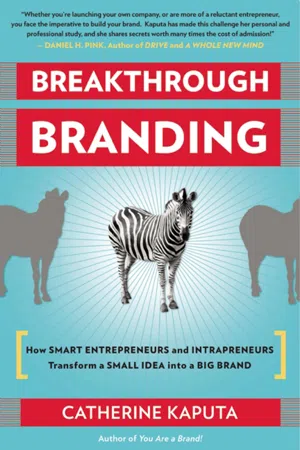
Even the smallest idea can have BIG impact when positioned correctly. Breakthrough Branding shows entrepreneurs, intrapreneurs, and small businesses alike the secrets to transforming a brainstorm into big bucks. From the grassroots growth of beverage brands like Red Bull, Honest Tea, and Innocent, to the exploding growth of digital brands like Twitter, Weibo, and Groupon; from the cult appeal of stores like Forever 21, to the success of virtual retailers like Zappos — successful companies of all types and sizes begin with three things: ambition, a winning idea, and a brand strategy. Branding expert Catherine Kaputa uses dozens of international brand histories to demonstrate what makes a brand thrive, and provides you with the tools to do the same. Learn how to define your audience, create a standout personality, and position yourself as superior to the competition — all by utilizing the power of branding! Packed with thoughtful reader exercises and filled with leading-edge social media strategies, Breakthrough Branding teaches novice start-ups to seasoned professionals how to leverage their assets to create a successful business.
Find the simple story in the product and present it in an articulate, intelligent, and persuasive way.
—Bill Bernbach, Legendary “Mad Man”
Destiny is a dramatic word—but really, the first step in starting a new venture is identifying your business destiny, determining what specific business you—and only you—were born to create. The best idea for you will involve the perfect convergence of your skills, talents, and passions with the needs of the marketplace.
The hardest part of launching a business is beginning. You need to find the brand idea that’s right for you. Yet, it’s the most important step. Finding your business idea is like examining your DNA. It’s finding what’s different, relevant, and special about you so that you can share it with others. It’s discovering where you belong in the world so you can embark on the journey that will take you there.
The Valley of Death
Entrepreneurs brand the time between coming up with a business idea and having a successful start-up as “The Valley of Death.” As the name implies, the beginning period is no picnic. It’s a tough time to get through intact. You don’t have enough financing. You don’t have all the skills and resources you need. You can die in the valley if you don’t get enough customers and money to cover cash flow.
Yet, in so many ways, this starting period is the most valuable time you will ever have as an entrepreneur. It’s the time when you can create tremendous value out of nothing. You’re creating a new product or service where there was none before. You’re positioning the brand so it can stand out in the marketplace. You’re creating intellectual property with a brand name and with your brand’s look and feel. You’re starting to build a reputation for the new brand and for Brand You. You’re developing tangible assets such as your product, equipment, and even real estate.
As a bootstrapping entrepreneur, you’re creating many valuable brand assets during the beginning phase that will set the course for brand success or failure. The beginning period, this Valley of Death, may be your riskiest time, but it is also your most valuable time creatively and strategically.
Yet, many entrepreneurs rush to market, shortchanging the formulation phase. They want to have a business, yet they don’t have a fully formed and viable idea. Or they have a copycat idea. Or a gargantuan, overly complicated idea. Or an idea that tries to appeal to everyone and therefore is destined for failure. When you try to appeal to everyone, you appeal to no one. If you don’t use this beginning phase to build a solid foundation of brand assets, you will likely not survive the Valley of Death.
The Paradox: Small Ideas Are Big
It all begins with an idea. In the branding business, people talk a lot about the “big idea.”
But I say, “Forget the big idea, go for a small idea.”
There’s a fundamental paradox of business ideas: the bigger the idea, the simpler and more focused it will be. Big ideas are small—simple, focused, and specific—so that they can occupy a unique niche and dominate their category. The best business and product ideas come from drilling down and being very targeted and specific. Drill down until you come up with a way that your brand can be superlative.
That way, you’re building a business on something that’s small enough to own and create a brand identity around and that will get you big results. You and your business will stand for something, rather than being a mashup of who knows what.
All good branding involves sacrifice—you must sacrifice the things that don’t belong to the core business idea. Too many entrepreneurs stumble over this simple reality. When expressing their business idea, they ramble on and on for fifteen minutes, leaving their listeners (investors, potential clients, potential employees) scratching their heads. Either they haven’t zeroed in on what they want to accomplish or they haven’t figured out how to express it simply. Whatever the case—they are not yet ready for business.
So get a clearly focused business idea. You don’t want to be an apple and orange business. You want a clear-cut business that you can define easily and effortlessly. Your simple sentence that defines your business will serve you well when pitching your idea to investors, attracting talent, talking to the press, and, most especially, connecting with your customers.
“SMALL” IDEA: a simple, focused brand promise that defines what’s special about your brand.
Your brand idea is your tagline or mantra for your business that expresses the core concept. It’s the promise of what your brand will offer customers that others don’t. For example, FedEx’s brand promise is its advertising tagline: “Your package will get there overnight. Guaranteed.” The Japanese retailer Uniqlo’s tagline is “Made for All,” reflecting its mission of creating stylishly simple casual clothes for all to wear. For its fruit smoothies, the U.K. company Innocent uses the tagline, “The fruit, the whole fruit, and nothing but the fruit.”
In breakthrough branding, you’ll find that you always convey the most when you say the least. So make it simple. You must figure out a way to articulate clearly, for yourself and others, what the business is, who it’s for, why it’s needed, and why it will be a success.
Your business idea should be short enough to write on the back of a business card. You want a phrase or sentence, not an elaborate paragraph. Another way of looking at it is, if you can’t explain your business idea successfully to a ten-year-old, you don’t have a clear-cut idea for your business. You need to be able to sum up what your business is and why it matters. As Einstein said, “Everything must be as simple as possible, but not simpler.”
Your sentence should contain a keyword or phrase that you want everyone to associate with your brand. Think of the way big brands try to own a word or phrase, like Google owns “search,” Volvo owns “safety,” and FedEx owns “overnight.” So when people think of your brand, they think of “X.” Or when they think of “X,” they think of your brand.
BRAINSTORMER: What’s your brand idea in a sentence? What’s the keyword?
When Your Heart Talks, Pay Attention
To be a successful entrepreneur, your goal has to be more than just making money. Entrepreneurship and finding your business idea are about finding your purpose. Your goal must be tied to your deeper story, your sense of destiny for yourself and your business. It must feel authentic and right for you. It’s discovering your personal vision that reveals your essence, your passion, and your values. That vision comes from your heart, not your head.
Great brands are always built on authenticity, on who you are and what your business can be, not what you want it to be. For a decade in the 1990s, Las Vegas marketed itself as a family vacation destination. Think about it, positioning Vegas as a family destination. Nobody goes to Vegas for family stuff, well, almost nobody. Vegas is about drinking and gambling like crazy and doing things you want to keep under wraps afterward. Its nickname is “Sin City,” after all. In 2003, when Vegas adopted authentic positioning, the city came up with its famous slogan, “What happens in Vegas, stays in Vegas.” And the branding was a smash success. Now, here was a positioning line that came from Vegas’s DNA. It was a brand promise that people could believe in.
Branding has to come from who you are and what your business can be, not from what you want it to be.
Great brands didn’t get that way by failing to deliver on an authentic brand promise. When customers and prospects believe what you say, you get a trust premium over competitors. Procter & Gamble found that its businesses that were growing faster than average, including Pampers, Tide, Downy, and Crest, had a trust advantage that gave these brands a market share advantage. A global study conducted by the former chief marketing officer of P&G found that the quality of a company’s external and internal communications around a shared customer ideal led to business success and the ability to grow.1
When we believe something is honest and comes from its true nature, what psychologists call essentialism, that even gives us pleasure.2 And that pleasure is lost when we find out something is “fake” or not what we thought it was. The pleasure of a good wine is influenced by whether we think it’s expensive or cheap. Just as we enjoy a painting that we trust is authentic, and don’t enjoy it when we are told it is a reproduction or a fake.
You need to build a business based on authenticity, based on what the business is and can be, and who you are and can be. More than working for others, entrepreneurship offers you the opportunity to be who you were meant to be, to succeed on your own terms. You don’t have to do it the company way anymore—you can and must do it your way. That’s the good news and the bad news, of course, because you won’t have the company to lean on or to blame when things go wrong. You can’t be fired or even reprimanded—but you can lose everything.
BRAINSTORMER: Why is this business the best and only business for you to start?
The Mouse That Roared
Small, “high-concept” ideas are different. They’re not copycat ideas but try to break new ground. They provide a fresh benefit, appeal to a hungry target audience, have a new process—a different something. Even though you’re a small business now, having an important difference will give you a loud voice in the marketplace.
Being different is a cardinal rule of branding. You don’t have to have a big idea, but you do have to have an idea that is different from your competitors’ ideas. Having a different idea for your business is powerful. Just being different from everything else in your category in some way is immensely helpful for your brand because you can position your business and products as unique, occupying their own niche.
You can’t own what someone else owns, so don’t even try. Once you’ve claimed your position in the market, no one can easily move in on your spot, either.
There are a lot of ways to be different. The ultimate way is to create a whole new product category and, in the process, to create a consumer need that no one has previously exploited—possibly even a need that consumers didn’t know they had. Apple has been wildly successful at this. But while not all of us are brilliant (or capitalized) enough to create a whole new product platform, we can make changes in the existing ones and be successful.
You could utilize a new technology that gives your product a competitive edge, as the various smartphone makers do every year, in an attempt to outmaneuver their competitors. Or your product might be made out of ingredients or by a process that’s different.
The television cook and author Sandra Lee created a new cooking concept she called Semi-Homemade. She came up with the name while walking down the aisle in a grocery store one day and seeing bags of semisweet chocolate for cooking. That’s sort of what I’m doing, she thought, because her dishes are made up of about 70 percent packaged ingredients and 30 percent fresh foods. While Lee’s concept is more than semi-controversial with many cooks, she has a thriving business with adoring fans who love her easy-to-prepare recipes and her appealing personal brand. Sandra Lee’s tagline for her cooking concept is “Keep It Simple, Keep It Smart, Keep It Sweet, Keep It Semi-Homemade.”3
Each target market has its preferences and hot points, and your product could tap into the mindset of a specific group or generation....
Table of contents
Cover Page
Title Page
Copyright Page
Dedication
Contents
Foreword
Introduction: Breakthrough Branding
Chapter 1: What’s the Brand Idea?
Chapter 2: The Alchemy of the Brand Entrepreneur
Chapter 3: Power Positioning
Chapter 4: The Making of a Brand’s Verbal Identity
Chapter 5: Creating Your Brand’s Look and Feel
Chapter 6: Pimp My Brand!
Chapter 7: Brand Big! Boldly Marketing the Brand
Chapter 8: Company Culture: One Team with One Dream
Chapter 9: What’s Your Pitch?
Chapter 10: Take the “Work” out of Networking
Chapter 11: From Small Idea to Big Brand
About the Author
Acknowledgments
Notes
Index
Trusted by 375,005 students
Access to over 1.5 million titles for a fair monthly price.
Study more efficiently using our study tools.
Frequently asked questions
Yes, you can cancel anytime from the Subscription tab in your account settings on the Perlego website. Your subscription will stay active until the end of your current billing period. Learn how to cancel your subscription
No, books cannot be downloaded as external files, such as PDFs, for use outside of Perlego. However, you can download books within the Perlego app for offline reading on mobile or tablet. Learn how to download books offline
Perlego offers two plans: Essential and Complete
Essential is ideal for learners and professionals who enjoy exploring a wide range of subjects. Access the Essential Library with 800,000+ trusted titles and best-sellers across business, personal growth, and the humanities. Includes unlimited reading time and Standard Read Aloud voice.
Complete: Perfect for advanced learners and researchers needing full, unrestricted access. Unlock 1.5M+ books across hundreds of subjects, including academic and specialized titles. The Complete Plan also includes advanced features like Premium Read Aloud and Research Assistant.
Both plans are available with monthly, semester, or annual billing cycles.
We are an online textbook subscription service, where you can get access to an entire online library for less than the price of a single book per month. With over 1.5 million books across 990+ topics, we’ve got you covered! Learn about our mission
Look out for the read-aloud symbol on your next book to see if you can listen to it. The read-aloud tool reads text aloud for you, highlighting the text as it is being read. You can pause it, speed it up and slow it down. Learn more about Read Aloud
Yes! You can use the Perlego app on both iOS and Android devices to read anytime, anywhere — even offline. Perfect for commutes or when you’re on the go. Please note we cannot support devices running on iOS 13 and Android 7 or earlier. Learn more about using the app
Yes, you can access Breakthrough Branding by Catherine Kaputa in PDF and/or ePUB format, as well as other popular books in Business & Management. We have over 1.5 million books available in our catalogue for you to explore.