The essential guide for working in diverse teams and across cultures today.
This practical self-help guide will optimize the performance of individuals and teams working in an intercultural environment. By increasing awareness of the nature and impact of diversity in the workplace and national cultural differences, it demonstrates how to use the power of difference to achieve positive results for all.
Learn how to mitigate unconscious bias to create inclusive organizations and how to use key cultural dimensions to communicate and cooperate in intercultural teams. Addressing the unique challenges of influencing across cultures and managing international transformation projects, this is an indispensable toolkit for a key competence in business.
Leading interculturalist Robert Gibson challenges conventional ideas and makes new connections between culture, diversity and neuroscience in this modern guide for anyone working virtually or together in a diverse team or international business. Use these simple and proven approaches for better communication, collaboration, leadership and decision making in today's globalised workplace.
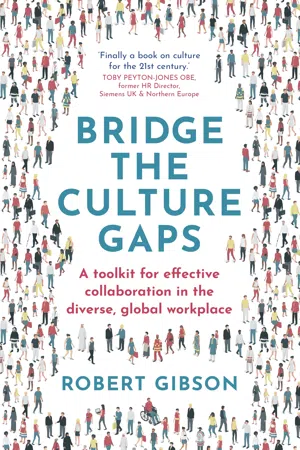
eBook - ePub
Bridge the Culture Gaps
A toolkit for effective collaboration in the diverse, global workplace
- 224 pages
- English
- ePUB (mobile friendly)
- Available on iOS & Android
eBook - ePub
Bridge the Culture Gaps
A toolkit for effective collaboration in the diverse, global workplace
About this book
Information
1
Mind the Gaps
The Impact of Culture
The real voyage of discovery consists not in seeking new landscapes, but in having new eyes.
Marcel Proust
Key questions
Why are cultural differences important?
What is culture?
Exercise 1.1
Before you start to read think about your attitude to culture. The exercise prepares you for the main topics covered in this book. If possible, discuss the statements briefly with a colleague or your team.
What do you think about the following statements?
- Globalization means that there is now a standard business culture everywhere.
- My company has been successful internationally for over 20 years. I travel a lot and don’t have any problems with people from other cultures.
- It is most efficient to work in a team with people who are like yourself.
- We pledge to get rid of unconscious bias in our organization.
- At last, I’ve found what I need. There’s a great book with cultural dimensions and data for the countries that I work with.
- I’m a native speaker of English so I’m lucky that I don’t have any problems communicating internationally.
- Face-to-face meetings are obviously better than virtual ones.
- My door is always open. If a team member has a problem, they just need to come and see me.
- The others accept my opinion because I am the expert in the team.
- All managers were sent the circular with the new policy. It has now been implemented globally.
- I’ve been there several times on holiday with my family. I’m sure we will have a great time when I start my three-year assignment.
- When in Rome do as the Romans do.
Suggested answers can be found in the answer key at the back of the book.
Importance of cultural differences
We live in a world of increasing volatility, uncertainty, complexity and ambiguity. The acronym ‘VUCA’, which originated in the US Army War College in the 1990s, is now widely used beyond the military context to describe the challenges of the twenty-first century. One of the key skills needed to thrive in the VUCA world is intercultural competence.
Globalization means that more people than ever before are coming into contact with cultures other than their own. Technology has created global hyperconnectivity. People are able to travel further, faster and more easily than in the past, the labour force is more mobile and diverse, and there are unprecedented numbers of people trying to escape from poverty, conflicts and natural disasters. Regardless of whether you talk about expats, migrants, refugees or global nomads, it is clear that many people are on the move.
The increase of offshoring, the internationalization of supply chains and global infrastructure projects, such as China’s ‘New Silk Road’ or ‘Belt and Road Initiative’, are leading to new levels of interdependency. Although globalization has led to a new degree of standardization, national and regional identities are asserting themselves, as is seen by the rise of nationalism in many parts of the world. There are four main areas where culture impacts international business:
1 Business travel
If you travel abroad for business, you inevitably experience cultural differences. For many business travellers this may not be more than a superficial experience. It is perfectly possible to stay in your comfort zone within an international ‘bubble’ even when you are thousands of miles away from home. You fly to an international airport, stay in a hotel belonging to an international chain, watch TV programmes on the same channels as at home and go to an office in a familiar corporate environment, to have meetings with colleagues who have studied at the same business school as you.
When you wake up in the morning you wonder where you are – the only thing that is different is the light switch on the wrong side of the bed. Even the breakfast buffet is similar, or even better, with noodles and dumplings as well as bacon and eggs, croissants and toast, muesli and porridge, and camel as well as cow’s milk. If you taste any local food, it is when you are invited for a meal at a local restaurant. Your culturally aware hosts have selected a place which is popular with international visitors; few, if any, locals are to be seen. You drink cola light and experience zero culture. All this can easily lead you to think that things are the same everywhere. Only when you dig deeper do you find out that this is not always the case.
2 International assignments
Individuals who go on a longer assignment to another country have more contact with local culture, and if your family goes with you then this will be even more intense. The working partner is happy in a familiar setting and stimulated by responsibilities unimaginable in their home country. For the ‘trailing spouse’ things aren’t so easy. They may have given up their career at home and can’t get a work permit abroad. Especially if you have children, the non-working partner may well have more contact with locals than you do and will have to deal with shopkeepers, teachers and doctors – all in a foreign language which they are struggling to learn. The dissatisfaction of your spouse or partner can put considerable strains on your relationship and, in extreme cases, lead to premature return. Most international assignments do not fail as dramatically as some of the literature might suggest, but too often the performance of the delegate on an international assignment is under par. It can be exciting to lead a nomadic life, but it can also make you rootless.
3 International teams
Even if you rarely, or never, go on business trips and aren’t among the relatively few people who are sent on a long-term delegation abroad, you are nevertheless increasingly likely to have to cope with cultural differences. As a member of a diverse team, you will need intercultural skills to collaborate effectively and be able to do this virtually, as many dispersed teams never, or rarely, meet face-to-face.
4 Going international
More and more people are affected by cross-border business. This ranges from setting up sales or offshore production facilities in different countries to being involved in joint-ventures or mergers and acquisitions. Under pressure to get things done quickly the culture factor is often neglected. The consequences are strained relationships, lost time and an escalation of costs.
There are many examples of failure to take cultural factors into account leading to loss of money and even lives. Barmeyer and Franklin (2016) describe how the Swedish furniture maker IKEA faced hefty criticism from Swedish customers when it produced a catalogue for the Arab world, with women airbrushed out of the pictures. Hammerich and Lewis (2013) show how the US retailer Walmart, which had been highly successful in the USA, tried to expand into Europe via Germany but had to withdraw after a few years. It lacked knowledge of work regulations and failed to take into account the behaviour of local customers. ‘Baggers’ at the cash tills to pack customers’ shopping, while expected in the USA, were looked on with suspicion by German shoppers. The ‘three-foot rule’, under which a shop worker had to ask the customer if they wanted any help if they approached them closer than three feet, was considered to be irritating rather than helpful. Employees objected to the morning warm-up workouts chanting the company song.
The sophisticated world of high tech is not exempt from cultural errors. In 1999 NASA’s $125 million Mars Climate Orbiter was lost in space because engineers failed to make a simple conversion from imperial/US customary units to metric units. Another infamous example is the crash of Asiana Airlines Flight 214 in 2013, one of a series of tragic accidents involving Korean planes. The Guardian (2014) reported that the pilot was being trained to fly the 777 and didn’t think he had the authority to abort the flight. ‘Among the other issues raised by the investigation are some that long have concerned aviation officials, including hesitancy by some pilots to abort a landing when things go awry or to challenge a captain’s actions.’ At that time many of the pilots had a military background, and Korean culture tends to favour steep hierarchies.
Culture and functions
Many books on intercultural business are for managers, and in the first wave of globalization they were the people at the forefront of coping with cultural differences. Of course, they still are, but it is time to shift the focus away from the jet-setting global executive and look more closely at the influence of cultural differences on people working in many other functions which are just as vital for business success.
Marketing
Marketing is perhaps the most obvious and celebrated area where cultural differences can have a major impact. Future demand for products and services is likely to increase most in China, India, Sub-Saharan Africa and Latin America as new middle classes emerge in these regions. To access these markets, businesses will need to understand the cultural differences which influence products, price, place and promotion.
Food for thought is provided by McDonald’s. While, of course, one of its strengths is that its products and processes are highly standardized, it has adapted to local demands. Spicy Wings are served in Beijing, McHuevo burgers in Montevideo, kosher Big Macs in Jerusalem and vegetarian McMaharajah burgers in Delhi. To be accepted in the Saudi Arabian market Starbucks even adapted its famous logo from the female siren figure to a crown.
An exclusive milliner in Munich found that customers from different cultures reacted very differently to the prices of her hand-made hats. While most locals wanted the highest quality for the lowest price, wealthy tourists from Russia looked at the most expensive hats on display first. They want to show their new-found wealth by wearing high-status fashion items.
At the beginning of the twenty-first century computer tomography scanners used by hospitals in Europe and the USA were considered to be too expensive and overengineered for use in regional hospitals in China. The European manufacturer realized that the equipment had to be adapted if it was to have a chance of being adopted in this market. ‘Culture-oriented usability’ means adapting the functionality to local needs.
Human resources (HR)
HR professionals are on the front line in the global ‘war for talent’. Demand for specialist staff and demographic changes mean that there is a worldwide shortage of skilled labour. It seems that the talents are winning the war.
‘They don’t even bother to send a photo or provide basic facts like their date of birth in their application,’ ...
Table of contents
- Cover
- Title
- Contents
- Introduction
- Chapter 1 Mind the Gaps: The Impact of Culture
- Chapter 2 Globality Check: Intercultural Competence
- Chapter 3 Return on Diversity: The Power of Difference
- Chapter 4 Brains and Bells: Making Better Decisions
- Chapter 5 The Intercultural Cocktail: Navigating Cultures
- Chapter 6 Decoding the Message: Intercultural Communication
- Chapter 7 Remotely Together: Global Virtual Collaboration
- Chapter 8 1 + 1 = 3: Inclusive Leadership
- Chapter 9 Oiling the Works: Influencing to Win
- Chapter 10 The Roller Coaster: Managing Global Change
- Chapter 11 The Barometer: Coping with International Assignments
- Chapter 12 Building Bridges: Strategies for Success
- Answer Key
- References
- About the Author
- Acknowledgements
Trusted by 375,005 students
Access to over 1.5 million titles for a fair monthly price.
Study more efficiently using our study tools.
Frequently asked questions
Yes, you can cancel anytime from the Subscription tab in your account settings on the Perlego website. Your subscription will stay active until the end of your current billing period. Learn how to cancel your subscription
No, books cannot be downloaded as external files, such as PDFs, for use outside of Perlego. However, you can download books within the Perlego app for offline reading on mobile or tablet. Learn how to download books offline
Perlego offers two plans: Essential and Complete
- Essential is ideal for learners and professionals who enjoy exploring a wide range of subjects. Access the Essential Library with 800,000+ trusted titles and best-sellers across business, personal growth, and the humanities. Includes unlimited reading time and Standard Read Aloud voice.
- Complete: Perfect for advanced learners and researchers needing full, unrestricted access. Unlock 1.5M+ books across hundreds of subjects, including academic and specialized titles. The Complete Plan also includes advanced features like Premium Read Aloud and Research Assistant.
We are an online textbook subscription service, where you can get access to an entire online library for less than the price of a single book per month. With over 1.5 million books across 990+ topics, we’ve got you covered! Learn about our mission
Look out for the read-aloud symbol on your next book to see if you can listen to it. The read-aloud tool reads text aloud for you, highlighting the text as it is being read. You can pause it, speed it up and slow it down. Learn more about Read Aloud
Yes! You can use the Perlego app on both iOS and Android devices to read anytime, anywhere — even offline. Perfect for commutes or when you’re on the go.
Please note we cannot support devices running on iOS 13 and Android 7 or earlier. Learn more about using the app
Please note we cannot support devices running on iOS 13 and Android 7 or earlier. Learn more about using the app
Yes, you can access Bridge the Culture Gaps by Robert Gibson in PDF and/or ePUB format, as well as other popular books in Business & Human Resource Management. We have over 1.5 million books available in our catalogue for you to explore.