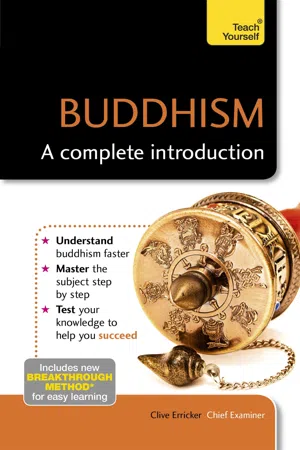
Buddhism: A Complete Introduction is a comprehensive and easy-to-use introduction, designed to give you everything you need to succeed, all in one place. Written by a leading expert, this book will help you if you are studying for an important exam or essay, or if you simply want to improve your knowledge. It is structured to mirror the way in which Buddhism is usually taught, starting with the life of the Buddha through to the prospects of Buddhism for the next generation.The book covers all the key areas that are considered central to Buddhism, including the Buddha's teachings, the scriptures and schools, the role of meditation and the moral and ethical context. It uses jargon-free English and includes features such as guided further reading and end of chapter questions to ensure that you understand all the concepts covered. Buddhism: A Complete Introduction includes: Chapter 1: Buddhists and Buddhism
Chapter 2: The life of the Buddha
Chapter 3: The Buddha's teaching
Chapter 4: Buddhist scriptures and schools
Chapter 5: Meditation and devotion
Chapter 6: Ethical conduct
Chapter 7: Moral Issues
Chapter 8: The social order
Chapter 9: Festivals and ceremonies
Chapter 10: Budhist today: East and West
Chapter 11: Transition, adaptation and influence: prospects for Buddhism in the twenty-first century
Learn effortlessly with a new easy-to-read page design and added features: Not got much time?
One, five and ten-minute introductions to key principles to get you started.Author insights
Lots of instant help with common problems and quick tips for success, based on the author's many years of experience.Test yourself
Tests in the book and online to keep track of your progress.Extend your knowledge
Extra online articles to give you a richer understanding of psychology.Five things to remember
Quick refreshers to help you remember the key facts.Try this
Innovative exercises illustrate what you've learnt and how to use it.
- 272 pages
- English
- ePUB (mobile friendly)
- Available on iOS & Android
eBook - ePub
Buddhism: A Complete Introduction: Teach Yourself
About this book
Information
Topic
Theology & ReligionSubtopic
Buddhism1
Buddhists and Buddhism

In this chapter you will learn:
• the basic Buddhist teachings and what makes them distinctive
• about the Buddhist idea of community
• about the practical effects of the Buddhist teachings and idea of community, and how these are related to the way Buddhists try to live their lives and respond to the world around them.


Thus shall ye think of all this fleeting world:
A star at dawn, a bubble in a stream,
A flash of lightning in a summer cloud,
A flickering lamp, a phantom, and a dream.
(The Diamond Sutra, 868 AD)
Who are Buddhists?
This is a question that many people in the West might well ask. The quotation above is from the Buddha himself, and one answer to our question is that Buddhists are those who understand the world in this way. But such a statement is easily misunderstood, so perhaps we should start by approaching our question in a less poetic fashion.
How would Buddhists today answer it? Some might reply that Buddhists are the followers of the Buddha and his teachings. While this is an accurate response, it is open to misunderstanding. For example, Buddhists do not follow the Buddha in the same way as Christians follow Christ. The reason for this is that the Buddha is not understood to be a god; nor did he teach his disciples a way to God. Indeed, he did not even claim that his teachings were a unique and original source of wisdom; but he did maintain that they had a very specific practical purpose and that they were meant to be useful.
Buddha always said, ‘Don’t take what I’m saying, just try to analyse as far as possible and see whether what I’m saying makes sense or not. If it doesn’t make sense, discard it. If it does make sense, then pick it up.’
(John Bowker, Worlds of Faith, BBC, 1983, p 134)
Another way of answering the question might be to say that Buddhists practise the dhamma (Pali) or dharma (Sanskrit). This word has a range of meanings that interconnect. Most importantly, dharma means ‘truth, law or teaching’. Thus, Buddhists are stressing that the Buddha’s teaching pointed to the truth; and moreover, that they are practising what the Buddha preached, truthful living, which is open to everyone.
The Dhamma can be practised by anybody. It can be practised by any man, woman, even by any child. It can be practised by someone in India, and it can be practised by someone in England. By someone in America, or someone in China. If there are people on the moon, it can be practised by those people on the moon. The Dhamma is universal … it’s for everybody – for every human being. Because every human being is the brother or sister of every other human being. The more we practise the Dhamma, the more we come together. It doesn’t matter whether we are born in India or whether we are born in England. If we practise the Dhamma, we are one. If we practise the Dhamma, we are brothers and sisters.
(Ven. Sangharakshita, Friends of the Western Buddhist Order Newsletter No. 54, p 2)
A third answer to the question would be to say that Buddhists are those who belong to the sangha. Sangha means ‘community’. Often it denotes the monastic community, but in a broader sense it refers to Buddhists in general. It could be said that Buddhists are part of the sangha in the way that Christians belong to the Church. However, the distinction of belonging to the Buddhist community is a commitment to living a life that cultivates well-being and happiness through following particular teachings, rules and practices. Sometimes the members of the sangha are referred to as ‘spiritual friends’.
For twenty-five centuries the Community has held Buddhism together. It is a refuge for the weary and an ideal of renunciation, a source of leadership and a standard of permanence in times of cultural change. It is an institution, and thus always available to those who need it. The religious vocation is given a home, the seeker is given a path, and the life of brotherhood is established as a model for all mankind.
(Stephan Beyer, The Buddhist Experience, Dickenson, 1974, p 65)
If we put all three answers together, we arrive at a more complete understanding of what it means to be a Buddhist.
The Three Jewels
The Buddha, dhamma, or dharma, and sangha are known as the Three Jewels, the implication of this being that they are what Buddhists hold most dear in life. It is usual to make a commitment to them; this takes place in a formal ceremony, which marks the intention to live a life that can be summarized in a verse found in the Dhammapada, a popular compilation of the Buddha’s teaching:
Not to do evil
To cultivate good
To purify one’s mind.
The importance of this commitment is made clearer by contrasting these Three Jewels with what Buddhists understand to be the unhelpful influences in life, also termed the three poisons: greed or craving, which is sometimes also termed desire; hatred or aversion; and delusion or ignorance. The opposition of these triple formulations succinctly defines the Buddhist path. By inclining to the former, and seeking to avoid the influence of the latter, Buddhists understand the purpose of life.
It is important to note that the three poisons (craving, aversion and delusion) should be understood as three aspects of the same condition or three inter-related symptoms. Each exacerbates the other; for example, craving increases aversion and aversion increases delusion, and vice-versa.
The Three Refuges
The Buddha, dhamma (dharma) and sangha are also known as the Three Refuges. Refuge is not used in its negative sense of hiding away from something; rather, it means that which provides safety and the possibility of growth, that which you can put your trust in. For this reason, the formal recitation of the Three Jewels is described as ‘going for refuge’. Although Buddhists of different persuasions would want to say a lot more about what this means and involves, we may begin here by saying that a Buddhist is one who has taken refuge in the Buddha, dhamma and sangha; from here, like the Buddha himself when he resolved to leave home in search of wisdom, he or she ‘goes forth’.
Through the simple act of reciting this formula three times, one declares oneself a Buddhist:
I go for refuge to the Buddha
I go for refuge to the Dhamma
I go for refuge to the Sangha.
The implication of this act is to radically reassess personal priorities and goals, as this passage written by a Japanese Buddhist teacher describes:
Taking refuge is the first step on th...
Table of contents
- Cover
- Title
- Contents
- Introduction
- How to use this book xxi
- 1 Buddhists and Buddhism
- 2 The life of the Buddha
- 3 The Buddha’s teaching
- 4 Buddhist scriptures and schools
- 5 Meditation and devotion
- 6 Ethical conduct
- 7 Moral issues
- 8 The social order
- 9 Festivals and ceremonies
- 10 Buddhism today: East and West
- 11 Transition, adaptation and influence: prospects for Buddhism in the twenty-first century
- Fact-check answers
- Copyright
Trusted by 375,005 students
Access to over 1.5 million titles for a fair monthly price.
Study more efficiently using our study tools.
Frequently asked questions
Yes, you can cancel anytime from the Subscription tab in your account settings on the Perlego website. Your subscription will stay active until the end of your current billing period. Learn how to cancel your subscription
No, books cannot be downloaded as external files, such as PDFs, for use outside of Perlego. However, you can download books within the Perlego app for offline reading on mobile or tablet. Learn how to download books offline
Perlego offers two plans: Essential and Complete
- Essential is ideal for learners and professionals who enjoy exploring a wide range of subjects. Access the Essential Library with 800,000+ trusted titles and best-sellers across business, personal growth, and the humanities. Includes unlimited reading time and Standard Read Aloud voice.
- Complete: Perfect for advanced learners and researchers needing full, unrestricted access. Unlock 1.5M+ books across hundreds of subjects, including academic and specialized titles. The Complete Plan also includes advanced features like Premium Read Aloud and Research Assistant.
We are an online textbook subscription service, where you can get access to an entire online library for less than the price of a single book per month. With over 1.5 million books across 990+ topics, we’ve got you covered! Learn about our mission
Look out for the read-aloud symbol on your next book to see if you can listen to it. The read-aloud tool reads text aloud for you, highlighting the text as it is being read. You can pause it, speed it up and slow it down. Learn more about Read Aloud
Yes! You can use the Perlego app on both iOS and Android devices to read anytime, anywhere — even offline. Perfect for commutes or when you’re on the go.
Please note we cannot support devices running on iOS 13 and Android 7 or earlier. Learn more about using the app
Please note we cannot support devices running on iOS 13 and Android 7 or earlier. Learn more about using the app
Yes, you can access Buddhism: A Complete Introduction: Teach Yourself by Clive Erricker in PDF and/or ePUB format, as well as other popular books in Theology & Religion & Buddhism. We have over 1.5 million books available in our catalogue for you to explore.