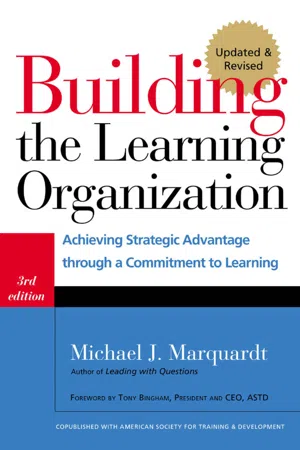
This essential best-practices toolkit with lessons from world-class leaders—FedEx, Nokia, Alcoa, Whirlpool, Microsoft, and others—tells how to successfully transform an organization into one that not only continually learns from its experiences but quickly translates that knowledge into improved performance. Rich with hands-on tools and dozens of new examples and case studies, this highly anticipated updated edition of the award-winning Building the Learning Organization puts the power of the author's Systems Learning Organization model into the hands of any manager who wants to participate in building, maintaining, and sustaining the next generation of learning organizations.
eBook - ePub
Building the Learning Organization
Mastering the Five Elements for Corporate Learning
- 240 pages
- English
- ePUB (mobile friendly)
- Available on iOS & Android
eBook - ePub
Building the Learning Organization
Mastering the Five Elements for Corporate Learning
About this book
Information
CHAPTER 1
The Emerging Need for Learning Organizations
Over the past ten years, numerous economic, social, and technological forces have intensified significantly, dramatically altering the work environment. These changes have occurred so rapidly and competition has increased so intensely that the large organizational dinosaurs with small pea-size brains that flourished in the twentieth century cannot survive in this new world of the twenty-first century. The survival of the fittest is quickly becoming the survival of the fittest to learn (Kline & Saunders, 2010; Frappaolo, 2006).
In his book Riding the Tiger: Doing Business in a Transforming World (1998), Harrison Owen writes, “There was a time when the prime business of business was to make a profit and a product. There is now a prior, prime business, which is to become an effective learning organization. Not that profit and product are no longer important, but without continual learning, profits and products will no longer be possible” (p. 1). Unless an organization continuously adapts to the environment via speedy, effective learning, it will die.
In short, external change and forces demand either organizational adaptation or organizational extinction. Only companies that can transform themselves into more intelligent, proficient engines of change will succeed in the new millennium. As Reginald Revans (1983), a pioneer of action learning, notes, “Learning inside must be equal to or greater than change occurring outside the organization or the organization dies” (p. 11). The new organization that emerges will need to possess greater knowledge, flexibility, speed, power, and learning ability so as to better confront the shifting needs of a new environment, more demanding customers, and smarter knowledge workers.
The successes are obvious. Organizations that learn faster will be able to adapt more quickly and thereby achieve significant strategic advantages in the global world of business. The new learning organization is able to harness the collective genius of its people at the individual, group, and system levels. This capability, combined with improved organizational status, technology, knowledge management, and people empowerment, will enable organizations to leave the competition in the dust.
Let us now examine the major winds of change that have compelled organizations to either learn or face extinction, forces that have altered the economic environment and the workplace as well as workers and customers. The eight most significant forces that have changed the business world and necessitate company-wide learning in the twenty-first century are:
1. Globalization and the global economy
2. Technology and the Internet
3. Radical transformation of the work world
4. Increased customer power
5. Emergence of knowledge and learning as major organizational assets
6. Changing roles and expectations of workers
7. Workplace diversity and mobility
8. Rapidly escalating change and chaos
Each of these forces must be understood and harnessed before the transformation to a learning organization is possible. Let’s briefly explore the influence of each one.
Force 1: Globalization and the Global Economy
We have entered the Global Age. We are an increasingly more global people with many common values and practices, and we are working increasingly for organizations with an international presence. Globalization has caused a convergence of economic and social forces, of interests and commitments, of values and tastes, of challenges and opportunities. We can easily communicate with people around the world because we share a global language (English) and a global medium for communications (computers and the Internet). The signs of the global marketplace are all around us. Consider the following statistics.
In 2010, U.S. corporations invested over $4 trillion abroad and employed more than 20 million overseas workers (Jackson, 2010); more than 100,000 U.S. firms are engaged in global ventures valued in excess of $2 trillion. For instance, McDonald’s operates more than 30,000 restaurants serving 58 million people a day in 120 countries, and Coca-Cola earns more money in Japan than in the United States. In addition, more than 70 percent of the profits for the $30 billion U.S. music industry is generated outside our country, and most big-bucks movies depend on global viewers for big profits.
At the same time, 10 percent of U.S. manufacturing is foreign owned and employs 4 million Americans. Mitsubishi USA is the United States’ fourth-largest exporter, and Toyota sells more cars than any U.S. auto manufacturer. Foreign investment in the United States has now surpassed $5 trillion. In fact, more than one-third of U.S. economic growth has been due to exports, which have provided jobs for more than 11 million Americans. In 2010, more than half the Ph.D.s in engineering, mathematics, and economics awarded by American universities went to citizens of other countries.
Worldwide, increasing numbers of companies, including Nokia, Xerox, Motorola, Honda, Samsung, and Microsoft, are manufacturing and selling chiefly outside their country of origin; for example, more than 70 percent of Canon’s employees work outside Japan. We hardly know anymore if a company is French, Japanese, Swedish, or American. The populations of many Gulf countries are made up of more foreign-born workers than native residents.
Financial markets are open twenty-four hours a day around the world, and global standards and regulations for trade and commerce, finance, products, and services have emerged.
Four main forces have brought us quickly to this global age: technology, television, trade, and travel. These four Ts have laid the groundwork for a more collective experience for people everywhere. People are watching the same movies, reading the same magazines, and dancing the same dances from Boston to Bangkok to Buenos Aires. We share tastes in food (hamburgers, pizza, tacos), fashion (jeans), and fun (Disneyland, rock music, television). Growing numbers of us speak a common language, English, which is now spoken by nearly 2 billion people in more than 150 countries, where it is either the first or the second language. Like all languages, English transmits culture and social values, and it is the global language of media, computers, and business. In addition, nearly 1 billion passengers fly the world’s airlines each year.
The global economy has in turn forced the creation of global organizations, companies that operate as if the entire world is their marketplace. They are fully integrated so that all their activities link, leverage, and compete on a worldwide scale. Global firms emphasize global operations above national or multinational ones. They use global sourcing for human resources, capital, technology, facilities, and raw materials. They deem cultural sensitivity to employees, customers, and patterns as critical to organizational success. A company is globalized when it develops a global corporate culture, strategy, and structure as well as global operations and people.
Although certain industries globalized earlier than others (especially telecommunications, electronics and computers, finance and banking, transportation, automotives, pharmaceuticals, petroleum, and biotechnology), every industry now has global players. The growing similarity in what customers want to purchase, including quality and price, has spurred tremendous opportunities, as well as tremendous pressures, to globalize. Even the largest firms in the biggest markets can no longer compete in domestic markets alone. Thinking and operating globally will be critical to organizational survival and growth in the twenty-first century.
Force 2: Technology and the Internet
Welcome to the new technological workplace, with teletraining, infostructures, and ubiquitous computers. In 1990, Alvin Toffler wrote that the advanced global economy and workplace cannot run for thirty seconds without computers; now it may be only for ten seconds. Yet today’s best computers and CAD/CAM systems will be Stone Age primitives within two years. The workplace will demand and require ever more technological advancements and innovations.
We already have technologies such as smart phones, mobile phones, cloud computing, optoelectronics, DVDs, information highways, local area networks (LANs) and wide area networks (WANs), groupware, virtual reality, and electronic classrooms. Workplace computer technology has progressed from mainframe to desktop to laptop to handheld. A significant proportion of a company’s operations requires computer-generated automation and customization. These technologies have become necessary for managing the data deluge so that we can learn faster in rapid-change, turbo-charged organizations. In a global economy—in which being informed, being in touch, and being there first can make all the difference between achieving success and failing—technology provides a big advantage indeed.
ORGANIZATIONAL IMPACT OF TECHNOLOGY
The impact of technology on organizations, management, and learning is mind-boggling. And it has only begun. The emerging power and applicability of technology will turn the world of work on its head. Because of technology, organizations will move toward being virtual rather than physical. People will be more closely linked to customers in Kuala Lumpur than to coworkers across the hall because of technology. Technology has made learning, not work itself, the prime purpose of business, and learning, as Zuboff (1988) proclaims, has become “the new form of labor.”
Technology increasingly requires that managers manage knowledge instead of people. Technology alters what, how, and why workers learn. Employees now need to train themselves through self-directed learning. And workplace learning no longer takes place in groups, at fixed times, and in certain locations for just-in-case purposes; instead, it is being implemented on the basis of exactly what’s needed, just in time, and only where it’s needed. The technology that has already restructured work will force those who are responsible for employee development to create ever more flexible and responsive learning and performance solutions (Waddill & Marquardt, 2011).
We inhabit a world in which virtual reality and interactive multimedia technologies will become commonplace. Cloud computing, smart phones, and worldwide access to Wi-Fi are a part of everyday life. Artificial intelligence technologies (expert- and knowledge-based systems, user interfaces that understand speech and natural language, sensory perception, and knowledge-based simulation) will be generally available. Intelligent tutoring systems will allow learner-based, self-paced instruction. Personalized digitized assistants, telecommunications and network advances, groupware, desktop videoconferencing, and collaborative software/group systems technology are now omnipresent in the workplace.
And the speed and impact of technology continue to accelerate. Trying to figure out the capabilities and future directions of this rapidly changing technology is a mind-boggling challenge. Let’s look at just a few of the already existing powers of technology.
Highly reliable, easily utilized, and affordable connectivity is rapidly becoming available anywhere, anytime. Superconducting transmission lines convey data up to one hundred times faster than fiber-optic networks: One line carries 1 trillion bits of information a second, enough to send the complete contents of the Library of Congress in two minutes.
Neural networks advance computer intelligence by utilizing associative “reasoning” to store information in patterned connections, thereby sequentially processing complex questions and commands using their own logic. Expert systems, a subset of artificial intelligence, are beginning to solve problems in ways that resemble the thinking processes of human experts.
The Internet is one of the most amazing and transforming technological additions to our lives. Its use is one of the fastest-growing phenomena the business world has ever seen, built from a base of less than 1,000 connected computers in the early 1980s to more than 2 billion today, and more and more of the searches are being performed by smart phones.
Intranets (for in-company connections) are rapidly catching up. Implementation of intranets is growing three times faster than electronic commercial applications, and almost all companies have intranet applications. As intranet sites continue to evolve, additional features will emerge. For example, it is already possible to engage in real-time training that combines a live mediator, online information, and remote attendees. Today, every business recognizes the critical value of developing comprehensive strategies for using both intranets and the Internet.
Some of the new high-tech learning programs have been called “the most powerful learning tools since the invention of the book.” With virtual reality, our minds are cut off from outside distractions and our attention is focused on powerful sensory stimulation (from a light-sound matrix) that bombards the imagination.
Technology is increasingly a part of all products and the total GNP, including aerospace, advanced industrial systems, and automotive. Already, nearly 30 percent of an automobile’s value is in its electronics. The computer service and computer software market has surpassed $900 billion, an increase of 50 percent in the past four years. Information technology is expected to form the basis of many of the most important products, services, and processes of the future.
The latest advance in technology is cloud computing, whereby shared servers provide resources, software, and data to computers and other devices on demand, as with the electricity grid. Cloud computing is a natural evolution of the widespread adoption of virtualization, service-oriented architecture, and utility computing. Details are abstracted from consumers, who no longer have need for expertise in, or control over, the technology infrastructure “in the cloud” that supports them.
Finally, an array of technological developments has now emerged for use in the home as well as in the office. These developments include the following:
• Integration of television, telecommunications, and computers through digitization and compression techniques
• Reduced costs and more flexible use and application of telecommunications through developments such as integrated services digital network (ISDN) lines, fiber optics, and cellular radio
• Increased portability through use of radio communications and miniaturization (cell phones, cameras, microphones, and high-resolution display screens)
• Expanded processing power resulting from new microchips and advanced software
• More powerful and user-friendly command and software tools that make it much easier for individuals to create and communicate their own materials
THE PROMISE OF NEW TECHNOLOGIES
The commodification of ultra-high technology offers spellbinding opportunities for creating new knowledge-exchange products. British Telecom, for example, thinks that future generations of portable phones could be installed in the user’s ear. A person could talk and simultaneously glimpse images or data pulled off the Internet and projected onto a magnifying mirror positioned beside one eye.
The technology of the future will respond to our voices and extend our senses. It will simulate complex phenomena—weather patterns, stock market crashes, environmental hazards—solving problems and predicting outcomes at a price anyone can afford. Computers, or networks of them, will become even more widespread as they are embedded in other objects or fixtures. These machines will reconfigure themselves as new applications are required. A whole new metaphor for computing is taking shape, patterned on the natural resilience and elegance of biological organisms. Patients may soon be able to have a detailed genetic analysis that will give them and their doctors an idea of what health risks they might face in the future (Venter, 2007).
To better...
Table of contents
- Cover Page
- Title Page
- Copyright Page
- Contents
- Foreword
- Preface
- Acknowledgments
- About the Author
- Chapter 1: The Emerging Need for Learning Organizations
- Chapter 2: The Systems Learning Organization Model
- Chapter 3: Building Learning Dynamics
- Chapter 4: Transforming the Organization for Learning Excellence
- Chapter 5: Empowering and Enabling People
- Chapter 6: Knowledge Management in Learning Organizations
- Chapter 7: Technology for Building the Learning Organization
- Chapter 8: Action Learning: The Cornerstone for Building a Learning Organization
- Chapter 9: Becoming a Learning Organization
- Bibliography
- Learning Organization Profile
- Glossary
- Index
Trusted by 375,005 students
Access to over 1.5 million titles for a fair monthly price.
Study more efficiently using our study tools.
Frequently asked questions
Yes, you can cancel anytime from the Subscription tab in your account settings on the Perlego website. Your subscription will stay active until the end of your current billing period. Learn how to cancel your subscription
No, books cannot be downloaded as external files, such as PDFs, for use outside of Perlego. However, you can download books within the Perlego app for offline reading on mobile or tablet. Learn how to download books offline
Perlego offers two plans: Essential and Complete
- Essential is ideal for learners and professionals who enjoy exploring a wide range of subjects. Access the Essential Library with 800,000+ trusted titles and best-sellers across business, personal growth, and the humanities. Includes unlimited reading time and Standard Read Aloud voice.
- Complete: Perfect for advanced learners and researchers needing full, unrestricted access. Unlock 1.5M+ books across hundreds of subjects, including academic and specialized titles. The Complete Plan also includes advanced features like Premium Read Aloud and Research Assistant.
We are an online textbook subscription service, where you can get access to an entire online library for less than the price of a single book per month. With over 1.5 million books across 990+ topics, we’ve got you covered! Learn about our mission
Look out for the read-aloud symbol on your next book to see if you can listen to it. The read-aloud tool reads text aloud for you, highlighting the text as it is being read. You can pause it, speed it up and slow it down. Learn more about Read Aloud
Yes! You can use the Perlego app on both iOS and Android devices to read anytime, anywhere — even offline. Perfect for commutes or when you’re on the go.
Please note we cannot support devices running on iOS 13 and Android 7 or earlier. Learn more about using the app
Please note we cannot support devices running on iOS 13 and Android 7 or earlier. Learn more about using the app
Yes, you can access Building the Learning Organization by Michael J. Marquardt in PDF and/or ePUB format, as well as other popular books in Business & Management. We have over 1.5 million books available in our catalogue for you to explore.