The ability to communicate clearly in business situations is crucial to anyone who wants to advance their career. Written by Martin Manser, a leading experts on business communication, this book quickly teaches you the insider secrets you need to know to in order to be understood. The highly motivational 'in a week' structure of the book provides seven straightforward chapters explaining the key points, and at the end there are optional questions to ensure you have taken it all in. There are also cartoons and diagrams throughout, to help make this book a more enjoyable and effective learning experience. So what are you waiting for? Let this book put you on the fast track to success!
- 128 pages
- English
- ePUB (mobile friendly)
- Available on iOS & Android
eBook - ePub
About this book
Information

Expressing yourself clearly is essential to communicating effectively and today we are going to look at the steps you need to take to express yourself clearly in writing.
First of all, we will consider general principles of writing, which apply especially to longer documents, and then we will consider specific media of writing: emails, letters and reports.
We can break down the writing process into different steps:
• thinking
• organizing
• writing your first draft
• editing your draft.
It is important to note that there are different steps; it isn’t simply a matter of typing an email with the first thing that comes into your mind and then pressing ‘send’!
The writing process
Thinking
Think about what you want to write. One good way of helping you start thinking what to write is to draw a pattern diagram (also known as a mind map). Take a blank piece of A4 paper. Arrange it in landscape position and write the subject matter of the report in the middle. (Write a word or few words, but not a whole sentence.) You may find it helpful to work in pencil, so that you can rub out what you write if necessary.
Now write around your central word(s) the different key aspects that come to your mind, maybe as a result of your reading. You don’t need to list ideas in order of importance; simply write them down. To begin with, you don’t need to join the ideas up with lines linking connected items.
If you get stuck at any point, ask yourself the question words why, how, what, who, when, where and how much. These may well set you thinking.
When I do this, I am often amazed at: (1) How easy the task is; it doesn’t feel like work! The ideas and concepts seem to flow naturally and spontaneously. (2) How valuable that piece of paper is. I have captured all (or at least some or many) of the key points. I don’t want to lose that piece of paper!
An example of a pattern diagram for a report on buying new computer systems can be seen in Figure 1 opposite.
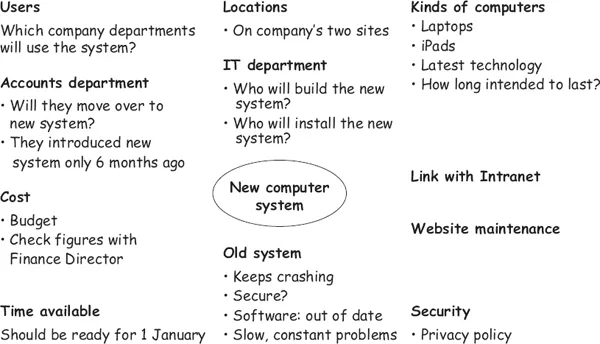
Figure 1 Example of a pattern diagram
Organizing
After you have completed the thinking stages with a pattern diagram, there are two further stages before you can begin writing. It is probably better to do them in the order shown here, but if that is difficult then do 2 then 1.
1 Refine the key message(s) of what you are trying to communicate. This can take some time – if you find it difficult, you can at least eliminate parts that are less important. For example, if you are analysing the disadvantages of an old computer system, then the exact technical details of the software are probably less significant than the fact that it has serious drawbacks, is out of date and no longer fulfils its original purpose.
To work out what your key message is, you also need to consider your document’s audience and response. If you are writing a report for your Finance Director, for example, you will want to present the financial facts (e.g. cost, return on investment) as your key message. However, if your Finance Director has already given the go-ahead to installing the new system and you are writing a report for colleagues in Research and Development who will be using the system, then your approach will be different. Your key message may then be on the usability of the new system and its advantages compared with the old one.
2 Organize the information. In other words, you need to arrange the information you are giving in a certain order. The aim here is to find the most appr...
Table of contents
- Cover
- Title
- About the Author
- Dedication
- Contents
- Introduction
- Sunday: Know your aims
- Monday: Listen carefully
- Tuesday: Write clearly
- Wednesday: Organize better meetings
- Thursday: Give successful presentations
- Friday: Build strong working relationships
- Saturday: Engage effectively online
- 7 × 7
- Answers
- Copyright
Trusted by 375,005 students
Access to over 1.5 million titles for a fair monthly price.
Study more efficiently using our study tools.
Frequently asked questions
Yes, you can cancel anytime from the Subscription tab in your account settings on the Perlego website. Your subscription will stay active until the end of your current billing period. Learn how to cancel your subscription
No, books cannot be downloaded as external files, such as PDFs, for use outside of Perlego. However, you can download books within the Perlego app for offline reading on mobile or tablet. Learn how to download books offline
Perlego offers two plans: Essential and Complete
- Essential is ideal for learners and professionals who enjoy exploring a wide range of subjects. Access the Essential Library with 800,000+ trusted titles and best-sellers across business, personal growth, and the humanities. Includes unlimited reading time and Standard Read Aloud voice.
- Complete: Perfect for advanced learners and researchers needing full, unrestricted access. Unlock 1.5M+ books across hundreds of subjects, including academic and specialized titles. The Complete Plan also includes advanced features like Premium Read Aloud and Research Assistant.
We are an online textbook subscription service, where you can get access to an entire online library for less than the price of a single book per month. With over 1.5 million books across 990+ topics, we’ve got you covered! Learn about our mission
Look out for the read-aloud symbol on your next book to see if you can listen to it. The read-aloud tool reads text aloud for you, highlighting the text as it is being read. You can pause it, speed it up and slow it down. Learn more about Read Aloud
Yes! You can use the Perlego app on both iOS and Android devices to read anytime, anywhere — even offline. Perfect for commutes or when you’re on the go.
Please note we cannot support devices running on iOS 13 and Android 7 or earlier. Learn more about using the app
Please note we cannot support devices running on iOS 13 and Android 7 or earlier. Learn more about using the app
Yes, you can access Business Communication In A Week by Martin Manser in PDF and/or ePUB format, as well as other popular books in Business & Business Communication. We have over 1.5 million books available in our catalogue for you to explore.