Understanding economics just got easier
The defining economic event of recent times - the global financial crisis of 2008 - was good for economists. That might sound crass but the truth is it stimulated interest in the subject by showing how important economic concerns are to our lives. Get the economy wrong and things we take for granted start to fall apart. It's a lesson that applies especially to those working in business, who, more than most, need to understand the subject. This book will help you by showing how economics can be useful for you in business, explaining economic ideas you might not have had time to explore previously and stimulating an interest in economics that encourages you to further study. Each of the seven chapters in Business Economics In A Week covers a different aspect of economics: - Sunday: Economics and your business
- Monday: The wonderful works of the market
- Tuesday: Businesses in the market
- Wednesday: Knowing your consumers
- Thursday: The limits of the market
- Friday: Business strategies and government macroeconomic policy
- Saturday: Surviving the international economy
eBook - ePub
Business Economics In A Week
What Economics Teaches You About Business In Seven Simple Steps
- 160 pages
- English
- ePUB (mobile friendly)
- Available on iOS & Android
eBook - ePub
Business Economics In A Week
What Economics Teaches You About Business In Seven Simple Steps
About this book
Information
Topic
Negocios y empresaSubtopic
Negocios en general
On Sunday we saw that governments provide laws to ensure that everybody follows market rules. And yesterday we discussed how governments intervene in markets to correct market failures. Both are microeconomic reasons for government intervention.
Today we are going to examine how governments intervene for macroeconomic reasons – those concerned with the whole economy. The reasons for this intervention come from macroeconomic theory, which shows how and why they go about intervening. Agreement is not always universal on what to do, but economists, and politicians, generally agree the objectives for the whole economy to be:
• full employment of labour
• stable prices (no or low inflation)
• steady economic growth
• balance of payments equilibrium
• an appropriate income and wealth distribution.
As well as theory, we will consider policies to achieve these objectives (apart from the balance of payments problem, considered tomorrow). We will also refer to events in the economy following the 2008 financial crisis. They revealed much about how governments influence economies.
Lots to look forward to, then, as our economics goes large!
‘The modern economic system fails to provide employment continuously for all who desire to work. This is generally recognized as one of the major defects of the system, and remedies for the defect are constantly being propounded.’
Joan Robinson
The business cycle
Economists suggest that over time output in economies follows a pattern called the business cycle. It looks like this:
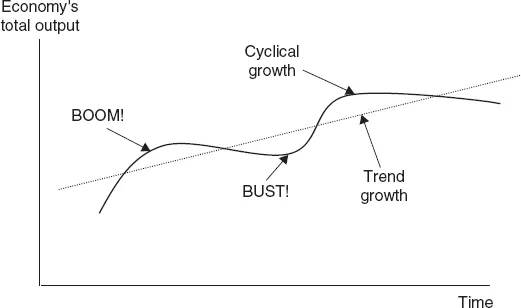
The business cycle
Output doesn’t follow the steady course of the line labelled ‘trend growth’ in the diagram. It seesaws around it along the line labelled ‘cyclical growth’. Output increases over time, but it’s not a smooth ride. When the economy booms, output grows, incomes of businesses and workers rise, prosperity reigns. In busts, output grows slowly or falls in a recession. Bad times bring lower sales, lower incomes and rising unemployment.
Recessions
A recession occurs when an economy’s output falls for two consecutive quarters of a year. The definition is arbitrary but it provides an agreed standard.
Businesses and the business cycle
Booms are usually considered good for businesses. Profits rise, businesses expand, and prospects of higher profits cause businesses to invest more. But booms can cause problems. Rising demand increases wages and raw material prices. Exporting becomes harder for businesses as higher prices cut overseas demand. In economics, every silver lining has its cloud.
During busts, profits fall, businesses fail and jobs disappear. The economist Joseph Schumpeter thought these effects benefit the economy. If inefficient businesses shut down, it releases resources for efficient businesses when the next boom comes. He called it ‘creative destruction’. He saw a silver lining.
And busts have other benefits. Prices and costs fall as demand falls, opportunities occur to capture sales of failed competitors, and, looking ahead, good times will return.
Managing the business cycle
Although optimism in a recession is not easy, the business cycle suggests that, if a business survives the downturn (as most do), good times return. Businesses should prepare for the inevitable recovery. That said, businesses, workers, consumers and governments would find life easier if the economy grew steadily. Not knowing when to expect booms or busts makes planning harder. With steady growth, people know where they stand.
Recognizing this, the economist John Maynard Keynes proposed that governments could use macroeconomic policy to ‘damp down’ the business cycle. Output still varies, but much less, and that helps everybody.
A Minsky moment
By the early 2000s many economists thought the business cycle was tamed. Hyman Minsky, an American economist, writing in 1992, disagreed. He thought economic crises remained likely. During booms, he argued, people become confident and borrow to buy assets such as property. But these assets eventually lose value as returns on them fall. Reduced wealth means demand falls drastically. The economic crisis follows. This is a ‘Minsky moment’. Many think the events of 2008 were such a moment.
A macroeconomic model of the economy
To understand how macroeconomic policy works in a ‘countercyclical’ manner, as economists say, we need our model of the economy from Sunday. That showed income circulating between firms and households. We will also add to it two other sectors, the government and overseas markets.
How the model works
As the model is circul...
Table of contents
- Cover
- Title
- About the Author
- Dedication
- Contents
- Introduction
- Sunday: Economics and your business
- Monday: The wonderful works of the market
- Tuesday: Businesses in the market
- Wednesday: Knowing your consumers
- Thursday: The limits of the market
- Friday: Business strategies and government macroeconomic policy
- Saturday: Surviving the international economy
- 7 × 7
- Answers
- Copyright
Trusted by 375,005 students
Access to over 1.5 million titles for a fair monthly price.
Study more efficiently using our study tools.
Frequently asked questions
Yes, you can cancel anytime from the Subscription tab in your account settings on the Perlego website. Your subscription will stay active until the end of your current billing period. Learn how to cancel your subscription
No, books cannot be downloaded as external files, such as PDFs, for use outside of Perlego. However, you can download books within the Perlego app for offline reading on mobile or tablet. Learn how to download books offline
Perlego offers two plans: Essential and Complete
- Essential is ideal for learners and professionals who enjoy exploring a wide range of subjects. Access the Essential Library with 800,000+ trusted titles and best-sellers across business, personal growth, and the humanities. Includes unlimited reading time and Standard Read Aloud voice.
- Complete: Perfect for advanced learners and researchers needing full, unrestricted access. Unlock 1.5M+ books across hundreds of subjects, including academic and specialized titles. The Complete Plan also includes advanced features like Premium Read Aloud and Research Assistant.
We are an online textbook subscription service, where you can get access to an entire online library for less than the price of a single book per month. With over 1.5 million books across 990+ topics, we’ve got you covered! Learn about our mission
Look out for the read-aloud symbol on your next book to see if you can listen to it. The read-aloud tool reads text aloud for you, highlighting the text as it is being read. You can pause it, speed it up and slow it down. Learn more about Read Aloud
Yes! You can use the Perlego app on both iOS and Android devices to read anytime, anywhere — even offline. Perfect for commutes or when you’re on the go.
Please note we cannot support devices running on iOS 13 and Android 7 or earlier. Learn more about using the app
Please note we cannot support devices running on iOS 13 and Android 7 or earlier. Learn more about using the app
Yes, you can access Business Economics In A Week by Thomas Coskeran in PDF and/or ePUB format, as well as other popular books in Negocios y empresa & Negocios en general. We have over 1.5 million books available in our catalogue for you to explore.