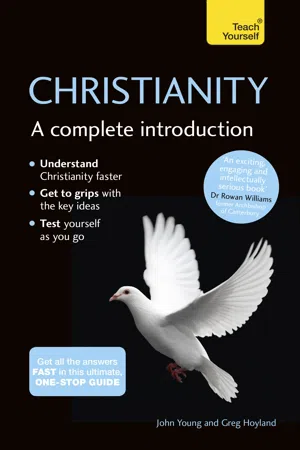
'An exciting, engaging and intellectually serious book' Dr Rowan Williams, 104th Archbishop of Canterbury 'I think it's brilliant!' Bishop Stephen Cottrell How is it that a faith that began in 1st century Palestine with a handful of followers has become the largest movement the world has ever known? Christianity: A Complete Introduction traces the story of the Christian faith from sandals to cyberspace. It describes the origins and key ideas of Christianity and gives an account of how it looks in the modern world. Socially, scientifically, economically and politically, Christianity today inhabits a very different world from that of Jesus of Nazareth and his early disciples. Yet it seems to possess an inherent ability to survive and thrive in the face of great change. It remains a compelling and powerful faith in the modern world, with a rich and diverse heritage. Whether you are preparing for an essay, studying for an exam, or simply want to expand your knowledge, Christianity: A Complete Introduction is your go-to guide.
- 368 pages
- English
- ePUB (mobile friendly)
- Available on iOS & Android
eBook - ePub
Christianity: A Complete Introduction: Teach Yourself
About this book
Information
Topic
Theology & ReligionSubtopic
Christian DenominationsPart 1:
The central figure
1
Jesus Christ

In this chapter you will learn about:
• the life of Jesus
• some of the teaching of Jesus
• the events at the end of his earthly life.


‘It is time, I believe, to recognize not only who Jesus was in his own day, despite his contemporaries’ failure to recognize him, but also who he is, and will be, for our own.’
T. Wright, Simply Jesus (SPCK, 2011), p.7.
Jesus has been the focus of more study, more controversy and more art than any other figure. He is the one who has ‘chopped history in half’: BC before Christ; AD Anno Domini, i.e. ‘in the year of Our Lord’ (sometimes called CE or Common Era). In today’s world, millions of people – from every continent and nearly every country – claim some allegiance to him. Christians make up about one-third of the world’s population.
Ralph Waldo Emerson, the American essayist, summed up the significance of Jesus when he said that his impact is not so much written on, as ploughed into, the history of the world. All this is remarkable enough. But when we consider the short and rather obscure life of Jesus, it becomes extraordinary. However, according to the Bible, there were clear indications of his greatness even before his birth.
The life of Jesus
According to St Luke’s Gospel, the story began in the district of Galilee in Israel. A young woman, betrothed but not yet married to a man called Joseph, was visited by the angel Gabriel. He announced (hence ‘the Annunciation’ – beloved by medieval artists) that she had been chosen by God to give birth to a son who was to be called Jesus. Troubled as Mary was by this news (‘How will this be, since I am a virgin?’) she declared herself ready to do God’s will: ‘I am the Lord’s Servant’ (Luke 1:38).
The child was due to be born at the time of a Roman census. For Mary and Joseph this entailed a journey of about 70 miles from Nazareth to Bethlehem near Jerusalem. It was in Bethlehem that the baby was born. Matthew and Luke tell us that the child was visited by local shepherds and wise men from eastern lands and that a choir from heaven celebrated the birth. King Herod, on hearing from the eastern travellers of the birth of ‘a king’, tried to kill the infant Jesus. But Mary, Joseph and Jesus (‘the holy family’) escaped to Egypt and so fulfilled a prophecy (Matthew 2:15). Eventually they returned to Nazareth, where Joseph earned his living as a carpenter – a craft which he taught his son.
We are told little about the early years of Jesus, apart from one visit to Jerusalem when he was 12 years old. On that occasion Jesus went to the Temple, where he listened to the teachers and asked and answered questions: ‘Everyone who heard him was amazed at his understanding and his answers’ (Luke 2:47).
We learn nothing more for nearly 20 years, when Jesus was baptized by his cousin John (‘the Baptist’) in the river Jordan. John was preaching a new message of repentance and revival and challenging the establishment religion. He recognized in Jesus someone who would carry that message even further and as he baptized Jesus a voice from heaven declared, ‘This is my Son, whom I love; with him I am well pleased’ (Matthew 3:17). Then Jesus was led by God’s Spirit into the desert where he fasted and wrestled with the devil for 40 days. This time of temptation was to fashion the shape of his ministry. Now he was ready.
After spending a night in prayer, Jesus called 12 disciples and set out on his travels around his small country. He began his ministry in his home area in the north, in the towns, villages and countryside around the Lake of Galilee. The four Gospels record some of his deeds and words. Jesus healed people with a wide range of diseases: a paralysed man, a man with leprosy, a woman who suffered from excessive bleeding, a man possessed by a demon. He even raised the dead (Luke 7:15; John 11:43).
He also showed power over nature: he turned water into wine, stilled a storm, and fed a huge crowd from five loaves and two fish. Miracle workers were common in first-century Palestine and the stories of Jesus’s miracles in the Gospels are remarkably restrained, not performed as ‘tricks’ but to underline his authority. Jesus became known as a powerful and controversial teacher, who was willing to challenge established traditions. Time for rest, solitude and prayer was limited, but he ‘often withdrew to lonely places and prayed’ (Luke 5:16)
 | Case study |
The birth narratives in the New Testament raise questions:
• Why do only two of the four Gospels carry these narratives?
• Why are the two accounts we have (Matthew and Luke) so different: one focusing on Mary, the other on Joseph?
• Did the birth of Jesus not matter to Mark and John?
• Are we intended to read these accounts of the birth of Jesus as history?
• Why does Paul not mention the Virgin Birth in any of his letters?
There is lively debate among scholars concerning the way in which the first Christians regarded Jesus of Nazareth. This is sometimes posed as a question: is the ‘Jesus of history’ the same as the ‘Christ of faith’? Some scholars believe that the early Christians used Jesus’s teaching freely, adapting it to their own purposes; even inventing sayings of their own. Others are convinced that the first believers treated his teaching with great reverence and took trouble to remember and record it accurately. They also point out that it would take someone of the stature of Jesus to invent the teaching of Jesus.
We must acknowledge that the early Christians were not just writing an historical record of the life of Jesus. For them it was the impact of his life rather than the facts of his life which mattered. The modern understandings of history and historical evidence are just that – modern. The facts about Jesus’s life were well known at the time so ‘proving’ them mattered less. What was far more important was to grapple with making sense of who Jesus was. Their writings are not primarily concerned with history but with theology.
This can be frustrating for us. In the modern era there have been a number of ‘quests for the historical Jesus’ – attempts to recover the human story in more detail. The physician and missionary Albert Schweitzer was one of th...
Table of contents
- Cover
- Title
- Aobut the Author
- Dedication
- Contents
- Acknowledgements
- Beginnings
- Part 1: The central figure
- Part 2: Christian belief and practice
- Part 3: The Christian Church
- Part 4: The modern world
- Glossary
- Taking it further
- Fact-check answers
- Copyright
Trusted by 375,005 students
Access to over 1.5 million titles for a fair monthly price.
Study more efficiently using our study tools.
Frequently asked questions
Yes, you can cancel anytime from the Subscription tab in your account settings on the Perlego website. Your subscription will stay active until the end of your current billing period. Learn how to cancel your subscription
No, books cannot be downloaded as external files, such as PDFs, for use outside of Perlego. However, you can download books within the Perlego app for offline reading on mobile or tablet. Learn how to download books offline
Perlego offers two plans: Essential and Complete
- Essential is ideal for learners and professionals who enjoy exploring a wide range of subjects. Access the Essential Library with 800,000+ trusted titles and best-sellers across business, personal growth, and the humanities. Includes unlimited reading time and Standard Read Aloud voice.
- Complete: Perfect for advanced learners and researchers needing full, unrestricted access. Unlock 1.5M+ books across hundreds of subjects, including academic and specialized titles. The Complete Plan also includes advanced features like Premium Read Aloud and Research Assistant.
We are an online textbook subscription service, where you can get access to an entire online library for less than the price of a single book per month. With over 1.5 million books across 990+ topics, we’ve got you covered! Learn about our mission
Look out for the read-aloud symbol on your next book to see if you can listen to it. The read-aloud tool reads text aloud for you, highlighting the text as it is being read. You can pause it, speed it up and slow it down. Learn more about Read Aloud
Yes! You can use the Perlego app on both iOS and Android devices to read anytime, anywhere — even offline. Perfect for commutes or when you’re on the go.
Please note we cannot support devices running on iOS 13 and Android 7 or earlier. Learn more about using the app
Please note we cannot support devices running on iOS 13 and Android 7 or earlier. Learn more about using the app
Yes, you can access Christianity: A Complete Introduction: Teach Yourself by John Young,Greg Hoyland in PDF and/or ePUB format, as well as other popular books in Theology & Religion & Christian Denominations. We have over 1.5 million books available in our catalogue for you to explore.