Modern Western European culture would have been impossible without the civilizations of ancient Greece and Rome. The disciplines of philosophy, drama, history, art, and mathematics all owe an immense debt to these two Mediterranean cultures. At the same time, there are aspects of this legacy that are less worthy of celebration. Slavery went hand in hand with democracy. The pursuit of beauty coexisted with breathtaking acts of brutality. Ancient writers have been used to support everything from colonial expansion and the trade in human flesh to the rejection of female franchise. Women suffered for centuries at the hands of doctors who were guided by bizarre notions found in ancient gynecological treatises. This book attempts to address two questions. Firstly, what are the distinctive features of the cultures of Greek and Roman that separate them out from other ancient civilizations? Secondly, why have these cultures been so influential on subsequent societies? It is this dual focus that makes this book distinctive. This book is not just about Greece and Rome. It is equally about why Greece and Rome mattered to people in the past, and why they should matter to us today. Each chapter in the book begins with a story or an incident that is designed to illustrate these themes. The first three chapters of the books (Homer, Athens, and Rome) are intended to give a chronological overview of the period. They will orientate the reader to the key places, actors, and historical trends. The remaining chapters focus on some of the most important and influential aspects of Greco-Roman culture.
- 160 pages
- English
- ePUB (mobile friendly)
- Available on iOS & Android
eBook - ePub
Classical World: All That Matters
About this book
Information

Beginnings
‘Now there are cornfields where Troy once was.’
Ovid, Heroides (1.53)
In the beginning was chaos. Or so the Greek poets claimed. It is an oddly comforting idea. Chaos – nothingness, the void – at least gives you a starting point for your story. You know where to begin. It is literally Ground Zero. It also gives the account a feeling of progress. After all, anything is better than nothing.
For the classical world, finding a beginning is not so easy. There is no one single moment of creation. The classical world emerges slowly into view and it is not a story of unimpeded success. Things go backwards as well as forwards. The roots of the classical world run deep. Traces of human habitation in the Mediterranean go back as far as 40,000 years. The lifestyle of these early inhabitants was often much better than their European neighbours to the north. As early as 20,000 BC we can see the great advantages that living on the shores of the Mediterranean brought for the interchange of goods and ideas. For example, we find at a number of Palaeolithic and Neolithic sites a bustling trade in blades made from obsidian brought some considerable distance from the island of Melos in the Cyclades. This hard volcanic glass produced blades of exceptional sharpness. Even today obsidian scalpels cut better than their steel rivals.
The ability of the Mediterranean Sea to act as the conduit for goods and ideas meant that the revolutions in agriculture and the domestication of plants and animals arrived in Greece from the Near East much earlier than they did in central Europe or Britain. The cultivation of the famous ‘Mediterranean triad’ of grain, grapes and olives begins not long after we see similar experiments in cultivation in the Near East at around 8,000 BC. It was this ‘networking’ of Mediterranean communities that was responsible for the tremendous advancements we see in Greece and later Italy as these cultures were able to take advantage of the more sophisticated civilizations of Egypt, Phoenicia, and Mesopotamia.
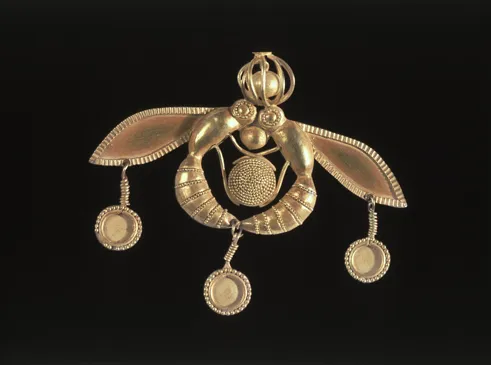

The Greeks were also adept at establishing their own internal networks. The palatial system that developed under the Minoan civilization (c. 3500–1100 BC) on the island of Crete unified large numbers of villages and groups under the control of a central authority. These organizations were able to harness agricultural surplus and transform it into highly developed economies that could support elaborate suprastructures: palaces, complex religious and social practices, and large bureaucracies to administer it all.
Visiting palatial sites like Knossos today, it is hard not to be impressed by both the size and sophistication of this culture. The palace is enormous and complex. Tourists are always struck by the beauty of the frescoes adorning the walls. The treasures unearthed here show exquisite workmanship using precious materials such as imported gold and ivory. It is easy to understand why Sir Arthur Evans (1851–1941), who unearthed this site in 1901, thought that he had discovered the palace of King Minos, the most famous mythical king of Crete. Given Minos’ association with the Minotaur (the monster was his stepson), the occurrence of bull imagery in the decoration of this labyrinthine palace only seemed to confirm the relationship. Certainly ‘Minoan’, the name he gave this civilization in honour of the king, has remained.
Evans was not the only archaeologist who thought that he was unearthing the stuff of legend. A few decades earlier, on 30 November 1876, the archaeologist Heinrich Schliemann (1822–90), at the site of Mycenae, claimed to have discovered the tomb of Agamemnon, the leader of the Greek forces at Troy. Handling the gold facemask that once covered a king’s face, Schliemann felt a moment of intimate connection: ‘I have gazed on the face of Agamemnon’, he is reported to have said.
In fact, Schliemann had discovered the tomb, not of Agamemnon, but of one of the important rulers of the Mycenaean civilization (c. 1600–1200 BC), named after the site Schliemann excavated.
This civilization flourished from c. 1400–1200 BC when it took over from the earlier Minoan civilization as the dominant power in Greece. The Minoan language (Linear A) remains unintelligible to us, but in the 1950s the language of the Mycenaeans (Linear B) was deciphered by Michael Ventris and John Chadwick. Mycenaean texts present a complex stratified society in which a considerable number of subsidiary officials administer large areas under the control of a ruler based in a central palace. Goods and services were centralized in the palace, which functioned as both storehouse and manufacturing centre.
Evidence reveals that the Mycenaeans were well connected with civilizations outside of Greece. Close ties with both Egypt and most of the principal Near Eastern kingdoms are documented. Textiles and high quality metalwork were popular exports. We find Mycenaean gold, silver and bronze work travelling as far as Italy and the Levant.
The Minoan and Mycenaean civilizations establish a formula for how to succeed in the Mediterranean. The ability to control and harness often-precious natural resources needs to be coupled with a facility to take advantage of the networking opportunities that the Mediterranean provides. It was impossible to stand alone. This last point is underlined by the collapse of Mycenaean civilization. At around 1200 BC, we notice the start of the collapse of important palaces. Fires consume large parts of them. Within the space of two generations, a number of sites are abandoned, never to be reoccupied. The central government collapses. Only dim memories of Mycenaean civilization remained in the Greek consciousness to be reworked as decorative ornaments in oral epic poems such as the Iliad and Odyssey.
The precise cause of the collapse remains debatable. However, what is clear is that this collapse was not happening in isolation. In the same decades as the collapse of the Mycenaean palaces, the Eastern Mediterranean is thrown into a huge turmoil that is felt as far as Sicily and southern Italy. The great Hittite Empire in Asia Minor falls apart. Many of its cities are abandoned or destroyed. Egypt is invaded by mysterious ‘sea people’ who plunder the kingdom and leave it immeasurably weakened.
The period after the collapse of the Mycenaean civilization used to be known as the ‘Dark Ages’. These days we prefer less pejorative terms such as the ‘Iron Age’. Certainly life in the ‘Dark Ages’ was not as bleak as scholars used to think. Yet, it is clear that the turmoil around 1200 BC took its toll. The sundered networks took a long time to recover and substantial reorganization needed to occur in both the Mediterranean and the Near East before either group was ready to engage with each other again on a scale that matched previous exchanges. Yet the formula persisted: as Greece emerged resurgent, the twin principles of internal organization and external engagement are once more recognizable. Politics and diplomacy are the bedrock of any successful state. It is these that keep chaos at bay.

Athens – the ‘lucky’ city
‘Our government favours the many instead of the few; this is why it is called a democracy. Our laws afford equal justice to all. Advancement depends not on social standing, but on ability.’
Pericles, Athenian statesman (c. 495–429 BC)
Athens was the city that never was supposed to succeed. It was the runt of the litter. If you had asked a Greek in the sixth century BC which city-state was destined for greatness, he would have named numerous cities ahead of Athens. Sparta by that time had established itself as ruler over large sections of the Peloponnese. Corinth was an impressive commercial capital whose goods could be found all over the Aegean. Miletus on the coast of Asia Minor was not only established as one of the centres for ancient philosophy and science, but was also an important wealthy power, having founded over 90 colonies that spread from the Black Sea, down the coast of Turkey, and out into the Mediterranean. There were dozens of contenders who had a better chance of making it big than Athens.
Yet in the space of a little over 100 years, Athens went from the back of the pack to its undisputed leader. It was a rise that astonished even the Ancients. Writing at the end of the first century AD, the biographer and essayist Plutarch wondered how Athens achieved greatness. Was it luck or cunning? Did Athens deserve to be more famous for her generals or her artists and philosophers? These days we might be surprised to learn that it was her success in military exploits that Plutarch identified as Athens’ greatest asset.
For us, Athens is synonymous with the rich life of the mind and the skills of her artisans. It is her cultural products that we admire so much. Her reputation rests on her democratic innovations, the elegance of the Parthenon, the power of her tragedy, and the cleverness of her philosophic schools. Yet all of those marvels, for which she is justly admired, could not have occurred had Athens not also been one of the most effective and ruthless military powers of her age.
Admittedly, Athens enjoyed some natural advantages. It is important to remember that most Greek city-states were tiny. The average Greek city-state occupied a landmass of between 50 and 100 square kilometres and had a population of approximately 400 to 900 male citizens. In contrast, the area of Attica is approximately 2,650 km2 and during her height Athens had a population of 30,000 male citizens. Along with wives, children, slaves, and foreigners, this gave the city a population of about 300,000.
Indeed, the difficulty of marshalling Athens’ resources may explain why the city was such a late developer. The early history of the city is one beset by stories of infighting among regional factions. Greek myth speaks of Attica (the area surrounding Athens) as home to 12 independent cities and, while this overstates the degree of urban sophistication of archaic Attica, it nevertheless correctly captures the level of intense regionalism. The unification of Attica under a central urban authority based in Athens was neither an easy process nor, ultimately, a completely successful one. Even in the fifth century BC, long after the unification of Attica, the historian Thucydides describes the emotional wrench that many Athenians felt as they left their villages in the country and went to cower behind the walls of the city as the opposing forces from Sparta invaded Attica. For many Athenian citizens, their ties with their local region were as, if not more, important than their ties to the city of Athens.

The Athenians liked to pretend it was the mythical King Theseus who unified the region of Attica under the control of Athens. Theseus – who slew the Minotaur and performed numerous amazing tasks including ridding the countryside of dangerous monsters and evil bandits – was Athens’ answer to Heracles, and his feats were clearly modelled on his more famous predecessor. On the Athenian treasury at Delphi the sculptural decoration features the labours of Heracles and Theseus side-by-side with the implicit invitation to compare the efforts of the two great heroes. Almost every indigenous institution that the Athenians valued was attributed to Theseus.
In fact, the person who should get the greatest credit for unifying Athens was not a mythical monster slayer, but an ambitious politician by the name of Pisistratus (c. 600–527 BC). His attempts to seize power in Athens dominate the second half of sixth century Athenian history. Our undoubtedly exaggerated accounts stress that there was nothing that Pisistratus would not do to get into power. He faked attacks on himself in order to be awarded a bodyguard. He dressed a woman up as the goddess Athena in an attempt to fool the Athenians into believing that he enjoyed divine favour. Finally, he invaded Attica with the backing of mercenaries in c. 546 BC and established himself as tyrant of Athens for almost 20 years. When he died, he was succeeded briefly by his sons Hippias and Hipparchus.
The reign of the Pisistratids (as they are known) represents an early Golden Age for Athens. The Pisistratids provided Athens with her first aqueduct, securing a water supply for the city. They encouraged the rural economy by promoting the cultivation of the olive. Under their influence Athenian traders and trade goods travelled as far north as the Black Sea and as far west as France. Pisistratus deserves credit: he made Athens look beyond her borders to seek a role on the Panhellenic stage. He put an end to factional infighting through a combination of exiling, bribing and neutralizing his opponents. He reorganized the city’s central marketplace and undertook an extensive building programme. A sign of this regime’s ambition can be seen in the enormous temple to Olympian Zeus which the Pisistratids initiated – a structure so large that it was not completed until many centuries later in the reign of the Roman Emperor Hadrian. Today its enormous columns remain one of Athens’ most striking landmarks. Under Pisistratus’ rule, Athens became a centre for poets, artists and thinkers.
Of course, no democratic Athenian would ever admit (at least not in public) that tyranny had its benefits. Pisistratus’ name was maligne...
Table of contents
- Cover
- Title
- Contents
- About the author
- Acknowledgements
- 1 Beginnings
- 2 Athens – the ‘lucky’ city
- 3 Rome
- 4 Women and slaves
- 5 Greek drama
- 6 Roman spectacles
- 7 Material culture
- 8 Ancient philosophy
- 100 Ideas
- Further reading
- Copyright
Trusted by 375,005 students
Access to over 1.5 million titles for a fair monthly price.
Study more efficiently using our study tools.
Frequently asked questions
Yes, you can cancel anytime from the Subscription tab in your account settings on the Perlego website. Your subscription will stay active until the end of your current billing period. Learn how to cancel your subscription
No, books cannot be downloaded as external files, such as PDFs, for use outside of Perlego. However, you can download books within the Perlego app for offline reading on mobile or tablet. Learn how to download books offline
Perlego offers two plans: Essential and Complete
- Essential is ideal for learners and professionals who enjoy exploring a wide range of subjects. Access the Essential Library with 800,000+ trusted titles and best-sellers across business, personal growth, and the humanities. Includes unlimited reading time and Standard Read Aloud voice.
- Complete: Perfect for advanced learners and researchers needing full, unrestricted access. Unlock 1.5M+ books across hundreds of subjects, including academic and specialized titles. The Complete Plan also includes advanced features like Premium Read Aloud and Research Assistant.
We are an online textbook subscription service, where you can get access to an entire online library for less than the price of a single book per month. With over 1.5 million books across 990+ topics, we’ve got you covered! Learn about our mission
Look out for the read-aloud symbol on your next book to see if you can listen to it. The read-aloud tool reads text aloud for you, highlighting the text as it is being read. You can pause it, speed it up and slow it down. Learn more about Read Aloud
Yes! You can use the Perlego app on both iOS and Android devices to read anytime, anywhere — even offline. Perfect for commutes or when you’re on the go.
Please note we cannot support devices running on iOS 13 and Android 7 or earlier. Learn more about using the app
Please note we cannot support devices running on iOS 13 and Android 7 or earlier. Learn more about using the app
Yes, you can access Classical World: All That Matters by Alastair Blanshard in PDF and/or ePUB format, as well as other popular books in History & Ancient History. We have over 1.5 million books available in our catalogue for you to explore.