As coaches and clients increasingly realise, the demands of business mean that it is now vital to integrate, understand and leverage cultural differences across countries and corporations. This work bridges the gap between coaching and interculturalism.
eBook - ePub
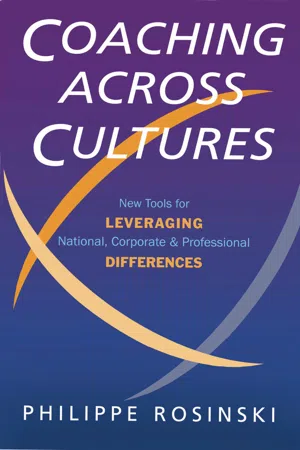
Coaching Across Cultures
New Tools for Leveraging National, Corporate and Professional Differences
- 336 pages
- English
- ePUB (mobile friendly)
- Available on iOS & Android
eBook - ePub
Coaching Across Cultures
New Tools for Leveraging National, Corporate and Professional Differences
About this book
Information
Part I
Coaching and Culture
Chapter 1
The Recent Discipline of Coaching
Coaching is a pragmatic humanism. Coaching values well-being and fulfillment. It emphasizes self-care, quality of life, and human growth. I call this the “being” side. Coaching is also a method to enhance performance and a leadership style that gets results. This I call the “doing” side. In other words, well-being is important, and human development is the prime method for getting results (see chapter 6 for more on being versus doing).
The emphasis on self-care should not be confused with selfishness. By giving themselves permission to take great care of their own needs and dreams (perhaps thanks to your coaching), coachees increase their energy level, connect with their passions, and enhance their capacity to serve fellow humans.
Coaches help people find practical solutions to the concrete challenges they face: how can people make the most of their time, improve leadership and communication, achieve ambitious work goals, have a better life balance, understand and use emotions, develop their creative thinking, overcome harmful stress, establish constructive relationships, and so on?
More fundamentally, coaches help coachees step back, take in the “big picture,” and craft the life they truly want, in other words, design a future they desire. In fact, both quality of life and productivity can be achieved when people embark on a journey that respects and builds on their aspirations and talents. Moreover, successful coaches help coachees find creative ways to serve their clients, colleagues, and society, while honoring their own wishes.
Coaches aim for concrete impact and tangible results. They enable peak performance. The best athletes have worked with coaches for a long time. Pete Sampras would not have conquered seven Wimbledon crowns and a record fourteen grand slam tennis titles without superb coaching. Today, in a fast-paced and competitive world, the demands on all professionals are greater, not only on athletes. Managers in particular, like sports champions, need to perform near-miracles. To that end, they increasingly use coaches to help them deploy their talents. They also become coaches themselves to unleash the potential of their staff.
Coaching has indeed become an important component of leadership. Lou Gerstner, as Chairman of IBM, declared in 1998, “In the past, it may have been sufficient for managers to deliver the numbers and close the deal. Today the definition of leadership at IBM is broader than that. You lead programs and projects, of course. But you’re also in the job to lead people, build a team, coach, and create a culture of high performance.”1
It will not be a surprise therefore that many excellent companies, including those depicted in this book, have utilized coaching. They consider coaching a key leadership competency for their executives.
What Is Coaching?
I define coaching as the art of facilitating the unleashing of people’s potential to reach meaningful, important objectives.
The key elements of this definition constitute the essence of coaching.2 I will begin with “objectives.”
1. Objectives
Coaching is oriented toward concrete impact and results; it is about helping to articulate and achieve objectives. The focus is on the current lives and future plans of the coachees.
2. Meaningful, important
Coaching seeks to engage coachees in an authentic way. To create real commitment, objectives cannot be artificially imposed or “sold.” Instead, they must resonate with coachees’ inner motives and values. Before helping to build an action plan, the coach helps coachees identify what is specifically important to them and what can make their lives truly meaningful and enjoyable. In addition to enabling coachees to serve themselves, the coach helps coachees serve others and pursue concrete objectives in the service of various stakeholders such as clients, employees, shareholders, and society.3
3. Potential
Coaches are deeply convinced that people have more potential than they are currently able to display. Great coaches often have a vision of what that potential might be, but more importantly, they are devoted to mastering the art of helping people discover, develop, and overcome obstacles to realize that potential.
4. Facilitating
Coaching is an interactive and developmental process where the coach enables coachees to find their own solutions, discover new opportunities, and implement actions.
5. People
Coaching can be applied to individuals and to teams. In the latter case, the coach works at two levels: helping the team achieve synergy (overall performance superior to the sum of individual contributions) and helping each individual team member separately reach his personal objectives. For the team overall, great coaches seek win–win solutions—opportunities that exist at the intersection between team and individual needs.4
6. Art
Coaching is the art of choosing an effective approach in a given situation, of creatively combining technical tools, models, and perspectives to address specific challenges, and of devising innovative processes to serve coachee needs. Technical mastery alone is not sufficient to produce excellent coaching. Because it is authentic in essence, coaching cannot be performed automatically or superficially. Intuition and synthetic intelligence5 are key competencies of great coaching.
Coaching versus Mentoring, Therapy, Consulting, and Teaching
Mentoring. Although leaders can act as coaches, I have found that this role is often confused with mentoring. Coaches act as facilitators. Mentors give advice and expert recommendations. Coaches listen, ask questions, and enable coachees to discover for themselves what is right for them. Mentors talk about their own personal experience, assuming this is relevant for the mentees. Coaches provide frameworks to help coachees build their own support networks. Mentors often open doors and put their protégés in contact with key people. With experience, any leader can act as a mentor and proffer advice and a hand up. It takes additional empathy, and skills to be a coach. Mentors can leverage their experience more effectively to the benefit of mentees by learning how to coach, notably for building ownership and responsibility.
Therapy. Therapy usually aims at healing emotional wounds from the past (and in some cases may be complementary to coaching). Coaching may help identify blockages from past personal history but with the intent of providing new ideas, resources, and options to address present challenges. The conversation in coaching is about “what” and “how to” (future) more than “why” (past).6
Consulting. Coaching, with its emphasis on process, differs from traditional consulting, which prescribes solutions. The rationale for using coaching is that coachees become better equipped, increase their ownership and ultimately their confidence, satisfaction, and performance. Consulting can be a complement to coaching when additional expert knowledge is desirable.
Teaching. Coaching starts with coachees’ desires and challenges; teaching, is centered on a curriculum that trainees need to try to apply in their situations.
Fundamental Perspectives
You will discover a variety of coaching methods throughout this book. Additional models have been very well described by other authors, some of whom I will evoke later. Let me recommend Richard Kilburg7 and Frederic Hudson,8 who have both proposed inventories of coaching foundations and methods. Frederic Hudson distinguishes psychological and social theories of adult development as the theoretical roots of coaching. Richard Kilburg mentions several coaching methods, including Cooperrider’s appreciative inquiry.
Permit me a brief overview/review of a few fundamental coaching perspectives. Coaching is an advanced form of communication. Consequently, if you want to excel at it, you first need to master communication. I can recommend Transactional Analysis (TA) and Neuro-Linguistic Programming (NLP) as models, both of which are helpful. Although these models have been around for a long time, they are still important as coaching foundations. Unfortunately, they are often overlooked. What matters in coaching is not the models per se but the ability to leverage these theoretical perspectives in real situations.
In the appendices, you will find descriptions of TA and NLP that I have found particularly helpful in my coaching practice. I also indicate how I have applied some of these concepts in a real coaching situation.
At this stage, however, let me just share one insight from TA, which refers to how you view yourself, how you see others, and the resulting impact. The model describes a mindset all coaches need to develop; it is also a useful tool for replacing destructive or ineffective communication strategies with productive and enriching ones. And it works across cultures.
You can choose, regardless of the situation, to adopt an “OK (self)–OK (others)” mindset: you trust yourself and tend to trust other(s). OK refers to our image of someone worthy of respect, with positive intentions, and able to make a difference. OK does not mean faultless. This mental outlook will naturally lead you to engage in constructive communication and actions, and enable you to develop richer and more productive relationships.
The important point is that OK–OK is a subjective choice, independent of “objective” reality. It does not matter that you could rationally also make a case for the other mental combinations (OK–not OK, not OK–OK, not OK–not OK). For example, if you distrust people (OK–not OK), your attitude will typically alienate them or lower their self-confidence. You foster vicious circles when you interpret their lack of commitment and poor results as a validation of your initial belief. Coaches prefer the OK–OK perspective, because self-fulfilling prophecies also work positively: when you trust yourself and others, you enable virtuous circles of respect, productive behaviors, and creativity.
One perspective that has not yet been a part of coaching is culture. In chapter 2, I will explore the cultural dimension of communication and discuss how it can be integrated into coaching.
The Coaching Process
A typical coaching process9 involves three steps and embeds several essential coaching features: conducting your assessment, articulating target objectives, and then progressing toward them.
Conducting Your Assessment. First, coachees are invited to systematically explore and honor their desires. Desires are essential because they house energy and passion. Consider the difference between wanting to do something and having to do something. As André Comte-Sponville noted, “When love is present, one does not have to worry about duty.” This being said, the assessment is also an opportunity for coachees to examine opportunities to serve others; thus the assessment includes the expectations of various stakeholders and their feedback.
The assessment phase typically includes making your coachees aware of the “mental filters” that exist, often unconsciously, between the external reality and their mental representation of it.10 In the same way that optical lenses can alter shapes and colors in photography, mental filters can create a unique subjective perspective that is different from objective reality.
In traditional coaching, the focus is on determining psychological filters. For example, the Myers-Briggs Type Indicator (see chapter 11) provides a concrete example of these kinds of filters and suggests our biases in the form of psychological preferences.
Coaching Across Cultures, however, invites you to consider both psychological and cultural filters, which are unfortunately often ignored in traditional coaching. The “Cultural Orientations Framework” presented in Part II will help you determine your personal cultural orientations (influenced by your nationality, profession, etc.) and establish a cultural profile. Recognizing and understanding these filters and how they influence our perception of people and events is the coachees’ first step; they then can consciously try to alter these filters and possibly overcome obstacles to their own effectiveness and success.
Articulating Target Objectives. Coaching is results oriented; therefore, coachees next project themselves into the future and define the objectives they will later strive to reach. In traditional coaching, the focus is on personal or corporate objectives. Coaching Across Cultures invites you to consider success globally, helping coachees to set target objectives beneficial to them, while serving their organizations and helping to make the world a better place. The “Global Scorecard” presented in chapter 12 will help you visualize a wide range of possible objectives, which are interconnected. Coachees will typically be more inspired and committed when they see how their work positively impacts society at large.
Progressing toward These Target Objectives. The third step is the journey toward those targets, and coaching is centered on coachees’ challenges during this journey. Coaches offer tools and help coachees apply them to deal with real issues as they arise. In other words, the coachees’ challenges drive the agenda; learning occurs “just-in-time.” Coaches also help coachees tap into their desires, leverage their strengths, overcome their weaknesses, and build on their successes along the way.
Types of Professional Coaching
In this section, I will concentrate on three coaching professions (personal, executive, and team coaching). However, let me first bring up a difficulty with coaching. Because it is a fairly new profession, many people are tempted to jump on the bandwagon and start offering “coaching services.” Such fly-by-night operations raise serious issues of quality and ethics, which could potentially harm coachees and damage the profession altogether. To my knowledge, these questions have been best addressed in an international context by the International Coach Federation (ICF).11
Personal Coaching
When a professional coach works with an individual who pays for the intervention, the process is called “personal coaching.” Thomas Leonard,12 who has trained many personal coaches,13 urges coachees to honor themselves and remake the world on their own terms. Leonard proposes “practical guidelines” to help coachees meet these objectives. Personal coach...
Table of contents
- Cover Page
- Title Page
- Copyright Page
- Dedication
- Table of Contents
- Preface
- Acknowledgments
- Introduction
- Part I—Coaching and Culture
- Part II—Leveraging Cultural Differences
- Part III—Facilitating the High-Performance and High-Fulfillment Journey
- Appendix 1—Transactional Analysis
- Appendix 2—Neuro-Linguistic Programming
- Appendix 3—Soliciting Written Feedback on Your Coaching
- Glossary
- Notes and References
- Bibliography
- About the Author
- Footnote
Trusted by 375,005 students
Access to over 1.5 million titles for a fair monthly price.
Study more efficiently using our study tools.
Frequently asked questions
Yes, you can cancel anytime from the Subscription tab in your account settings on the Perlego website. Your subscription will stay active until the end of your current billing period. Learn how to cancel your subscription
No, books cannot be downloaded as external files, such as PDFs, for use outside of Perlego. However, you can download books within the Perlego app for offline reading on mobile or tablet. Learn how to download books offline
Perlego offers two plans: Essential and Complete
- Essential is ideal for learners and professionals who enjoy exploring a wide range of subjects. Access the Essential Library with 800,000+ trusted titles and best-sellers across business, personal growth, and the humanities. Includes unlimited reading time and Standard Read Aloud voice.
- Complete: Perfect for advanced learners and researchers needing full, unrestricted access. Unlock 1.5M+ books across hundreds of subjects, including academic and specialized titles. The Complete Plan also includes advanced features like Premium Read Aloud and Research Assistant.
We are an online textbook subscription service, where you can get access to an entire online library for less than the price of a single book per month. With over 1.5 million books across 990+ topics, we’ve got you covered! Learn about our mission
Look out for the read-aloud symbol on your next book to see if you can listen to it. The read-aloud tool reads text aloud for you, highlighting the text as it is being read. You can pause it, speed it up and slow it down. Learn more about Read Aloud
Yes! You can use the Perlego app on both iOS and Android devices to read anytime, anywhere — even offline. Perfect for commutes or when you’re on the go.
Please note we cannot support devices running on iOS 13 and Android 7 or earlier. Learn more about using the app
Please note we cannot support devices running on iOS 13 and Android 7 or earlier. Learn more about using the app
Yes, you can access Coaching Across Cultures by Philipe Rosinski in PDF and/or ePUB format, as well as other popular books in Business & International Business. We have over 1.5 million books available in our catalogue for you to explore.