**Powerful coaching questions to get the best out of any situation.**In coaching, questions are the route to progress. Questions enable the people being coached to arrive at their own solutions and, crucially, to 'own' them as well. The effectiveness of this tool applies to anyone in a coaching role, whether as a leader, a professional coach, or a people management executive. A good question, asked at the right moment, can be transformative. Great questions allow coaches to influence, develop and shape someone's thinking far beyond that of their own knowledge or area of expertise, propelling the learner to new levels of insight, awareness, action and effectiveness. Coaching Questions for Every Situation delivers bags of context-specific questions to leaders and coaches right when they need them most, equipping them with the essential tools to deal with a difficult situation, raise performance or offer a moment of motivation. It includes sections on both virtual coaching and coaching across cultures.The book explains the guiding principles behind great questions as well as the pitfalls to avoid, serving as a practical guide to becoming a highly effective questioner.
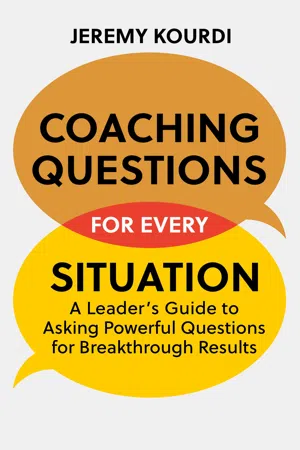
eBook - ePub
Coaching Questions for Every Situation
A Leader's Guide to Asking Powerful Questions for Breakthrough Results
- 224 pages
- English
- ePUB (mobile friendly)
- Available on iOS & Android
eBook - ePub
Coaching Questions for Every Situation
A Leader's Guide to Asking Powerful Questions for Breakthrough Results
About this book
Information
Part 1
Personal Coaching Questions
The chapters in this part of the book focus on the personal issues that shape an individual’s effectiveness and mindset. These issues include the self-awareness, emotional intelligence, relationship building skills, energy and resilience, and the ability to learn and adapt, handle tough challenges, make the best decisions and choices, solve problems, and chart the right course that will drive an individual towards greater personal fulfilment and success.
While these questions are intended to be used by the coach/leader who is coaching a client or colleague, they are also hugely effective for self-coaching. In other words, coaches can usefully reflect on many of these questions themselves.
This highlights a significant point about coaching: while many of the issues discussed during a coaching conversation are extrinsic – meaning that they relate to external factors such as decisions or events – the place to start is actually the individual’s mindset. In other words, it helps to know what to expect and to prepare for it, and that applies both to the coach and the coachee.
CHAPTER 1
Questions about You
Self-awareness is a vital attribute when coaching, learning, leading or doing pretty much anything. It is vital in questioning for several fundamental reasons:
1. It helps build understanding about:
• how your questions and your approach are being received generally
• the progress, or otherwise, that you are making
• the impact you are having.
2. It ensures that you are able to play to your strengths and minimize the effect of your weaknesses. Crucially, self-awareness is an important way marker on the road to humility, self-improvement, understanding, empathy and progress. The alternatives to being self-aware are not good! Antonyms include clueless, uninformed, oblivious.
3. The ability to elevate personal performance and lead with impact starts with each of us personally. After all, we can’t expect someone to do something that we either do not fully understand, or that we do not value for ourselves.
4. We need to be seen to develop our own performance. This is vital not only for your own personal effectiveness but also because:
• it drives and encourages your coachees to improve
• it enables us to ensure our skills and mindset remain current, relevant and agile
• it is how we shape a culture of performance.
How can I develop greater self-awareness in myself and others?
Four simple methods can help develop self-awareness and an understanding of our impact on others:
1. Ask for feedback. Do this often and routinely, and from a wide range of people at all levels in the business and across all aspects of your life.
2. Work with a coaching supervisor. Supervision is essential for professional coaching. Essentially, it is a form of coaching for coaches, but much more specifically focused on:
• how the coach feels, and why
• troubleshooting any issues or concerns
• providing a sounding board or ‘sense check’ for the coaches’ responses
• maintaining self-awareness and understanding any development needs.
3. Rigorously develop personal insight. This may take the form of a psychometric assessment test or 360-degree feedback. Choose whatever suits your context and preference. It may only need to happen occasionally, but it needs to happen. A good starting point is to look at yourself and identify your:
• Weaknesses
• Strengths
• Limits
• Motivations
• Personal and professional goals
• Needs
• Values
• Priorities
• Dominant emotions.
You will then start to build up a picture of how others see and experience you because all of these factors influence how you behave. At that point, you can ask yourself whether that is how you would like to be experienced, and if it’s not, you can begin to think about what you might need to change.
4. Use the Leader’s Shadow (see box).
The Leader’s Shadow
The Leader’s Shadow is a way to develop self-awareness, enabling individuals to focus on their impact on others – a vital issue when coaching. The Leader’s Shadow also enables leaders and coaches to understand and embrace their personal style, become aware of areas of strength and weakness, and recognize their sphere of influence and impact.
To use the technique, first think about each element and then write down the following in each quadrant:
• What I say – how I set context and frame issues, the key messages I convey and what I repeat or emphasize
• How I act – my behaviours, symbols,...
Table of contents
- Cover
- Title
- Dedication
- Contents
- INTRODUCTION – The Guiding Principles and Techniques of Coaching
- PART 1 – Personal Coaching Questions
- PART 2 – Coaching Questions for Typical and Difficult Challenges
- PART 3 – Coaching Questions for Defining Moments of Leadership
- Notes on Sources and Further Reading
- Acknowledgements
- About the Author
Trusted by 375,005 students
Access to over 1.5 million titles for a fair monthly price.
Study more efficiently using our study tools.
Frequently asked questions
Yes, you can cancel anytime from the Subscription tab in your account settings on the Perlego website. Your subscription will stay active until the end of your current billing period. Learn how to cancel your subscription
No, books cannot be downloaded as external files, such as PDFs, for use outside of Perlego. However, you can download books within the Perlego app for offline reading on mobile or tablet. Learn how to download books offline
We are an online textbook subscription service, where you can get access to an entire online library for less than the price of a single book per month. With over 1.5 million books across 990+ topics, we’ve got you covered! Learn about our mission
Look out for the read-aloud symbol on your next book to see if you can listen to it. The read-aloud tool reads text aloud for you, highlighting the text as it is being read. You can pause it, speed it up and slow it down. Learn more about Read Aloud
Yes! You can use the Perlego app on both iOS and Android devices to read anytime, anywhere — even offline. Perfect for commutes or when you’re on the go.
Please note we cannot support devices running on iOS 13 and Android 7 or earlier. Learn more about using the app
Please note we cannot support devices running on iOS 13 and Android 7 or earlier. Learn more about using the app
Yes, you can access Coaching Questions for Every Situation by Jeremy Kourdi in PDF and/or ePUB format, as well as other popular books in Business & Management. We have over 1.5 million books available in our catalogue for you to explore.