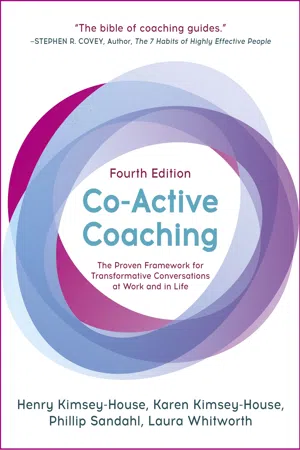
The definitive edition - updated and expanded, with access to an online toolkit.' The bible of coaching guides...No other book gives you the tools, skills, and the fundamentals needed to succeed in these delicate relationships.' Stephen R. Covey, Author of The 7 Habits of Highly Effective People Co-Active Coaching offers current and aspiring coaches, leaders and managers in organisations and anyone wanting to strengthen interpersonal relationships, a practical, yet transformative communication process called the Co-Active Model. Since its creation by the authors more than 25 years ago, the Co-Active Model and the book have formed the foundation of the authors' six-part coach training program delivered globally to tens of thousands of individuals each year through the authors' training institute, CTI. With its origins in the coaching profession, the Co-Active Model also applies to work and interpersonal relationships because it is based on principles of effective communication backed by current scientific research. In this highly-anticipated new edition, the universal applicability of the the Co-Active Model is emphasised. It goes beyond the one-on-one coach/coachee structure to include guidance for leaders and managers on how they can add a coaching competency to their professional skill set.New to this edition: · Every chapter has been updated for relevance and direct application to coaching in all of its forms, including in the workplace
· New material covering: current neuroscience research, Co-Active approaches to leadership development and working with groups and teams
· More examples drawn from the authors' first-hand experiences, especially in workplace settings
· More examples of the Co-Active Model applied internationally
· Updated/fine-tuned glossary (less jargon)
· Web-based 'Toolkit' with 27 exercises, questionnaires, checklists, and reproducible forms
eBook - ePub
Co-Active Coaching
The proven framework for transformative conversations at work and in life - 4th edition
- 218 pages
- English
- ePUB (mobile friendly)
- Available on iOS & Android
eBook - ePub
Co-Active Coaching
The proven framework for transformative conversations at work and in life - 4th edition
About this book
Information
PART 1
Co-Active Fundamentals
From day one, coaching focuses on the coachee. People participate in or seek out coaching because they want things to be different. They are looking for change or they have important goals to reach. They may be motivated to write a book, to start a business, to make a leap up the career ladder, to have a healthier body. They come to coaching in order to be more effective or more satisfied in life and work; they come to develop new skills to help navigate life’s changes.
Sometimes people want more from life: more peace of mind, more security, more impact in their work. And sometimes they want less: less confusion, less stress, less financial pressure. In general, they come to coaching because they want a better quality of life—more fulfillment, better balance—or a different process for accomplishing their desires. Whatever the individual reason, it all starts with a stirring of motivation within the coachee.
Part 1 explains what the coach brings to this interaction and shows what the process looks like from a co-active perspective. In this part of the book, we outline the elements and convey a sense of how they fit together in a comprehensive model. In later chapters, we expand on these major components to provide more depth and offer examples from coaching conversations.
In these first two chapters, you will also see how the fundamentals of co-active coaching apply to those informal conversations at work and even at home. While it’s true that not every conversation we have with another person fits the definition of a co-active conversation opportunity, the awareness of these fundamentals provides insight into those conversations. Sometimes what first appears as a mundane—even trivial—exchange taps into something much more important, deeper, with meaning that wasn’t anticipated by either party.
No doubt at some time in your life you’ve experienced this. The direction of a conversation becomes suddenly more personal, vulnerable perhaps, definitely not planned. By understanding the fundamentals of co-active coaching, you will be better prepared to see the opportunity in these situations and engage more effectively—not as a counselor or problem solver, but in a co-active way that courageously enters the conversation more as a companion on an unexpected journey. In a way, that describes the fundamental nature of every coaching conversation: being present in the moment, open to what shows up, even if we started with a plan.
There is a subtext to every conversation. That subtext is made up of assumptions, expectations, and unspoken agreements. It’s also made up of relationship qualities that include individual status, values, and beliefs—all melding together in a conversation that may be about something very ordinary. It’s easy to ignore the subtext in favor of focusing on the conversation on the surface; we’re more familiar with that option and it’s more comfortable, but it can miss the opportunity for a deeper conversation. It is that deeper conversation that builds relationship, trust, and empowered results. An understanding of the co-active model and its fundamentals will help equip you to have more awareness, and it will allow you to bring a wider range of competence to any conversation.
These first two chapters will give you, either as coach or in your leadership role, insight into dimensions of the conversation that are not so visible but have enormous impact on results and the ongoing relationship.
CHAPTER 1
The Co-Active Model
The term co-active refers to the fundamental nature of a coaching relationship in which the coach and coachee are active collaborators. In co-active coaching, this is a relationship—in fact an alliance—between two equals for the purpose of meeting the coachee’s needs. The term itself brings together the essential human qualities of being and doing:
■ Who we are
■ Who we are in relationship
■ Who we are being and want to be
■ How we are actively creating
■ What we are doing—or in some cases not doing—to achieve the results we want in life and work
Coach and coachee are in this together, “co-operating” as coachees take action.
Four Cornerstones
The four cornerstones represent the fundamental beliefs of a co-active way of being in relationship and conversation at the deepest level. We take a stand for these as essential to the impact that is possible in coaching and any coach-like conversation. The co-active coaching model rests on these four declarations. They form a container that holds the co-active conversation. In fact, the cornerstones make it possible to have a truly co-active conversation. In order for engaged and empowered relationship to exist—the “co” in co-active—and in order for life-giving action on the part of the coachee to manifest, these four create the necessary structure.
People are Naturally Creative, Resourceful, and Whole
We start with this assertion: people are, by their very nature, naturally creative, resourceful, and whole. They are capable: capable of finding answers, capable of choosing, capable of taking action, capable of recovering when things don’t go as planned, and, especially, capable of learning. This capacity is wired into all human beings no matter their circumstances. In the co-active model, it is more than a belief; it is a stand we take.
The alternative is a belief that people are fragile and dependent. With that belief, the coach’s job would be to guide the coachee to the safest possible outcome. You can feel the difference. When we take a stand for other people’s natural creativity and resourcefulness, we become champions on their behalf, not worried hand holders. As coaches, when we assume that others are resourceful and creative, we become curious and open to possibilities. We enter into a process of discovering with the coachee, not dictating. We expect to be amazed.
The key here is naturally. Yes, of course there are times when the circumstances feel overwhelming, when even the most resilient human beings feel that the mountain is too high, the road to cross too wide, the effort simply not in their power. Circumstances and that inner sabotaging voice that says “Why bother?” or “You don’t have what it takes” can leave anyone feeling much less than creative or resourceful, and just a fraction of whatever whole is. On those days more perhaps than on any others, it is our place as coaches, our gift to see the true, natural selves who were and are still capable. We remind them of their own inner light and help them find it again—because it is there. Naturally.
Focus on the Whole Person
For people who want to be helpful, including most new coaches or people in a coaching role, the question that’s often foremost on their minds is “What’s the problem to solve?” It’s a question that comes from the best of intentions: a desire to understand and provide valuable assistance so that a troublesome problem can be handled quickly and efficiently. There is urgency in the air, and we want to be helpful.
Leaders and managers—even those who truly value coaching as an essential and valuable contribution to their role—still easily fall into this trap. Under enormous pressure to get results and get results now, the first task they take on is to identify the problem to be solved. This urge is perfectly understandable, and of course solving problems is important. But leaders manage people, not just problems. Developing talent and creating a more resourceful and effective organization creates sustainable results, long after the presenting problem is solved. Even under organizational stress, this whole-person mind-set sees opportunity not to be overlooked.
When a coach is sitting across from a coachee (even by telephone), the coach is not sitting across from a problem to be solved; the coach is sitting across from a person. This person does have a problem to solve—a change to make, a dream to fulfill, a task to accomplish, a goal to reach. All of that is true. But this person is more than the problem at hand—or the goal, the dream, the task. This is a whole person: heart, mind, body, and spirit. And this issue, whatever it is, is not neatly isolated. It is inexorably entwined in the coachee’s whole life.
Maybe the word focus is a little misleading. This cornerstone is certainly not a hard, tight, concentrated focus on the whole person. It is more of a soft or broad focus, an attentive focus that includes the whole person and the whole life, listening on many levels. Too often in our eagerness to be helpful we access only the place between our ears. We use the mind to probe and understand and then create logical, pragmatic solutions.
Analysis and logic are worthy and useful attributes, but they are not the whole story. Sometimes a “correct” solution can have emotional consequences that are just as important; sometimes what the mind says yes to, the spirit feels at a loss with. We are not suggesting that a coach should be focusing on coaching heart, mind, body, and spirit as independent elements, but a coach or anyone in a co-active conversation ought to be tuned in to the influences that are present in these different dimensions.
It was not so many years ago that talking about emotions was taboo, especially in the workplace. Today, courses in developing mastery in emotional intelligence are commonplace, thanks to the groundbreaking work of Daniel Goleman. In a similar way, awareness of body language and the exceptional work of somatic practitioners has paved the way to a much better and more widespread conversation about the role of body in communication.
Surely the most sensitive of these dimensions is spirit. Spirit is the most elusive term to define, coming by many different names and different expressions, but it is present with every human being. In coaching, spirit is not limited to a form of spirituality and certainly not to a religion. But there is a spirit dimension that influences human choices. At the core, it includes the sense of living according to values, or a calling, or a power greater than ourselves. Sometimes it is intuition, a feeling in our gut, and sometimes it is a conviction that we know we must live by. It is a spirit dimension that transcends this one decision; in fact, we only know it is spirit because it feels transcendent.
Obviously, a focus on the whole person also means that as coaches we are aware of all the ways the issue or topic before us is interwoven in this person’s life. There is a vast ecology of people and priorities that are interconnected with whatever is the current subject of conversation. It is also entirely possible for the coach and coachee to limit the conversation to a single, narrow subject while at the same time having an antenna for the possibility of connecting this single issue to a broader or deeper conversation. The ability to take the conversation into any area that the coachee finds compelling doesn’t mean the coach insists on declaring the destination and going there. Again, the key is increased awareness, because no topic exists in isolation. A decision in one area of life inevitably ripples through all areas of life. An exciting career move may be very fulfilling—and it may affect health, family relationships, free time, and geography. A coach can work effectively with a coachee on a very narrow topic, but in the co-active way there is a larger picture also at play, and that is the whole person.
Dance in This Moment
A conversation is a powerful and dynamic interchange between people. It’s natural to pay attention to the content of the conversation—the words, the positions, the ideas—that’s often what is most “visible” and easiest to respond to. And yet, as important as the words and content are, there is much more going on in every moment. Every conversation creates tone, mood, nuance. There is as much information, sometimes more in how the words are said versus the words chosen; sometimes there is more information in what is not said than what is said.
For the coach this becomes an exercise in listening intently at many levels, and of course, choosing when and how to respond, to intervene. The information about what to say or ask does not come from a script. It comes in the moment, in THIS moment, and then the next moment. To “dance in this moment” is to be very present to what is happening right now and respond to that stimulus, not to a master plan.
To “dance” is to respond from a co-active core meaning both “co” as in collaborative, and active, moving the dance forward. In a truly coactive conversation there are moments when the coach leads the dance, moments when the coachee leads the dance, and moments when it is not clear at all who is leading and who is following.
All three states of the dance are natural; the third, the point where it seems to lose leader/follower designation, is a rare state o...
Table of contents
- Cover
- Title
- Copyright
- Contents
- Preface to the Fourth Edition
- Acknowledgments
- Introduction
- Part 1: Co-Active Fundamentals
- Part 2: Co-Active Contexts
- Part 3: Co-Active Principles
- Part 4: Integration and Vision
- Glossary
- About the Authors
- Index
Trusted by 375,005 students
Access to over 1.5 million titles for a fair monthly price.
Study more efficiently using our study tools.
Frequently asked questions
Yes, you can cancel anytime from the Subscription tab in your account settings on the Perlego website. Your subscription will stay active until the end of your current billing period. Learn how to cancel your subscription
No, books cannot be downloaded as external files, such as PDFs, for use outside of Perlego. However, you can download books within the Perlego app for offline reading on mobile or tablet. Learn how to download books offline
Perlego offers two plans: Essential and Complete
- Essential is ideal for learners and professionals who enjoy exploring a wide range of subjects. Access the Essential Library with 800,000+ trusted titles and best-sellers across business, personal growth, and the humanities. Includes unlimited reading time and Standard Read Aloud voice.
- Complete: Perfect for advanced learners and researchers needing full, unrestricted access. Unlock 1.5M+ books across hundreds of subjects, including academic and specialized titles. The Complete Plan also includes advanced features like Premium Read Aloud and Research Assistant.
We are an online textbook subscription service, where you can get access to an entire online library for less than the price of a single book per month. With over 1.5 million books across 990+ topics, we’ve got you covered! Learn about our mission
Look out for the read-aloud symbol on your next book to see if you can listen to it. The read-aloud tool reads text aloud for you, highlighting the text as it is being read. You can pause it, speed it up and slow it down. Learn more about Read Aloud
Yes! You can use the Perlego app on both iOS and Android devices to read anytime, anywhere — even offline. Perfect for commutes or when you’re on the go.
Please note we cannot support devices running on iOS 13 and Android 7 or earlier. Learn more about using the app
Please note we cannot support devices running on iOS 13 and Android 7 or earlier. Learn more about using the app
Yes, you can access Co-Active Coaching by Henry Kimsey-House,Karen Kimsey-House,Phillip Sandahl, Alexis Phillips,Laura Whitworth in PDF and/or ePUB format, as well as other popular books in Business & Human Resource Management. We have over 1.5 million books available in our catalogue for you to explore.