The fast-track MBA in communication
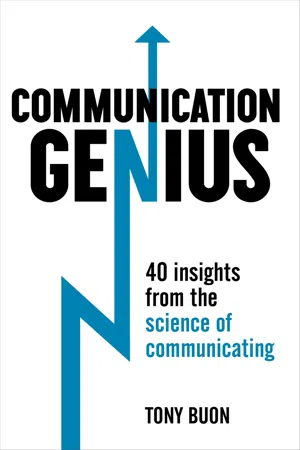
Imagine having instant access to the world's smartest thinking on human communication - and being shown exactly what to do to guarantee that all of your communication is right, every time. Communication Genius makes it easy to apply the scientific facts that researchers know about communication to the real world. 40 chapters based on cutting-edge business and psychology research projects reveal what works and what doesn't work when we interact with each other. Each of the 40 chapters is a mini-masterclass in communicating better, explaining the research and showing you how to apply it for yourself to improve your own communication skills.Too often, conventional wisdom says one thing while research says another. Communication Genius cuts through the noise to bring you proven research and techniques for applying it that will simply make you a better all-round communicator.With chapters on body language, emotional intelligence, neuro-linguistic programming (NLP), presentations, mimicry, groupthink and the latest neuroscience, Communication Genius explodes some myths and gives you the best that science has to offer on communication. Quick to read and intensely practical, this book will bring a little communication genius into your day.'A must read if you want to communicate better' Professor Sir Cary Cooper, Manchester Business School, University of Manchester 'Required reading for anyone seeking to better their communication skills in the workplace and otherwise' Dr Anastasia P. Rush, Clinical Psychologist, CEO HELLAS EAP (Greece) 'Calls into question accepted 'beliefs' (Maslow's hierarchy) and introduces the reader to an array of new theories from "IQ" racism to the Obama effect' Kate Nowlan, Chief Executive, CiC Employee Assistance, Fellow Royal Society of Arts (FRSA) 'Tony has done a fantastic job in pulling together an amazing number of articles and scientific studies and making them understandable to the lay person' Andrew Kinder,
Chartered Counselling & Chartered Occupational Psychologist, Employee Assistance Professionals Association (EAPA -UK) Chair
- 288 pages
- English
- ePUB (mobile friendly)
- Available on iOS & Android
eBook - ePub
About this book
Information
 | COMMUNICATION IS NOT ALL ABOUT BODY LANGUAGE |
The captains of England and Australia can barely exchange pleasantries these days without a body-language expert immediately declaiming on the angle of their handshakes.
Lawrence Booth, cricket writer and editor of Wisden Cricketers’ Almanack
Body language is a popular term for the process of communicating non-verbally through conscious or unconscious gestures and actions. This includes the subtle movements of the face and the body. In modern usage, it can also cover vocal tone, nuance and intonation (Morris, 1967).
It is very common to hear speakers and business trainers claim that words account for 7 per cent of the meaning of the message, tone of voice for 38 per cent, and body language 55 per cent. However, few speakers and trainers seem to have bothered to read the original research and continue to popularize the 93 per cent myth.
In 1971, Professor Albert Mehrabian, a professor of psychology at UCLA, wrote a book called Silent Messages. In this and in a book published a year later (Non-Verbal Communication, 1972), he focused on a very specific area of communication research. This was the communication of positive or negative emotions via single spoken words.
Mehrabian’s primary assumption is that only a few basic dimensions of human emotions are conveyed non-verbally. He states these are: like-dislike, status and responsiveness (1971). Mehrabian derived his ideas about the percentages of communication that are verbal or non-verbal from two studies he published in 1967.
In the first experiment (Mehrabian & Ferris, 1967), people listened to a recording of a woman saying the word ‘maybe’ in three different tones to suggest liking, neutrality and disliking. The male subjects were shown photos of women’s faces demonstrating the three emotions and were asked to guess the emotions indicated by three types of communication. That is the gestures in the photos, the voices alone, and then both together. The photos received more accurate responses by a ratio of 3:2. This suggests that when we receive conflicting messages, we tend to believe what we see.
In the second experiment (Mehrabian & Wiener, 1967), subjects listened to nine recorded words: three suggesting liking (‘honey’, ‘dear’ and ‘thanks’), three suggesting neutrality (‘maybe’, ‘really’ and ‘oh!’) and three suggesting disliking (‘don’t’, ‘brute’ and ‘terrible’). The words were spoken with different tones, and the subjects were asked to deduce the emotions contained in the words as spoken. The experiment found that the tone of voice had more influence on meaning.
Mehrabian then combined the two sets of data in his 1971 book (where most people seem to get the data from) to suggest the ratio of 7:38:55. In this book he asks the question, is there a systematic and coherent approach to resolving the general meaning or impact of an inconsistent message? (p 43). Mehrabian, based on his laboratory studies, suggests there is. He states that his experimental results show: Total Liking = 7 per cent Verbal Liking = 38 per cent Vocal Liking = 55 per cent Facial Liking (p 43).
So the impact of facial expression is stronger than just words. If the facial expression is inconsistent with the words, the degree of liking conveyed by the facial expression will dominate. Mehrabian concluded that if words and non-verbal messages are in conflict, people have confidence in the non-verbal. For example, on the telephone, if a person’s vocal tone contradicts the words spoken, then the tone is what determines the total impression.
This is interesting work, but it is also very narrow and applies only to the communication of liking and attitudes. It cannot be extrapolated to communication in general. Mehrabian himself states on his website (2015) the warning:
Please note that this and other equations regarding relative importance of verbal and non-verbal messages were derived from experiments dealing with communications of feelings and attitudes (i.e., like-dislike). Unless a communicator is talking about their feelings or attitudes, these equations are not applicable (Mehrabian, 2015).
For example, can you watch a foreign film and still understand 93 per cent of what is happening. Does a book only convey 7 per cent of its meaning from the text? Can you visit a country where you do not know the language and still understand most of what you hear? Of course not.
Mehrabian never said in any publication that 93 per cent of communication is non-verbal. In fact, speech writer Max Atkinson quotes personal communication from Mehrabian to him about the myth in his 2014 book on communication. Mehrabian says:
I am obviously uncomfortable about misquotes of my work. From the very beginning I have tried to give people the correct limitations of my findings. Unfortunately the field of self-styled ‘corporate image consultants’ or ‘leadership consultants’ has numerous practitioners with very little psychological expertise (2014: p 228).
The complexity of human communication
In New Scientist, Caroline Williams reports that Mehrabian ‘cringes every time he hears his theory applied to communication in general’ (2013). In many ways, it is more interesting that the Mehrabian Myth has continued to be so resilient. Its appeal is probably linked to the fact that it is based on ‘scientific research’ and that it has a set of statistics that are easy to teach.
So just how important is body language and why is the 7 per cent – 38 per cent – 55 per cent formula so wrong? Body language depends on the situation entirely. Words are important and so are body gestures, vocal tone and eye movement. Any formula of how much communication is non-verbal is meaningless. It will always depend on a multiplicity of factors including context, culture and the environment (Knapp & Hall, 2005; Hostetter, 2011).
Non-verbal communication is a very complex area and requires careful analysis. Make sure it is research-based and that the research has not been conducted solely in a laboratory or just with rats. The study of non-verbal behaviour, with its strong situational, cultural and environmental influences must be researched in ‘real world’ settings wherever possible (Lee et al, 1992; Knapp & Hall, 2005).
Words are only part of the message, but they are a vital part. Non-verbal communication (such as tone and body gestures) supports the words spoken by conveying the speaker’s feelings (McNeill, 1992). Words are vital in communication; just consider how hard it was to guess that movie title in the last game of ‘charades’ you played.
Non-verbal communication depends on the context. What something ‘means’ in one situation may be very different in another. For example, a raised voice in a negotiation can suggest anger or simply game-playing. Further, most children learn to read the facial expressions of their primary caregivers very early and can quickly read when a scolding is genuine or fake.
Most people seem to believe that when someone folds their arms they are defensive. However, this gesture can mean many different things in different situations. The person could be cold, confident, self-comforting or even vulnerable (Williams, 2013). Without culture, context and environment it is impossible to read this single gesture.
It is always better to look for clusters of gestures rather than trying to read a single gesture. For example, if a person scratches their face it does not mean they are lying (James, 2008). However, if they scratch their face, pause, speak in a monotone and don’t blink, then you may start to question what they are telling you. Of course, the above behaviours should be compared to a person’s baseline (normal) behaviour.
Be aware of cultural differences in non-verbal communication. Certain gestures appear to be very similar in all people, for example, smiling and fear (Ekman, Sorenson & Friesen, 1969; Ekman, 2001). However, some body language is very specific to a particular group. Awareness of how your body language differs from others is a very useful insight and the way to improve communication.
To suggest that words make up only 7 per cent of communication is incorrect. Words are incredibly powerful. Words can hurt, and they can heal. Consider for a moment the impact of the words ‘you are stupid’ on a five-year-old when spoken by a teacher or parent. Consider how important the word ‘sorry’ is when resolving conflict or healing pain.
So what are the big takeaways here?
• Next time you hear a body-language ‘expert’ tell you that words comprise only 7 per cent of the message, be aware that they may not have read the research they are quoting.
• The 7 per cent–38 per cent–55 per cent rule, where words make up only 7 per cent of communication, is wrong. This formula cannot be applied to communication in general.
• Dismiss simplistic guides to complex issues like non-verbal communication. Human behaviour is very complex and one-dimensional explanations are often ill-informed.
Sources
Mehrabian, A. (1971), Silent Messages. Belmont, CA: Wadsworth
References
Atkinson, M. (2014), Seen & Heard: Conversations and commentary on contemporary communication in politics, in the media and from around the world. London: Sunmakers
Ekman, P. (2009), Telling lies: Clues to Deceit in the Marketplace, Politics, and Marriage. New York: W. W. Norton & Company
Ekman, P., Sorenson, E. R. & Friesen, W. V. (1969), ‘Pan-Cultural Elements in Facial Displays of Emotion’, Science, Vol. 164 No. 3875 pp 86–8
Hostetter, A. B. (2011), ‘When do gestures communicate? A meta-analysis’, Psychological Bulletin, Vol. 137 Issue 2 pp 297–315
James, J. (2008), The Body Language Bible. London: Vermilion
Knapp, M. L. & Hall, J. A. (2005), Nonverbal Communication in Human Interaction (6th ed.). Belmont, CA: Wadsworth
Lee, M. E., Matsumoto, D., Kobayashi, M., Krupp, D., Maniatis, E. F. & Roberts, W., ‘Cultural Influences on Nonverbal Behavior in Applied Settings’. In Feldman, R. S. (Ed.) (1992), Applications of Nonverbal Behavioural Theories and Research. New Jersey: Lawrence Erlbaum
McNeill, D. (1992), Hand and Mind: What Gestures Reveal About Thought. Chicago: University of Chicago Press
Mehrabian, A. (1971), Silent Messages. Belmont, CA: Wadsworth
M...
Table of contents
- Cover
- Title
- About the Author
- Acknowledgements
- Contents
- Introduction
- 1. Communication is not all about body language
- 2. Men and women are not from different planets
- 3. Brainstorming: you may have been doing it incorrectly
- 4. Does everybody lie?
- 5. Can your handwriting reveal your personality?
- 6. Maslow was wrong; your needs are not hierarchical
- 7. The myths of emotional intelligence
- 8. Subliminal communication: hidden messages
- 9. Women do not talk more than men
- 10. NLP and communication
- 11. The placebo effect and communication
- 12. Attending skills in communication: the SOLER model
- 13. Discovering active listening
- 14. Restricting PowerPoint® to enhance communication
- 15. Space wars: why proxemics matters
- 16. Mimicry, mirroring and the chameleon effect
- 17. Checking your email too often wastes time
- 18. Stop judging a book by its cover
- 19. Paraphrasing and listening
- 20. We are all individuals, or are we?
- 21. Obedience: the communication of compliance
- 22. Communicating violence
- 23. Groupthink: revisiting the theory of error
- 24. The Forer Effect: gullibility in action
- 25. Educational credentials and the racism of intelligence
- 26. Measuring national culture
- 27. Cultural differences in communication
- 28. Silence as a form of communication
- 29. Communication and facial expressions
- 30. The Obama Effect: reducing stereotyping
- 31. Communication starts with the eyes
- 32. Neuro-scientific communication
- 33. Our brain cannot cope with too much information
- 34. Reading a good book may improve your empathy
- 35. Using big words doesn’t make you look smarter
- 36. Turning off your smartphone can make you work smarter
- 37. Social media communication
- 38. Online communication: why do people troll?
- 39. Selfies: a new form of communication
- 40. Swearing, cursing and communication
- List of research studies
- Copyright
Trusted by 375,005 students
Access to over 1.5 million titles for a fair monthly price.
Study more efficiently using our study tools.
Frequently asked questions
Yes, you can cancel anytime from the Subscription tab in your account settings on the Perlego website. Your subscription will stay active until the end of your current billing period. Learn how to cancel your subscription
No, books cannot be downloaded as external files, such as PDFs, for use outside of Perlego. However, you can download books within the Perlego app for offline reading on mobile or tablet. Learn how to download books offline
Perlego offers two plans: Essential and Complete
- Essential is ideal for learners and professionals who enjoy exploring a wide range of subjects. Access the Essential Library with 800,000+ trusted titles and best-sellers across business, personal growth, and the humanities. Includes unlimited reading time and Standard Read Aloud voice.
- Complete: Perfect for advanced learners and researchers needing full, unrestricted access. Unlock 1.5M+ books across hundreds of subjects, including academic and specialized titles. The Complete Plan also includes advanced features like Premium Read Aloud and Research Assistant.
We are an online textbook subscription service, where you can get access to an entire online library for less than the price of a single book per month. With over 1.5 million books across 990+ topics, we’ve got you covered! Learn about our mission
Look out for the read-aloud symbol on your next book to see if you can listen to it. The read-aloud tool reads text aloud for you, highlighting the text as it is being read. You can pause it, speed it up and slow it down. Learn more about Read Aloud
Yes! You can use the Perlego app on both iOS and Android devices to read anytime, anywhere — even offline. Perfect for commutes or when you’re on the go.
Please note we cannot support devices running on iOS 13 and Android 7 or earlier. Learn more about using the app
Please note we cannot support devices running on iOS 13 and Android 7 or earlier. Learn more about using the app
Yes, you can access Communication Genius by Tony Buon in PDF and/or ePUB format, as well as other popular books in Business & Business Communication. We have over 1.5 million books available in our catalogue for you to explore.