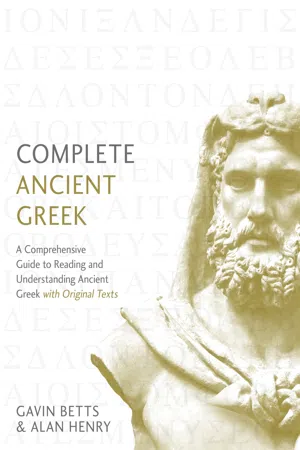
Designed for complete beginners, and tested for years with real learners, Complete Ancient Greek offers a bridge from the textbook to the real world, enabling you to learn the grammar, understand the vocabulary and even how to translate the writings of Socrates and Homer. Structured around authentic material, placing an emphasis on the importance of reading classical texts in the original, and introducing both a grammar perspective and a full introduction to essential vocabulary, this course also features: -25 learning units plus maps and verb guide -Authentic materials - language taught through key texts -Teaches the key skills - reading and understanding Ancient Greek grammar and vocabulary -Culture insights - learn about the culture and beliefs of the Ancient Greeks -Self tests and learning activities - see and track your own progress.Featuring additional exercises in this new edition, this is a genuinely comprehensive yet accessible introduction to Ancient Greek. Rely on Teach Yourself, trusted by language learners for over 75 years.
The Greek alphabet consists of 24 letters, each with its traditional name. Today it is used in both upper and lower case but in antiquity it existed only in different varieties of capitals. The pronunciation given below does not in every case reflect what we know of the language of fourth-century Athens (the type of Greek described here – see Introduction); because we learn ancient Greek for the purpose of reading, not of communication, we do not need to be as careful about its pronunciation as we would be with a modern language.
Letter
Name
Pronunciation
A α
alpha (ἄλϕα)
a (see below)
B β
bēta (βῆτα)
b
Γ γ
gamma (γάμμα)
g (as in game, never as in gesture, but as n in ink before κ, ξ, χ or another γ; see below)
Δ δ
delta (δέλτα)
d
E ε
epsīlon (ἒ ψῑλόν)
short e (as in met)
Ζ ζ
zēta (ζῆτα)
sd (as in wisdom, but represented in English as z)
Η η
ēta (ἦτα)
long e (like ai in fairy)
Θ θ
thēta (θῆτα)
th (as in thing; see below)
I ι
iōta (ἰῶτα)
i (see below)
Κ κ
kappa (κάππα)
k (but represented in English as c)
Λ λ
lambda (λάμβδα)
l
M μ
mū (μῦ)
m
Ν ν
nū (νῦ)
n
Ξ ξ
xī (ξεῖ)
x (as in axe)
O ο
omicron (ὂ μικρόν)
short o (as in lot)
Π π
pī (πεῖ)
p
P ρ
rhō (ῥῶ)
r
Σ σ, ς
sigma (σίγμα)
s (as in sign)
T τ
tau (ταῦ)
t
Υ υ
upsīlon (ὒψῑλόν)
u (but represented in English as y except in diphthongs, e.g. hypothesis, autopsy)
Φ ϕ
phī (ϕεῖ)
ph (see below)
Χ χ
chī (χεῖ)
ch (see below)
Ψ ψ
psī (ψεῖ)
ps (as in maps)
Ω ω
ōmega (ὦμέγα)
long o (like oa in broad)
When initial or medial, sigma takes the form σ but when final it is written ς. Examples are σύστασις composition, Σωσιγένης Sosigenes. There is only one upper-case sigma (Σ).
In Greek words taken into English and in transcriptions of Greek proper names, Greek letters are normally represented by their phonetic equivalent, except where indicated above (and in some diphthongs – see Note 2 below).
Consonants
Unless an example is given, use normal English pronunciation. To distinguish between κ and χ, the latter is pronounced as the ch in the Scottish pronunciation of loch. The letters ζ, ξ, ψ are double consonants and the equivalents of σδ, κσ, πσ respectively, for which they must always be used. For example, when σ is added to the stem γῡπ- we must write γ
ψ, never γ
πς (5.1). The letters θ, ϕ, χ are not double consonants; the pronunciation given above is that normally used today but in the Greek of our period they were pronounced as t, p, k with an accompanying emission of breath (i.e. something like these consonants in English when initial. Compare the difference between the English and French pronunciation of the P in Paris).
Examples of the second pronunciation of γ are: σπόγγος (spóngos) sponge, Σϕίγξ (Sphinx) Sphinx, ἔλεγχος (élenchos) scrutiny.
Vowels
All Greek vowels have a long and short pronunciation. These pronunciations have separate symbols in the case of ε/η and ο/ω. The other vowels have both values but only one symbol. In works of reference, but not in normal printed texts, the two values of these vowels are distinguished by marking the long form with a bar above (macron), ᾱ, ῑ, ῡ. They are pronounced:
ᾱ as in father
α (i.e. short a) as in a shortened version of ᾱ, like u in but, never as in sat (this sound did not exist in Greek).
ῑ as ee in need
ι as i in sit (or, more accurately, as in French petit).
ῡ as in French sûr
υ as in French tu
Diphthongs
Ancient Greek has two types o...
Table of contents
Cover
Title
Contents
Acknowledgements
Meet the authors
Introduction
How to use this book
Abbreviations
Map of ancient Greece
Unit 1
Unit 2
Unit 3
Unit 4
Unit 5
Unit 6
Unit 7
Unit 8
Unit 9
Unit 10
Unit 11
Unit 12
Unit 13
Unit 14
Unit 15
Unit 16
Unit 17
Unit 18
Unit 19
Unit 20
Unit 21
Unit 22
Unit 23
Unit 24
Appendices
The principal parts of verbs
Vocabulary
Suggestions for further study
Copyright
Trusted by 375,005 students
Access to over 1.5 million titles for a fair monthly price.
Study more efficiently using our study tools.
Frequently asked questions
Yes, you can cancel anytime from the Subscription tab in your account settings on the Perlego website. Your subscription will stay active until the end of your current billing period. Learn how to cancel your subscription
No, books cannot be downloaded as external files, such as PDFs, for use outside of Perlego. However, you can download books within the Perlego app for offline reading on mobile or tablet. Learn how to download books offline
Perlego offers two plans: Essential and Complete
Essential is ideal for learners and professionals who enjoy exploring a wide range of subjects. Access the Essential Library with 800,000+ trusted titles and best-sellers across business, personal growth, and the humanities. Includes unlimited reading time and Standard Read Aloud voice.
Complete: Perfect for advanced learners and researchers needing full, unrestricted access. Unlock 1.5M+ books across hundreds of subjects, including academic and specialized titles. The Complete Plan also includes advanced features like Premium Read Aloud and Research Assistant.
Both plans are available with monthly, semester, or annual billing cycles.
We are an online textbook subscription service, where you can get access to an entire online library for less than the price of a single book per month. With over 1.5 million books across 990+ topics, we’ve got you covered! Learn about our mission
Look out for the read-aloud symbol on your next book to see if you can listen to it. The read-aloud tool reads text aloud for you, highlighting the text as it is being read. You can pause it, speed it up and slow it down. Learn more about Read Aloud
Yes! You can use the Perlego app on both iOS and Android devices to read anytime, anywhere — even offline. Perfect for commutes or when you’re on the go. Please note we cannot support devices running on iOS 13 and Android 7 or earlier. Learn more about using the app
Yes, you can access Complete Ancient Greek by Gavin Betts,Alan Henry in PDF and/or ePUB format, as well as other popular books in Languages & Linguistics & Ancient Languages. We have over 1.5 million books available in our catalogue for you to explore.