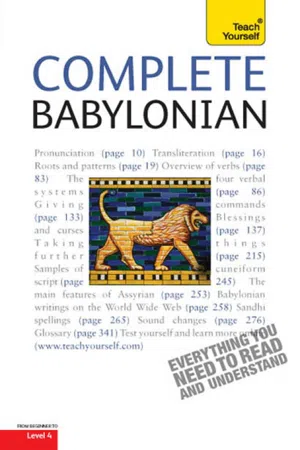
Do you want to engage with Babylonian culture and literature in the original language?The course will introduce you to a fascinating world of gods and demons, heroes and kings.The readings are drawn from myths, letters, law-codes, medical incantations, and other authentic, ancient writings. The language is presented in the Roman alphabet, with an explanation of cuneiform script, and the main features of Assyrian - cognate with Babylonian - are also explained.Learn effortlessly with a new easy-to-read page design and interactive features in this book from Teach Yourself, the No. 1 brand in language learning.
eBook - ePub
Complete Babylonian
A Comprehensive Guide to Reading and Understanding Babylonian, with Original Texts
- 320 pages
- English
- ePUB (mobile friendly)
- Available on iOS & Android
eBook - ePub
Complete Babylonian
A Comprehensive Guide to Reading and Understanding Babylonian, with Original Texts
About this book
Information
Part one
Getting started
1

Introduction
Babylonian is a very beautiful and highly regular language, and one which vaunts a vertiginously vast, varied, and vibrant body of writings. It is a member of the Semitic family, and so is related to Arabic, Hebrew, Aramaic, and Ethiopic. It was spoken – and, happily for us today, written – in the south of ancient Iraq. It was alive from before 2000 BC to at least 500 BC, and continued to be used as a language of scholarship and cult even after dying out as a vernacular tongue. It was usually written on clay tablets (ranging in size from a postage stamp to a large book), but other surfaces (clay prisms, stone monuments) were also used. The latest Babylonian writings which can be precisely dated are astronomical almanacs from 74 to 75 AD.
Decipherment was achieved in the 1850s, and though the language is now well understood, the number of scholars proficient in it is extremely small, so that great numbers of ancient documents have yet to be studied, and startling discoveries continue to be made. As an academic subject at university level, this makes Assyriology (i.e. the language-based study of ancient Iraq) one of the most exciting fields in the humanities. One does not, however, have to study Assyriology full-time, let alone devote oneself to it professionally, in order to enjoy the cultural and linguistic delights which a knowledge of Babylonian has to offer. The language is not complicated, and though at first glance the unfamiliarity of the vocabulary seems a large hurdle, most grammatical principles are simple, and progress is correspondingly fast.
Babylonian’s closest relative was Assyrian (which was spoken in the north of ancient Iraq). The two are so similar that they are often viewed as dialects of a single language, ‘Akkadian’. This book will explain the main ways in which Assyrian differs from Babylonian, thereby providing a basic knowledge of Assyrian.
For a preview of the sorts of things you will be reading, have a look at the Key to the exercises. The exercises are all taken verbatim from original Babylonian sources. (For sentences longer than one word, the source is specified in the Key.)
1.1 Periods of the language
For a language with such a long recorded history, Babylonian was astonishingly stable. Though different stages or ‘periods’ are recognized, each with its own characteristics, they are so similar that someone who has mastered the language of one period will not have to work hard to learn that of another.
The language of the second millennium is conventionally divided into two periods: Old Babylonian (c. 2000–1500 BC), and Middle Babylonian (c. 1500–1000 BC). During the second millennium BC, the vernacular language was also (give or take the odd archaism, poetic licence of various kinds, and such stylistic traits as generally characterize literary language) the language of literature. In the first millennium BC, a deeper cleavage developed between the language of literature (‘Standard Babylonian’) and the vernacular (‘Neo-Babylonian’): the former remained close to the language of the second millennium (Old and Middle Babylonian), while the latter underwent a number of changes. This course introduces you to the language of the second millennium and to the literary language of the first (Standard Babylonian). Proficiency in these will enable you to read the great works of Babylonian literature and scholarship, and it will also provide you, should you require it, with a solid foundation for studying the vernacular language of the first millennium (Neo-Babylonian). Exercises are given separately for Old and Middle Babylonian on the one hand (they are very similar) and Standard Babylonian on the other. You may wish to do both sets of exercises in parallel, or first complete one set and then work through the other.
1.2 Reading fragments
Most cuneiform manuscripts (i.e. inscribed clay tablets) are fragmentary. Often scholars have managed to piece multiple fragments of the same manuscript back together, but even so the proportion of manuscripts on which all the original cuneiform signs are perfectly preserved is small. It is fortunate, therefore, that a given work is often extant on multiple manuscripts: even though each of these may be fragmentary, together they often give a complete or near-complete text. This is especially common for first millennium literary and scholarly works. (By contrast, letters of all periods tend to be extant on only one manuscript.)
Did you know?
It is one of the exciting things about Assyriology that new (fragments of) manuscripts are being found all the time. Thus, for example, in 1930 The Epic of Gilgameš (‘Standard’ version) was known from 108 inscribed clay fragments. By 2003 this number had grown to 184; thanks to the new sources, breaks could be filled, and the text of the Epic is becoming more complete.
When modern editors have multiple manuscripts at their disposal, they usually produce a ‘composite text’, taking one bit from one manuscript, another bit from another manuscript, and so on, and putting variants at the bottom of the page in the so-called ‘apparatus criticus’. Especially in editions of first millennium manuscripts, the result is an eclectic entity, heterogeneous in both spelling and grammar: it does not reflect the intentions of a single scribe, but amalgamates the habits and intentions of many scribes. The Standard Babylonian exercises in this book are mostly taken from modern editors’ composite texts. Do not be surprised, then, if Standard Babylonian sentences seem to be internally inconsistent in spelling etc.
1.3 Other books
Iraqi would be a very good idea, while learning Babylonian, to familiarize yourself with other facets of Mesopotamian (i.e. ancient Iraqi) culture and history. This would provide useful background knowledge to bear in mind when translating the sentences in this book. You might start by reading translations of epics and myths, to get a feel for the sort of things that Babylonian stories talked about. To this end, one can recommend A.R. George’s The Epic of Gilgamesh (Penguin Classics, 2003), Stephanie Dalley’s Myths from Mesopotamia (Oxford World’s Classics, 2008), and (with a bigger selection) B. R. Foster’s Before the Muses: An Anthology of Akkadian Literature (CDL Press, 2005).
An excellent and beautifully illustrated one-volume introduction to the history and culture of Mesopotamia is Michael Roaf’s Cultural Atlas of Mesopotamia (Andromeda, 1999). More detailed are Marc van de Mieroop, A History of the Ancient Near East (Blackwell, 2006) and Amélie Kuhrt, The Ancient Near East, 2 vols. (Routledge, 1997).
If you like drinking from multiple wells (often a good idea in language learning), other introductions to Babylonian are: Richard I. Caplice, Introduction to Akkadian, 3rd ed. (Rome, 1988) and J. Huehnergard, A Grammar of Akkadian, 2nd ed. (Winona Lake, 2005). Caplice’s book is very condensed, Huehnergard’s more fulsome. You might also find it rewarding to equip yourself with a copy of A Concise Dictionary of Akkadian (see Unit 42.1) and start consulting it alongside the Glossary at the back of this book.
Beware of recent reprints of venerable books – owing to the rapid pace of discovery, scholarship about Babylonian grammar and philology ages quite quickly.
2
How to use this book
The function of this book is to provide you with the resources with which you can learn Babylonian. As it is you who is doing the learning, you have to remain in control of what you are learning, and exercise some initiative in learning it.
A book of language instruction is not (alas!) like a good novel, to be read at even speed from cover to cover. Some sections are straightforward and can be read quite quickly, while others need to be absorbed carefully and slowly. You will judge which pace of reading is right for you from one section to another.
Since the standard reference grammar of Babylonian is in German (W. von Soden’s Grundriss der akkadischen Grammatik, 3rd ed., Rome, 1995), more information has been provided in the present book than would normally be given in a work for beginners. Accordingly, it is not necessary to have mastered everything on a page (or even in a Unit) before moving on to the next. Sometimes it suffices to get the gist, and to remember where to look the information u...
Table of contents
- Cover
- Title Page
- Contents
- Meet the author
- Only got ten minutes?
- Part one: Getting started
- Part two: Nouns and adjectives
- Part three: Strong verbs
- Part four: Weak and irregular verbs
- Part five: Clauses into sentences
- Part six: Further topics
- Part seven: Reference
- Sumerograms and their Babylonian equivalents
- Key to the exercises
- Glossary
- Abbreviations
- Index
- Copyright
- Acknowledgements
- Credits
Trusted by 375,005 students
Access to over 1.5 million titles for a fair monthly price.
Study more efficiently using our study tools.
Frequently asked questions
Yes, you can cancel anytime from the Subscription tab in your account settings on the Perlego website. Your subscription will stay active until the end of your current billing period. Learn how to cancel your subscription
No, books cannot be downloaded as external files, such as PDFs, for use outside of Perlego. However, you can download books within the Perlego app for offline reading on mobile or tablet. Learn how to download books offline
We are an online textbook subscription service, where you can get access to an entire online library for less than the price of a single book per month. With over 1.5 million books across 990+ topics, we’ve got you covered! Learn about our mission
Look out for the read-aloud symbol on your next book to see if you can listen to it. The read-aloud tool reads text aloud for you, highlighting the text as it is being read. You can pause it, speed it up and slow it down. Learn more about Read Aloud
Yes! You can use the Perlego app on both iOS and Android devices to read anytime, anywhere — even offline. Perfect for commutes or when you’re on the go.
Please note we cannot support devices running on iOS 13 and Android 7 or earlier. Learn more about using the app
Please note we cannot support devices running on iOS 13 and Android 7 or earlier. Learn more about using the app
Yes, you can access Complete Babylonian by Martin Worthington in PDF and/or ePUB format, as well as other popular books in Languages & Linguistics & Ancient Languages. We have over 1.5 million books available in our catalogue for you to explore.