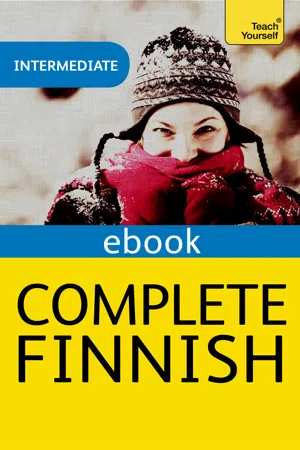
Complete Finnish is a comprehensive language course that takes you from beginner to intermediate level. This ebook contains text only and no audio content. The new edition of this successful course has been fully revised and is packed with new learning features to give you the language, practice and skills to communicate with confidence. -Maps from A1 to B2 of the Common European Framework of Reference (CEFR) for languages
-Discovery Method - figure out rules and patterns to make the language stick
-Teaches the key skills - reading, writing, listening and speaking
-Learn to learn - tips and skills on how to be a better language learner
-Culture notes - learn about the people and places of Finland
-Outcomes-based learning - focus your studies with clear aims
-Test Yourself - see and track your own progressRely on Teach Yourself, trusted by language learners for over 75 years.
- 448 pages
- English
- ePUB (mobile friendly)
- Available on iOS & Android
eBook - ePub
About this book
Information
Topic
Lingue e linguisticaSubtopic
Lingue | Hyvää huomenta Good morning |
In this unit you will learn how to:

CEFR: Can introduce oneself and use basic greetings; can ask and answer simple questions about personal details (A1). Can cope with a limited number of follow-up questions (A2).
 | Greetings |
Hyvää huomenta (Good morning) is the first greeting of the day. Respond to it by saying Hyvää huomenta or Huomenta. During the day you can say Hyvää päivää (literally, Good day), to which you can reply Hyvää päivää or Päivää. For a less formal greeting meaning ‘Hello’ or ‘Hi’, people say either Hei, Terve or Moi at any time of the day. Everybody uses these short greetings in everyday encounters with people they know. Common greetings used at specific times during the day include Hyvää iltapäivää (Good afternoon), Hyvää iltaa (Good evening) and Hyvää yötä (Good night – when going to bed). All of these can be answered by repeating the whole greeting or just the second half, leaving out the word hyvää as in English: Huomenta (Morning). Finns shake hands when first introduced, particularly in a formal context, i.e., when dealing with people you don’t know very well or in a business or work situation; in these situations you take leave by saying Näkemiin (Goodbye). Friends often greet each other with poskisuukko (a kiss on the cheek) or halaus (a hug). While among friends and people you know well, you can say goodbye by saying either Hei or Hei hei, Moi or Moi moi. You will also hear other versions of informal leave-taking, e.g., Heippa (Bye the byes) or Hei sitten (Bye then).


Table of contents
- Cover
- Title
- Contents
- Meet the author
- Introduction
- How this book works
- Learn to learn
- General remarks about Finnish
- Pronunciation guide
- 1 Hyvää huomenta Good morning: Greeting people and saying goodbye, saying who you are and your nationality, saying which language(s) you speak, asking how someone is and saying how you are
- 2 Hauska tutustua Nice to meet you: Introducing yourself and introducing other people to one another, saying where you are from and where you live and work, asking where someone else is from and where he or she lives and works
- 3 Yksi, kaksi, kolme … One, two, three …: Asking for and telling the time, saying and understanding numbers, asking for straightforward information and following the answers, saying when something happens
- 4 Kävelkää suoraan eteenpäin Walk straight on: Asking where different places are and following the information given, asking for directions, understanding simple directions, finding your way around the centre of Helsinki
- 5 Hyvää matkaa! Have a good journey!: Making inquiries about travelling and understanding times given, asking about departures and arrivals, asking about different means of travel, purchasing tickets and making reservations
- 6 Nähdään See you: Making telephone calls, making arrangements to meet somebody, making suggestions for what to do and where to meet, replying to suggestions and negotiating suitable alternatives
- 7 Hyvää ruokahalua! Bon appetit!: Describing your daily routine, talking about food and eating, saying what you like and what you don’t like, stating preferences, ordering food and drink in a restaurant or bar
- 8 Ruokaostoksilla Food shopping: Asking for things in shops, saying what you would like and how much you would like, talking about food in Finland, shopping for a variety of foods, using the most common measures
- 9 Kesämökillä At the summer house: Expressing ‘to go and do something’, saying ‘I must do something’, telling what you can do and what you know how to do, making suggestions that include others, describing what happens at a summer house
- 10 Kuinka sinä voit? How are you feeling?: Describing how you feel and inquiring how someone else is feeling, explaining to a chemist what you need and buying the items you need, making a doctor’s appointment, describing your symptoms when you are ill, using time expressions
- 11 Tulkaa käymään! Come and see us!: Receiving and accepting an invitation, describing your home, talking about how Finns live, socializing at a party, using dates and months
- 12 Kerro vähän itsestäsi Tell us a little bit about yourself: Talking about yourself, describing your hobbies and interests, talking about your family, differentiating between main features of standard and colloquial forms of spoken language
- 13 Miksi sinä haluat oppia puhumaan suomea? Why do you want to learn to speak Finnish?: Talking more about yourself and your family, describing your background, talking about your education and your studies, talking about your work and professional training, familiarizing yourself with the Finnish educational system
- 14 Millainen ilma ulkona on? What is the weather like outside?: Talking about the seasons and points of the compass, asking about and describing the weather, reading and understanding weather forecasts, using more expressions of time
- 15 Haluaisin vuokrata auton I’d like to rent a car: Renting a car, arranging period of hire and negotiating a dropoff, asking for and following spoken directions and confirming whether understood correctly, understanding the most common road signs, explaining minor problems with a car
- 16 Iltauutiset The evening news: Talking about entertainment: television, radio, cinema and theatre, making suggestions and stating preferences, finding out about broadcasting and entertainment in Finland
- 17 Onnea! Congratulations!: Reading and understanding an invitation, offering congratulations and seasonal greetings, discussing buying an appropriate present and considering reasons for the choice, following a wedding ceremony, asking how Christmas is celebrated in Finland
- 18 Suomalaisella sisulla With Finnish determination: Saying when you were born and asking when someone else was born, talking about dates and periods in time, describing frequency, asking questions to elicit information about historical events and politics
- Answer key to the activities and to Test yourself
- Finnish–English Vocabulary
- Grammar glossary
- Appendix 1: The verb olla to be
- Appendix 2: Question words
- Appendix 3: Pronouns
- Appendix 4: The numbers
- Copyright
Trusted by 375,005 students
Access to over 1.5 million titles for a fair monthly price.
Study more efficiently using our study tools.
Frequently asked questions
Yes, you can cancel anytime from the Subscription tab in your account settings on the Perlego website. Your subscription will stay active until the end of your current billing period. Learn how to cancel your subscription
No, books cannot be downloaded as external files, such as PDFs, for use outside of Perlego. However, you can download books within the Perlego app for offline reading on mobile or tablet. Learn how to download books offline
We are an online textbook subscription service, where you can get access to an entire online library for less than the price of a single book per month. With over 1.5 million books across 990+ topics, we’ve got you covered! Learn about our mission
Look out for the read-aloud symbol on your next book to see if you can listen to it. The read-aloud tool reads text aloud for you, highlighting the text as it is being read. You can pause it, speed it up and slow it down. Learn more about Read Aloud
Yes! You can use the Perlego app on both iOS and Android devices to read anytime, anywhere — even offline. Perfect for commutes or when you’re on the go.
Please note we cannot support devices running on iOS 13 and Android 7 or earlier. Learn more about using the app
Please note we cannot support devices running on iOS 13 and Android 7 or earlier. Learn more about using the app
Yes, you can access Complete Finnish Beginner to Intermediate Course by Terttu Leney in PDF and/or ePUB format, as well as other popular books in Lingue e linguistica & Lingue. We have over 1.5 million books available in our catalogue for you to explore.