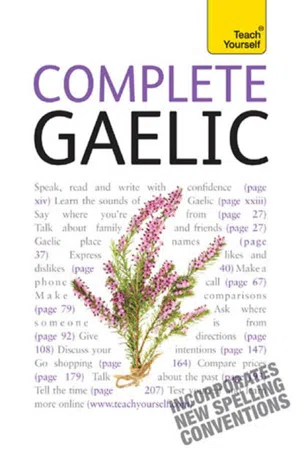
Are you looking for a complete course in Gaelic which takes you effortlessly from beginner to confident speaker? Whether you are starting from scratch, or are just out of practice, Complete Gaelic will guarantee success! This edition is fully updated to reflect the published spelling conventions, and has complete audio support online.The course is structured in thematic units and the emphasis is placed on communication, so that you effortlessly progress from introducing yourself and dealing with everyday situations, to using the phone and talking about work. By the end of this course, you will approach Level B2 of the Common European Framework for Languages: Can interact with a degree of fluency and spontaneity that makes regular interaction with native speakers quite possible without strain for either party.Learn effortlessly with a new easy-to-read page design and interactive features: NOT GOT MUCH TIME? One, five and ten-minute introductions to key principles to get you started.AUTHOR INSIGHTS Lots of instant help with common problems and quick tips for success, based on the author's many years of experience.GRAMMAR TIPS Easy-to-follow building blocks to give you a clear understanding.USEFUL VOCABULARY Easy to find and learn, to build a solid foundation for speaking.DIALOGUES Read and listen to everyday dialogues to help you speak and understand fast.TEST YOURSELF Tests in the book and online to keep track of your progress.TRY THIS Innovative exercises illustrate what you've learnt and how to use it.AUDIO Access the audio for this course for free by downloading it to the Teach Yourself Library app or streaming it on library.teachyourself.com.The course is available as a print book (9781444105919) and as a pack comprising the book and double CD (9781444102369).
Mairead NicRath meets her friend Tormod MacÌomhair on the Uig, Skye-Tarbert, Harris ferry one day. They are later joined by Mairead’s cousin Iseabail NicLeòid, whom Tormod does not know.
CD1, TR 2
Mairead
Hallo, a Thormoid.
Tormod
Hallo, a Mhairead. Ciamar a tha thu?
Mairead
Tha gu math, tapadh leat. Ciamar a tha thu fhèin?
Tormod
Tha gu math, tapadh leat. Tha i brèagha an-diugh.
Mairead
Tha gu dearbh.
(Iseabail joins them.)
A Thormoid, seo Iseabail.
Tormod
Hallo, Iseabail. ’S mise Tormod MacÌomhair.
Iseabail
Hallo, a Thormoid. ’S mise Iseabail NicLeòid. Ciamar a tha sibh?
Tormod
Tha gu math, tapadh leibh. Ciamar a tha sibh fhèin?
Iseabail
Meadhanach math, tapadh leibh. Cò às a tha sibh, a Thormoid?
Tormod
Tha mi à Leòdhas. Cò às a tha sibh fhèin, Iseabail?
Cò às a tha sibh, a Thormoid?Where are you from, Norman?
Tha mi à Leòdhas.I’m from Lewis.
Cò às a tha sibh fhèin, Iseabail?Where are you from yourself, Ishbel?
Tha mi às an Eilean Sgitheanach.I’m from Skye.
Mìneachadh (Explanation)
Surnames Many Scottish surnames begin with the Gaelic word Mac meaning son, e.g.: MacDonald, MacInnes, MacAllister. These literally mean Son of Donald, Son of Angus and Son of Alasdair. In Gaelic, the form of such surnames changes when referring to a female. Murdo MacRae is MurchadhMacRath, but MargaretMacRae is MaireadNicRath.
Nic means daughter (of). A similar system operates in Iceland with the forms -son and -dottir at the end of surnames, e.g.: Magnusson and Magnusdottir. Other forms of Gaelic surnames also change when referring to a female person, as in the examples below:
Males
Females
Tormod Caimbeul
Iseabail Chaimbeul
Iain Camshron
Mairead Chamshron
Alasdair Grannd
Màiri Ghrannd
Familiar and formal forms In Gaelic there are two ways of saying you. Thu is used in contexts of familiarity and informality, as when addressing someone you know well, or someone your own age. In less familiar, more formal settings, such as conducting business and when showing respect to older persons and to one’s superior, the form sibh is used. Sibh is also the plural form of you. The same distinction is made between tapadhleat (familiar singular) and tapadhleibh (plural and formal singular).
Obair (Exercises)
1Lìon na beàrnan. (Fill the gaps.) Fill in the gaps in the following sentences with the appropriate names from the box b...
Table of contents
Cover
Title Page
Contents
Meet the authors
Only got a minute?
Only got five minutes?
Introduction
Spelling and pronunciation
1 Ciamar a tha thu?
2 Càit’ a bheil sibh a’ dol?
3 Dè ’n aois a tha thu?
4 ’S toil leam biadh Innseanach
5 Dè tha thu ag iarraidh?
6 Dè tha thu a’ dèanamh?
7 Chan eil mi gad chluinntinn
8 ’S e Muileach a tha ann
9 Càit’ a bheil am banca?
10 Chaidh sinn a-null thairis an-uiridh
11 Feumaidh mi falbh
12 Dè ’s fheàrr leatsa?
13 Tha sin nas fheàrr
14 Tha mi air mo shàrachadh
15 Tha dùil againn falbh
16 Nach tèid sinn gu diosgo?
17 Chan urrainn dhomh a ràdh le cinnt.
18 Dè b’ àbhaist dhuibh a bhith a’ dèanamh?
19 Dè thuirt i?
20 Tha iad an dòchas ur faicinn
21 Bhiodh sin math
22 An còrdadh e riutsa?
23 Cuin a chaidh an taigh a thogail?
Sùil air ais
Na Freagairtean
Faclair
Ainmean: Appendix
Grammatical index
Copyright
Trusted by 375,005 students
Access to over 1.5 million titles for a fair monthly price.
Study more efficiently using our study tools.
Frequently asked questions
Yes, you can cancel anytime from the Subscription tab in your account settings on the Perlego website. Your subscription will stay active until the end of your current billing period. Learn how to cancel your subscription
No, books cannot be downloaded as external files, such as PDFs, for use outside of Perlego. However, you can download books within the Perlego app for offline reading on mobile or tablet. Learn how to download books offline
We are an online textbook subscription service, where you can get access to an entire online library for less than the price of a single book per month. With over 1.5 million books across 990+ topics, we’ve got you covered! Learn about our mission
Look out for the read-aloud symbol on your next book to see if you can listen to it. The read-aloud tool reads text aloud for you, highlighting the text as it is being read. You can pause it, speed it up and slow it down. Learn more about Read Aloud
Yes! You can use the Perlego app on both iOS and Android devices to read anytime, anywhere — even offline. Perfect for commutes or when you’re on the go. Please note we cannot support devices running on iOS 13 and Android 7 or earlier. Learn more about using the app
Yes, you can access Complete Gaelic Beginner to Intermediate Book and Audio Course by Boyd Robertson,Iain Taylor in PDF and/or ePUB format, as well as other popular books in Languages & Linguistics & Languages. We have over 1.5 million books available in our catalogue for you to explore.