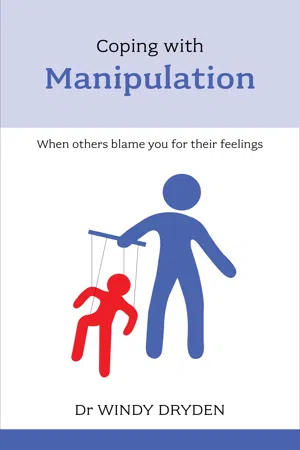
This book focuses on the common situation when someone blames you for the way they feel. It explores the underlying reasons why others may refuse to take emotional responsibility for themselves, and looks at what you can do about it. It's possible to let people feel what they want to feel - and live at peace with them and with yourself.
- 112 pages
- English
- ePUB (mobile friendly)
- Available on iOS & Android
eBook - ePub
Coping with Manipulation
About this book
Information
Subtopic
Emotions in PsychologyIndex
Psychology1
People feel the way they believe
The principle of emotional responsibility
Introduction
This book focuses on the common situation when someone blames you for the way that he or she feels. When this happens the person may say only that you caused those feelings or additionally he or she may depreciate you for causing them. In this book, I will lump both together. Here are some examples of what people may say to you when they blame you or hold you responsible for upsetting them, depending on the nature of their feelings.
• ‘You have upset me.’
• ‘You frighten me.’
• ‘You make me depressed.’
• ‘You have guilt-tripped me.’
• ‘You have made me so ashamed to be a member of this family.’
• ’You make me so angry when you won’t listen to me.’
• ’You have really hurt my feelings.’
• ‘You made me mad with jealousy when you flirted with that man at the party.’
• ‘You like to make me really envious of you, don’t you?’
In Chapter 3, I will discuss the reasons why people blame you for the way that they feel. But first, in this chapter, I will outline the principle of emotional responsibility, a concept that is crucial for you to understand if you are to deal effectively when people accuse you of causing them to feel a certain way.
Cognitive Behavioural Therapy
You have probably have heard of Cognitive Behavioural Therapy (CBT). This is a therapeutic tradition that is made up of different approaches, most of which share one major principle: that our disturbed feelings are largely determined by the way we think. This is summed up by a phrase that is attributed to Epictetus, the Greek Stoic philosopher:
People are disturbed not by things, but by the views that they take of things.
Rational-Emotive Cognitive Behavioural Therapy
Within the CBT tradition there are about a dozen distinct approaches. This book is based on one of them, known as ‘Rational Emotive Behavioural Therapy’ (REBT), an approach to CBT that was originated by the noted American psychologist Dr Albert Ellis (1913–2007). REBT’s basic position is a modification of Epictetus’s dictum:
People are not disturbed by things. Rather, they disturb themselves by the rigid and extreme beliefs that they hold about things.
These rigid and extreme beliefs are known collectively as irrational beliefs because they are false, illogical and unconstructive. I refer to this approach as ‘Rational-Emotive Cognitive Behavioural Therapy’ (RECBT) to denote that, while it is firmly in the CBT tradition, its distinctiveness is REBT.
While RECBT argues that irrational beliefs are at the core of our disturbed emotions, it also notes that these beliefs influence the way in which we subsequently act and think and that such behaviour and thinking serve to perpetuate our disturbed emotions. I will discuss this in greater depth in Chapter 2.
Emotional responsibility vs ‘You have upset me’
RECBT is based on the principle of emotional responsibility. As shown above, this means that when a person has disturbed feelings about a negative event (henceforth known as an adversity in this book), then these feelings are based largely on the rigid and extreme beliefs that the person holds about the adversity. So, while the adversity contributes to the person’s disturbed feelings – after all, if the adversity had not occurred, he (in this case) would not have felt disturbed – what contribute much more to his disturbed feelings are his beliefs. Since the person holds these beliefs, he can be said to be responsible for holding them and therefore, by extension, for the disturbed feelings that stem from these beliefs. However, just because the person is responsible for his disturbed feelings, it does not follow that he should be depreciated or depreciate himself for making himself disturbed.
Let me now compare the principle of emotional responsibility with the views expressed by people who blame you for causing their disturbed feelings. In order for me to do this, I will first outline what in RECBT is known as the ‘ABC’ framework. In this framework, ‘A’ stands for adversity,1 ‘B’ stands for beliefs and ‘C’ stands for the consequences of these beliefs. These consequences refer to the emotions that the person feels about the adversity, how he tends to act in the face of the adversity and how he subsequently thinks about the adversity once he has disturbed himself about it.
Let me use a specific example to make this comparison clear.
Mary’s mother asked her to go shopping with her but Mary declined, saying that she had already promised to go for a coffee with a friend. Mary’s mother became very hurt and blamed Mary for making her feel hurt.
Who is responsible for Mary’s mother’s feelings? ‘B’ largely determines ‘C’
Here is the RECBT perspective on who is responsible for Mary’s mother’s feelings using the ‘ABC’ framework.
‘A’ = My daughter has rejected me
‘B’ = My daughter must not reject me. It’s terrible that she has. Poor me!
‘C’ = Hurt.
Conclusion
As we can see, while Mary’s rejection of her mother (as her mother saw it) contributed to her mother’s hurt feelings, her mother largely created these feelings with her own rigid and extreme beliefs. Therefore, Mary’s mother is largely responsible for her feelings because she is largely responsible for the beliefs that she holds. In RECBT, we call the position ‘“B” largely determines “C”’ the principle of emotional responsibility.
Who is responsible for Mary’s mother’s feelings? ‘A causes C’
Here is Mary’s mother’s perspective on the same episode.
‘A’ = My daughter has rejected me
‘C’ = Hurt.
Conclusion
From Mary’s mother’s perspective, Mary has rejected her by not agreeing to go shopping with her in favour of having coffee with her friend. Her view is that this rejection, as she sees it, has caused her hurt and that Mary, therefore, is responsible for her hurt feelings.
If the position ‘“B” largely determines “C”’ is called the principle of emotional responsibility, we could say that the position ‘“A” causes “C”’ should be called the principle of emotional irresponsibility, since the person who is experiencing the feelings takes no responsibility for their creation. The principle of emotional irresponsibility is present when the other person blames you for causing his or her feelings.
Understanding the ‘A’ in the ‘ABC’ framework
As I have already discussed, in RECBT we use an ‘ABC’ framework to explain the principle of emotional responsibility. This model is simple but it is not simplistic, and where misunderstandings of the model occur these stem from confusion about what ‘A’ is. Originally, in RECBT, ‘A’ stood for ‘activating event’, which quite literally meant an event triggering a person’s beliefs that explained the way she (in this case) felt, acted and subsequently thought. The problem with the concept of ‘activating event’ centred on the question ‘What is an “event”?’ Most people thought that an event reflected what actually ha...
Table of contents
- Cover
- About the author
- Overcoming common problems series
- Title page
- Copyright
- Table of contents
- 1. People feel the way they believe: the principle of emotional responsibility
- 2. Understanding the disturbed emotions of others
- 3. Why others blame you for upsetting them
- 4. Why you respond unhealthily to being blamed for upsetting others
- 5. How to respond healthily to being blamed for upsetting others
- 6. Case examples of responding healthily to being blamed for upsetting others
- 7. Putting it all together: the six principles
- Appendix 1 Healthy vs unhealthy negative emotions
- Appendix 2 Rigid vs flexible beliefs
- Appendix 3 Awfulizing vs non-awfulizing beliefs
- Appendix 4 Discomfort intolerance vs discomfort tolerance beliefs
- Appendix 5 Depreciation vs acceptance beliefs
- Search items
Trusted by 375,005 students
Access to over 1.5 million titles for a fair monthly price.
Study more efficiently using our study tools.
Frequently asked questions
Yes, you can cancel anytime from the Subscription tab in your account settings on the Perlego website. Your subscription will stay active until the end of your current billing period. Learn how to cancel your subscription
No, books cannot be downloaded as external files, such as PDFs, for use outside of Perlego. However, you can download books within the Perlego app for offline reading on mobile or tablet. Learn how to download books offline
Perlego offers two plans: Essential and Complete
- Essential is ideal for learners and professionals who enjoy exploring a wide range of subjects. Access the Essential Library with 800,000+ trusted titles and best-sellers across business, personal growth, and the humanities. Includes unlimited reading time and Standard Read Aloud voice.
- Complete: Perfect for advanced learners and researchers needing full, unrestricted access. Unlock 1.5M+ books across hundreds of subjects, including academic and specialized titles. The Complete Plan also includes advanced features like Premium Read Aloud and Research Assistant.
We are an online textbook subscription service, where you can get access to an entire online library for less than the price of a single book per month. With over 1.5 million books across 990+ topics, we’ve got you covered! Learn about our mission
Look out for the read-aloud symbol on your next book to see if you can listen to it. The read-aloud tool reads text aloud for you, highlighting the text as it is being read. You can pause it, speed it up and slow it down. Learn more about Read Aloud
Yes! You can use the Perlego app on both iOS and Android devices to read anytime, anywhere — even offline. Perfect for commutes or when you’re on the go.
Please note we cannot support devices running on iOS 13 and Android 7 or earlier. Learn more about using the app
Please note we cannot support devices running on iOS 13 and Android 7 or earlier. Learn more about using the app
Yes, you can access Coping with Manipulation by Windy Dryden in PDF and/or ePUB format, as well as other popular books in Psychology & Emotions in Psychology. We have over 1.5 million books available in our catalogue for you to explore.