How many splashy scandals and crisis situations have befallen companies and public figures in the past week alone? How did the organizations and people at the center of those crises manage the situation? Did they survive with their reputations intact or are they facing an ongoing public nightmare that keeps building on itself in the era of social media?This new book from veteran public relations expert Edward Segal is based on the following premise: it's not a matter of IF a scandal or crisis will hit, it's WHEN. How a company deals with it will have lasting impact on their reputation, profits, and more. But for most organizations, when a crisis hits, they're caught off guard and ill-prepared. While essential, crisis plans are worthless unless properly executed, as the stories and examples featured throughout Crisis Ahead attest. Edward Segal's vivid and memorable accounts underscore the benefits of practicing and updating crisis plans at least once a year. The book also provides a template for creating a customizable crisis management plan. Crisis Ahead is for CEOs, senior staff, corporate communication professionals, HR and legal teams, boards of directors, and front-line employees who need to know what to do in the moment: what levers to pull and what moves to make in real time when faced with a crisis, scandal, or disaster. This book is written with the need for speed in mind. It's concise and practical with a light touch and occasional humor to help people on the front lines prepare for, survive, and bounce back from a crisis. It includes dozens of anecdotes, stories, and lessons about how companies, organizations, and individuals - ranging from Amazon, Apple, and the European Union, to Disney, Starbucks, and entrepreneur Elon Musk - have prepared for, created, managed, and communicated about crisis situations.
eBook - ePub
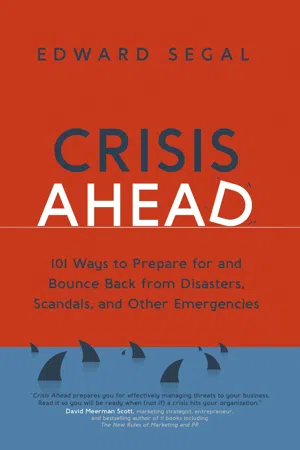
Crisis Ahead
101 Ways to Prepare for and Bounce Back From Disasters, Scandals, and Other Emergencies
- 224 pages
- English
- ePUB (mobile friendly)
- Available on iOS & Android
eBook - ePub
Crisis Ahead
101 Ways to Prepare for and Bounce Back From Disasters, Scandals, and Other Emergencies
About this book
Information
CHAPTER 1
How Ready Are You?
Find Out Now Before It’s Too Late
Three things that never work for avoiding, managing, or recovering from a crisis are ignorance, denial, and wishful thinking.
You just learned that someone in your IT department has sent an email to all your customers, vendors, and media contacts. The message contains derogatory comments about you and embarrassing photos of you.
What would you do?
Don’t wait until you have a crisis to find out whether you are ready for it. You are bound to be disappointed with the answer. It’s safe to assume that if you are reading this book, you want to know now what you can or should do when a crisis strikes. The first step is to take a reality check about your vulnerability to a crisis and how prepared you are to deal with one.
The 10 Rs of Crisis Management
There are several major steps you can take to help ensure that you are as ready as you can be for any crisis. I’ve boiled the steps down to the following 10 rules—“The 10 Rs of Crisis Management.”
- Risk. Identify the risk triggers that would cause a crisis for your organization. Some risks may be unique to your company because of the nature of your business. For example, if you’re an airline, a risk trigger would be an plane crash. Other triggers could apply no matter what type of business you are in, such as embezzlement or sexual harassment.
- Reduce. Take the steps that are necessary and prudent to lessen known risks. These steps can be as basic as following common-sense accounting procedures in order to help prevent fraud and forgery to more extensive actions such as providing appropriate training or retraining to employees.
- Ready. Have a crisis plan in place and ready to implement when it is needed. Because one size will not fit all companies, the plan should be customized to meet the needs and realities of your organization and industry.
- Redundancies. Have back-up and contingency plans in case they are required. Since it is impossible to plan for every eventuality, a Plan B, Plan C, or Plan D may be needed, just in case.
- Research. Get all the information you can about your crisis, including details about what just happened, is happening now, or you expect to happen. Knowing the who, what, when, where, why, and how of the situation is essential in helping to respond strategically, effectively, and efficiently.
- Rehearse. Practice implementing your plan on a regular basis—at least once a year. Having a plan and not practicing it is not much different than having no plan at all. The more you practice implementing the plan, the more prepared you will be if and when you need to use it.
- React. Activate your plan when necessary. Know what will trigger a crisis and how you would respond to different crisis scenarios. A crisis is no time to try to learn as you go along.
- Reach Out. Immediately communicate with those who are affected by or concerned about the crisis. Your company or o...
Table of contents
- Cover
- Contents
- Introduction
- Chapter 1: How Ready Are You? Find Out Now Before It’s Too Late
- Chapter 2: If You Fail to Plan, You’re Planning to Fail
- Chapter 3: Put Your Plan to the Test
- Chapter 4: When the Sh*t Hits the Fan: Best Practices
- Chapter 5: How to Work with the Media during a Crisis
- Chapter 6: Learn from the Successes and Mistakes of Others
- Chapter 7: Bouncing Back: How to Recover from a Crisis
- Acknowledgments
- Notes
- Index
- About the Author
Trusted by 375,005 students
Access to over 1.5 million titles for a fair monthly price.
Study more efficiently using our study tools.
Frequently asked questions
Yes, you can cancel anytime from the Subscription tab in your account settings on the Perlego website. Your subscription will stay active until the end of your current billing period. Learn how to cancel your subscription
No, books cannot be downloaded as external files, such as PDFs, for use outside of Perlego. However, you can download books within the Perlego app for offline reading on mobile or tablet. Learn how to download books offline
Perlego offers two plans: Essential and Complete
- Essential is ideal for learners and professionals who enjoy exploring a wide range of subjects. Access the Essential Library with 800,000+ trusted titles and best-sellers across business, personal growth, and the humanities. Includes unlimited reading time and Standard Read Aloud voice.
- Complete: Perfect for advanced learners and researchers needing full, unrestricted access. Unlock 1.5M+ books across hundreds of subjects, including academic and specialized titles. The Complete Plan also includes advanced features like Premium Read Aloud and Research Assistant.
We are an online textbook subscription service, where you can get access to an entire online library for less than the price of a single book per month. With over 1.5 million books across 990+ topics, we’ve got you covered! Learn about our mission
Look out for the read-aloud symbol on your next book to see if you can listen to it. The read-aloud tool reads text aloud for you, highlighting the text as it is being read. You can pause it, speed it up and slow it down. Learn more about Read Aloud
Yes! You can use the Perlego app on both iOS and Android devices to read anytime, anywhere — even offline. Perfect for commutes or when you’re on the go.
Please note we cannot support devices running on iOS 13 and Android 7 or earlier. Learn more about using the app
Please note we cannot support devices running on iOS 13 and Android 7 or earlier. Learn more about using the app
Yes, you can access Crisis Ahead by Edward Segal in PDF and/or ePUB format, as well as other popular books in Business & Corporate Governance. We have over 1.5 million books available in our catalogue for you to explore.