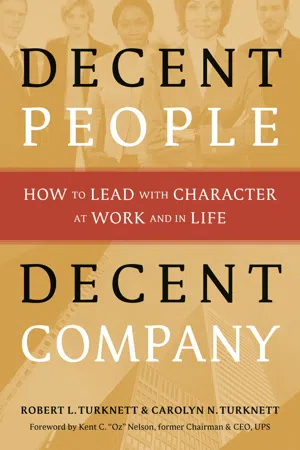
Inspiring people who lead with integrity move things forward, garner commitment from others, and are willing to ask the tough questions when necessary. These are the real leaders who generate and sustain cultures of character in organizations. Decent People, Decent Company now puts the power to develop the core qualities of leadership character into the hands of anyone dedicated to bringing integrity, respect, and personal responsibility back to the workplace - regardless of their place in the organization. Drawing on more than 25 years experience working with hundreds of CEO, managers, and teams, this innovative husband and wife team provide both the inspiration and the tools to help people move from asking "Why don't they?" to asking "What can I?" With their original and dynamic Leadership Character Model, the Turknetts have captured the essence of what it takes to revitalize attitudes and behavior, unleash leadership integrity, and reinvigorate organizations. Decent People, Decent Company identifies the eight essential traits of leadership character: empathy, emotional mastery, lack of blame, humility, accountability, courage, self-confidence, and focus on the whole. In chapters that focus on each quality individually, dozens of leaders, in their own words, bring to life the struggles and triumphs of developing the behaviours of character and ethical leadership required to bring out the best in everyone.
eBook - ePub
Decent People, Decent Company
How to Lead with Character at Work and in Life
- 216 pages
- English
- ePUB (mobile friendly)
- Available on iOS & Android
eBook - ePub
Decent People, Decent Company
How to Lead with Character at Work and in Life
About this book
Information
INTEGRITY—THE NATURE OF CHARACTER
CHAPTER 1
Character, Culture, and Change
Early in his career, Bob was the psychologist for the Brevard County school system in Florida. As part of his job, he routinely visited all the schools in the county, and afterward he would come home and talk about what he’d seen: “Different schools have such different feels,” he said. “At some, the kids all seem so happy. They have their work and drawings posted everywhere, but the rooms feel orderly. The teachers seem to love their jobs. And I don’t know how they do it, but the principals seem to know every kid’s name. The kids love to see their principal coming down the hall. But at other schools nobody seems happy. The teachers sound like they’re yelling and pleading all the time. I’ve heard some really harsh words, and you hardly see the principal outside the office. Some schools are just so chaotic I can’t see how anybody’s learning a thing.”
Each school had its own personality or culture. Bob soon realized the difference was due in large part to the type of leadership coming from the principal. Where the school’s personality was negative, the principal was often remote and rigid; there were lots of unnecessary rules, and the teachers felt micromanaged. Where there was an absence of discipline the principal tended to be permissive and ineffectual. Where there was a positive atmosphere the principal was visible and engaged and seemed to encourage creativity and new ideas from both teachers and students. Most other factors were equal. It was one school system with uniform rules and guidelines, and ostensibly the same high standards in all schools. Most of the neighborhoods had similar demographics. But different styles of leadership produced different results because organizations are malleable. Performance tended to be higher in schools with positive personalities. In every case, the leadership emanating from the principal made a significant difference between a happy school and a hostile one, a good place to learn and a poor one. Each school was a distinct social system affected by the specific inputs of the leadership it received.
The leadership of any organization plays a primary role in creating its culture. Bob’s observations in the schools bear that out. It’s also true that the nominal leaders don’t do it alone. In all social systems every participant makes a contribution, whether actively or passively, intentionally or unconsciously, creatively or destructively. Power doesn’t flow only from the top to the bottom; people at every level of an organization have influence on its tenor, style, and ultimate effectiveness. Human beings are also malleable, and so are social systems such as corporations and workplaces. How we think of ourselves affects the nature of our participation and, in turn, the culture of the organization itself.
LEADERSHIP CAN COME FROM ANYONE
The Customer Care Club
At a supermarket in a small town in Georgia, an assistant manager had initiated a “customer care team” for employees, but two weeks later he was promoted and transferred to another location. Alice, the assistant front-end manager, and Oscar, the produce manager, had been excited about the project and couldn’t stand the thought of letting it go. They went to Gordon, the store’s general manager, for permission to continue the project. “Ideas were just popping in our heads,” Alice recalls. “We chose the name customer care club instead of team because some people saw team as something management sets up. But club seemed to mean that others who want to can join. We thought that if we increased employee morale, it would increase customer satisfaction.”
They decided to start with the break room. It was a mess: small and dingy with a seven-foot ceiling that made it seem like a cell, and an old microwave with a broken latch. They couldn’t make the room bigger, but they could make it better and brighter. They painted the room themselves, and Alice had the idea of painting a blue sky and clouds on the ceiling. Management agreed to install a new microwave and a snack machine, which might not sound like much of a victory in a food store but actually took the club members’ best powers of persuasion.
Then, an employee newsletter was started. “It’s always good to see your name in the newspaper,” Alice explains, “and the paper helps us recognize even the little things members do to serve customers better.”
“Employees are excited: They look at their newsletters before they look at their paychecks,” Gordon says. “Another way we give recognition is to bring members into the weekly department head meeting and talk about the special things they’ve done for customers.”
“We also realized that we needed input from our customers,” adds Oscar, who built and installed a writing shelf under the store bulletin board to hold comment cards and pens. The store responds to all complaints, but now most comments are positive. “Members now seem to care about what happens to the store,” Oscar says. “They don’t just do one job—they take care of the whole store. Before, when you’d ask people to do something other than their exact job responsibilities, they would say, ‘I don’t get paid to do that.’ Now, they come in to work smiling and do what needs to be done. Turnover is decreasing, and teens are telling their friends that this is a good place to work.”
Gordon has been confident enough in his skills as a manager to let employees not only take the lead but also give him feedback on his management style. “Originally I was a hatchet man, but I’ve mellowed over the years; I’ve learned to listen more. Before, I’d sometimes go out just to walk around the store, but at times I’d have something else on my mind and I wouldn’t speak to anyone. I heard about a teenage employee who thought I didn’t like her because I ignored her. That was a lesson for me.”
Everyone reports that Gordon’s leadership style has changed dramatically, and he agrees. “I always allowed only department heads to give me feedback in closed management meetings,” Gordon says. “Now, though, everyone can tell me what they think, and they can do it throughout the day.” It has paid off for him in reduced stress. “I used to worry. Now when I leave the store, I know I have fifteen or twenty people I can count on to have my interest and the store’s interests at heart.”
“Results have been excellent,” he concludes. “There’s been a reduction in the number of negative comments, an increase in production in the store, an increase in the number of customer compliments, an increase in positive 1-800 calls, and—best of all—a double-digit increase in sales.”
• • •
RELATIONAL LEADERSHIP
Clearly, we can change our minds about leadership. For example, we can decide that leadership is something we each participate in and can contribute to no matter where we are in the hierarchy. Changing our minds changes the way we behave, and that makes possible changes in other people and in the very system in which we are operating.
In a 1996 article, William Drath, a research scientist at the Center for Creative Leadership, wrote:
There are leaders, but they don’t make leadership happen. And there are followers, but they are not the objects of the leader’s leadership behavior. Leaders and followers alike participate in leadership. Leadership is a property of the relationships people form when they are doing something together. Good sets of relationships constitute good leadership, which produces good leaders and good followers.1
Leadership, in other words, is an aspect and function of a social system, not just of particular individuals within it, and everyone who participates in the system has the responsibility to contribute to it.
Organizations must be understood and structured in ways that encourage this kind of participation. The information age technologies we all now work with have made this change both imperative and inevitable as they enable virtually instant communication and networking among people at all levels, inside and outside an organization. The old up-and-down-only dynamic has been replaced. Of course, some positions still entail more power and responsibility than others, but we all know that managing in today’s environment is not about issuing orders and imposing control. It’s about awareness, resilience, and adaptation; about listening, coaching, collaborating, and evolving. Those qualities are only possible when everyone feels responsible for the enterprise as a whole, respectful of it and respected by it as well.
We Create the Systems We Are In
What you believe about yourself and others, about how organizations work, and about leadership and hierarchies has an enormous impact on what you see and experience as you participate in an organization. Many organizational theorists believe that social reality and social behavior are not preprogrammed but rather dynamically created by the people involved. This idea, called social constructivism, holds that our ideas about how that reality is created affect what we create.
Whether it’s objectively true or not, if you believe that the company for which you work does not want your input, you probably will keep your ideas to yourself and eventually will come to feel degraded and resentful. Your experience of the organization will be a negative one.
This could be your experience even if the organization is not so rigidly hierarchical. The top-down models we all have in our heads from early learning can make us behave as though it’s true, even when no one, including top leadership, consciously wants it that way. What happens is people don’t try things; they box themselves in; they sit down and shut up (or just complain at the water cooler) when they could make a difference if they tried. Even top leaders who proclaim they want people in the organization to take initiative may at times reflexively fall back into the old style, too, thinking, “I’m in charge here,” and fail to listen.
If, instead, you believe your ideas are good ones and your colleagues should hear them, you’re more likely to express yourself freely and to have a more powerful experience of participation.
The work of David Cooperrider, professor of organizational behavior at Case Western Reserve University, and his colleagues grew out of this kind of thinking. Called Appreciative Inquiry, it is grounded in social constructivism theory, the idea that we create social reality as we go, cocreating it continually with those around us.
Cooperrider believes the attitudes we have toward an organization and the assumptions we bring to the situation will have a profound impact on what we find and experience there. If a change agent, such as an outside consultant or senior leader new to the enterprise, approaches an organization seeing it as nothing more than a collection of problems to be figured out and solved, the people within the organization will come to see the company that way and become more and more dispirited. If the change agent, however, starts by looking for what is going right and assumes there are existing strengths to find, people within the organization develop energy, enthusiasm, and an appreciation of the strengths of the whole. Cooperrider has written:
Organizations are products of human interaction and mind rather than some blind expression of an underlying natural order. Deceptively simple yet so entirely radical in implication, this insight is still shattering many beliefs, one of which is the long-standing conviction that bureaucracy, oligarchy, and other forms of hierarchical domination are inevitable. Today we know that this simply is not true.2
Another belief this notion shatters is that people who do not happen to be placed high in the power structure lack the ability to exert influence on the whole.
We ourselves are not by any means strict social constructivists. We don’t think, for instance, that a tyrannical boss would necessarily be any more benevolent just because his underlings were somehow convinced to see him that way. We do think there’s a good deal of truth in the idea that we have considerable power over our experience of reality. The top leaders within any organization are the primary originators of its culture, but any member is capable of having an influence over it, too. (Our study of organizational behavior has led us to believe that balanced views are usually best. When theories compete, there are often important truths to be gleaned from many visions.)
As we have said, the views people have about themselves and others, and about the way the organization works, make a huge difference in what they see and how they behave. We create our reality. If leaders have an especially big impact on that reality, it’s primarily because everyone else pays so much attention to their ideas, behaviors, and moods.
Cooperrider believes those of us serving as agents of change should take an “appreciative” approach, building on the positives we find, to help the organization actually become more positive and healthier. This central theme of Appreciative Inquiry is of great value to us in our work. We encourage you to try it yourself.
We Get What We Expect
In his first inaugural address, Abraham Lincoln called on his fellow Americans to summon “the better angels of our nature.” Summoning our nobler side—the part that doesn’t take the easy way out, that makes the decent choice even when it’s difficult; that forgives; that doesn’t take advantage of others—usually takes a conscious decision and some effort, but it’s well worth it. People who consciously try to bring out the best in themselves and others are happier and more successful because the effort usually works. To some degree at least, we end up seeing what we are looking for.
Lyn was an avid gardener when our children were young. “One year,” she remembers, “I saved the seeds from a particularly delicious cantaloupe. The next spring I planted them. The vines grew really vigorously and started flowering. Fruit began forming, but it kept turning dark. I figured something was wrong with them, and I kept throwing these ‘rotten cantaloupes’ away. Then one day our oldest son, Rob, who was five at the time, came in from the garden. He said, ‘Mom, it’s so funny–your cantaloupes look just like that squash we once had for supper.’ The seeds, of course, were not from a cantaloupe vine but from an acorn squash; I’d mixed them up. And because I was looking for something else, I had thrown away a lot of perfectly good squash!”
If We Expect Better, We Get That, Too
Expectations work the same way in organizations. The way managers and leaders view the people they are managing makes a remarkable difference in their subordinates’ behavior and performance. If a manager acts with the belief that a direct report is not very capable, that employee is likely to demonstrate mediocre behavior. If a manager believes the best about a worker’s capabilities, good work is the more probable result.
In a 1977 study, male college students were shown pictures of several women and asked to rate them as attractive or unattractive.3 Then each student had a telephone conversation with one of the women. Before the call was made, the student was given a picture of one of the previously rated women and told that she was the person with whom he was speaking. After the phone “date,” the student was asked for his impressions. As expected, when he thought he was talking to an attractive woman, he rated her as warmer and friendlier. More startling was the next phase of the experiment. Independent observers were asked to listen in on the phone conversations and then give their impressions of the women. The women who were talking to men who thought they were attractive were rated by the observers as warmer and friendlier, even though they had seen no pictures. The callers actually seemed to elicit the behavior they were expecting. This phenomenon has been called behavioral confirmation; it seems that our expectations about behavior are powerful enough to elicit that very behavior.
In another famous experiment, Robert Rosenthal, a professor of social psychology at Harvard University, and his colleague, Lenore Jacobson, worked with elementary school children from eighteen classrooms.4 They chose 20 percent of the children at random from each room and told their teachers that they were “intellectual bloomers.” They explained that these children could be expected to show remarkable gains during the school year. Indeed, the students in the designated group showed average IQ gains of two points in verbal ability, seven points in reasoning, and four points in overall IQ. They really did bloom because their teachers expected them to.
Such studies have been repeated many times with business managers and show that leaders can change the performance of those who report to them by changing the way they think about those employees.
This isn’t magic, and it isn’t really even mysterious. Like the expectations of the men about the women in the telephone experiment, and of the schoolteachers about the supposedly gifted children, the beliefs of managers about their workers can translate into all kinds of subtle but tangible behaviors that help produce precisely the expected results. From observation, th...
Table of contents
- Cover Page
- Title Page
- Copyright Page
- Contents
- Foreword
- Preface
- Acknowledgments
- About the Authors
- Introduction
- Part One: Integrity—The Nature of Character
- Part Two: Respect—The Will to Understand
- Part Three: Responsibility—The Power to Act
- Integrity at Work, and All the Time
- Afterword
- Notes
- Index
Trusted by 375,005 students
Access to over 1.5 million titles for a fair monthly price.
Study more efficiently using our study tools.
Frequently asked questions
Yes, you can cancel anytime from the Subscription tab in your account settings on the Perlego website. Your subscription will stay active until the end of your current billing period. Learn how to cancel your subscription
No, books cannot be downloaded as external files, such as PDFs, for use outside of Perlego. However, you can download books within the Perlego app for offline reading on mobile or tablet. Learn how to download books offline
We are an online textbook subscription service, where you can get access to an entire online library for less than the price of a single book per month. With over 1.5 million books across 990+ topics, we’ve got you covered! Learn about our mission
Look out for the read-aloud symbol on your next book to see if you can listen to it. The read-aloud tool reads text aloud for you, highlighting the text as it is being read. You can pause it, speed it up and slow it down. Learn more about Read Aloud
Yes! You can use the Perlego app on both iOS and Android devices to read anytime, anywhere — even offline. Perfect for commutes or when you’re on the go.
Please note we cannot support devices running on iOS 13 and Android 7 or earlier. Learn more about using the app
Please note we cannot support devices running on iOS 13 and Android 7 or earlier. Learn more about using the app
Yes, you can access Decent People, Decent Company by Carolyn N. Turknett,Robert L. Turknett in PDF and/or ePUB format, as well as other popular books in Business & Business Ethics. We have over 1.5 million books available in our catalogue for you to explore.