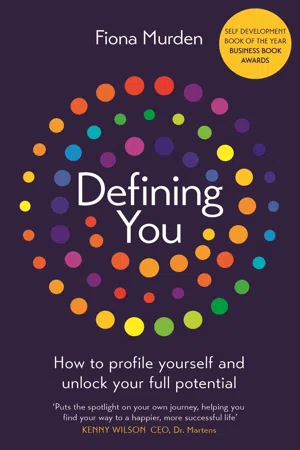
* SELF DEVELOPMENT BOOK OF THE YEAR 2019, BUSINESS BOOK AWARDS* Have you ever wondered what a profiling session would tell you about yourself? Fiona Murden helps some of the most successful people in the world to understand their behaviour and improve their performance. Here she guides you through the professional profiling assessment process in private, to help you discover your strengths, understand what really drives you and learn which environments will help you to excel. Step by step you will build your unique personal profile. Use the questionnaires in the book, run a 360 assessment, draw up your early years timeline and enjoy some valuable self-reflection. Fiona then expertly - and sensitively - coaches you through interpreting your results and taking your next steps to fulfil your potential. Our behaviour is at the core of what we do. This is your ultimate self-awareness toolkit to help you understand both your own and other's behaviour and to positively influence it. Along the way you may even start to sleep better, think more clearly and have good moods more often. Defining You opens a window into the elite process of psychological profiling and presents a clear path to improving your effectiveness with immediate actions and tangible tips. A NOTE FROM THE PUBLISHER:
Dear reader, please note that the Credo test and participant report featured in Chapter 5 of Defining You is no longer available free of charge to readers. We trust this will not spoil your enjoyment of the book.
eBook - ePub
Defining You
How to profile yourself and unlock your full potential - SELF DEVELOPMENT BOOK OF THE YEAR
- 272 pages
- English
- ePUB (mobile friendly)
- Available on iOS & Android
eBook - ePub
Defining You
How to profile yourself and unlock your full potential - SELF DEVELOPMENT BOOK OF THE YEAR
About this book
Information
CHAPTER 1
Observe, Don’t React

To step into the company of a psychologist is to enter a world of observation and hypothesis. To do my job effectively, I need to move away from my normal everyday way of seeing the world. As humans our view is unintentionally and unconsciously riddled with biases and preconceptions. Before I meet someone in a professional capacity, the first and most critical thing I do is to get into the correct mindset. I step away from my “normal” way of seeing the world so that I am ready to explore my client’s story open-mindedly, carefully, and constructively. To do my job effectively I need to observe, not react to what I hear. One of my key objectives is to meet the client with a clean slate, testing information from the standpoint of not believing it to be true. This requires a curious-minded approach, one that looks at things from different angles and perpetually explores alternative options.
In this chapter, we will look at “perpetual curiosity” and how it can benefit you in exploring who you are. You’ll discover how curious you are and be given guidance on developing this crucial life skill. I’ll then outline how you can step back from your emotions and biases in order to observe rather than react. This is useful on many levels, since an understanding of how your emotions are influencing your judgments can help you:
- improve your personal relationships and influencing ability;
- observe other people’s reactions and respond calmly, rather than getting into the position where you think “I wish I hadn’t said that”;
- improve your decision-making skills;
- understand organizational politics and navigate them more effectively;
- and, most importantly, maintain a healthier brain.
The Delight of Curiosity
Curiosity is the essence of human existence. “Who are we? Where are we? Where do we come from? Where are we going?” I don’t know. I don’t have any answers to those questions. I don’t know what’s over there and around that corner. But I want to find out.
—Eugene Cernan, American astronaut
Curiosity is a fascinating, even magical behavior that’s relevant to each and every one of us. It defines our natural inquisitiveness as humans, since without curiosity we wouldn’t have moved beyond being cave dwellers. Exploiting our curiosity has enabled us to reach the advanced scientific and technological world of the twenty-first century. Over the past couple of decades, neuroscience, the study of how our brain works, has taken massive leaps forward and has given us insight into how and why we do things, at a level we’ve never experienced before.
You have already proven yourself more curious than the average adult: a recent study revealed that only around 10% of the EU population aged 25–64 participated in “lifelong learning.”1 Picking up a book on personal development puts you in a minority of proactive learners who have a sense of curiosity.
We most commonly associate curiosity with children and their raw, hungry desire to understand the world around them and their place in it. While research suggests that as we age our inquisitiveness tends to fade,2 curiosity is just as relevant in adulthood, not only helping you discover more about who you are, but providing a basis on which to build better relationships, unlock creativity and innovation, grow your intellect, and boost your general health and well-being.
In his book Curious, Ian Leslie describes the process of curiosity in childhood.3 This is a useful framework from which to see the psychological investigation carried out in a profiling session. Psychologists have to be curious, persistently exploring meaning to get beneath the surface of the complex layers of human behavior and intention and really understand what makes someone tick. In a sense, I consider my job to be very like that of a detective. Whether I’m watching Sherlock Holmes, Hercule Poirot, Colombo, Inspector Morse, or Maigret, I always feel connections and parallels between their work and mine: their resolute approach and insistent need never to take anything at face value. These masters of curiosity see things from every angle until they find the clues that unlock the mystery.
Leslie describes the three steps of curiosity as follows:
1 KNOWING WHAT YOU DON’T KNOW
You approach a situation accepting your own inexperience. You’re not presuming you know the answer, but rather asking questions with an open mind and really considering the answers. This is known as empathic curiosity: an interest in the thoughts and feelings of other people, and remaining ready to encounter the unexpected.4
I meet every client from a position of naivety: no expectations and no presumptions. This way I can really connect with them, putting my own presuppositions aside in order to understand their personal experiences and how those have affected who they are.
I encourage you to use this approach when working through the book. Rather than answering questions with your habitual response, think about what you really think, feel, and want. Don’t assume you know the answers until you’ve looked at things from every angle, dig beneath the surface, and ask yourself why you feel the way you do about certain things, how the beliefs you have formed came about, what led you to take certain decisions. Doing this will provide far richer insights to work with in defining you.
2 IMAGINING DIFFERENT, COMPETING POSSIBILITIES
You hold more than one possibility in mind at any given time, and explore which one is right. For example, when meeting someone shy, consider “Is this person shy when they meet new people?” or “Are they quiet in this situation because they’re nervous?” This element of curiosity is essential when it comes to the line of questioning I take in profiles, drawing inferences about a client’s mental state, judgments, and actions while recognizing that nothing is a foregone conclusion. Any thought or idea needs to be explored and tested.
When you’re working through this book, try to remember that the first decision you come to about yourself may not be the right one. It’s essential always to consider more than one inference and thoroughly explore it before jumping to a conclusion. Try to suspend judgment until you have explored all the options. It may help you find out something about yourself you’d never considered before.
3 UNDERSTAND THAT YOU CAN LEARN FROM OTHER PEOPLE
Keep an open mind to others’ thoughts, attitudes, and experiences. In social situations, we have a natural tendency to show other people what we know about a familiar subject, rather than listening to what they can tell us. Yet pausing to learn about them and asking questions inevitably provide information that we can reapply to ourselves. For example, you may find a different way of seeing things, a means of overcoming an issue that you hadn’t thought of, an opportunity that you didn’t know about.
When profiling, I employ these three steps on a perpetual loop, testing and retesting hypotheses. In the same way, a detective doesn’t close down an investigation before every avenue has been explored.
The positives about being curious extend beyond the role of exploring your own makeup. Here are some examples.
CURIOSITY MAKES PEOPLE FEEL VALUED
When we show genuine interest in others, wanting to know them and not to judge them, it builds trust and allows a deeper connection to form, ultimately fueling positive relationships.
Matthew Lieberman, a social psychologist and neuroscientist who wrote the book Social: Why Our Brains Are Wired to Connect,5 explains why it’s an evolutionary necessity for us to connect with others. Social connections are as important to our survival as the need for food, safety, and shelter, and are essential to our mental well-being. As a result, the brain rewards us by releasing neurotransmitters that lead to feelings of pleasure when we build meaningful relationships, and curiosity helps us do this.
CURIOSITY ENABLES INNOVATION AND CREATIVITY
Todd Kashdan, who’s carried out extensive research on the topic, says: “When curiosity is supported in the workplace, employees feel energized, engaged and committed, and this helps drive innovation.”6
Being given the freedom to think divergently, to investigate and follow different streams of thinking, and to hold different possibilities in mind, allows people to “think outside of the box.” I’ve seen numerous examples of cultures that close down creativity by preventing this form of curiosity. On the other hand, I’ve worked with organizations where innovation thrives as a result of employees being allowed to make mistakes and being encouraged to explore, learn, discover, and create.
CURIOSITY UNDERPINS INTELLECT
Sophie von Stumm from the University of Edinburgh worked with colleagues to look at curiosity within an academic setting. She found that intellectual curio...
Table of contents
- Cover
- Praise
- Title Page
- Copyright
- Dedication
- Contents
- Foreword
- Introduction – In the Company of a Psychologist
- Part I: Reflecting
- Part II: Collecting
- Part III: Doing
- Conclusion
- The Credo Test
- Acknowledgments
- Notes
- Bibliography
- About the Author
- Footnotes
Trusted by 375,005 students
Access to over 1.5 million titles for a fair monthly price.
Study more efficiently using our study tools.
Frequently asked questions
Yes, you can cancel anytime from the Subscription tab in your account settings on the Perlego website. Your subscription will stay active until the end of your current billing period. Learn how to cancel your subscription
No, books cannot be downloaded as external files, such as PDFs, for use outside of Perlego. However, you can download books within the Perlego app for offline reading on mobile or tablet. Learn how to download books offline
Perlego offers two plans: Essential and Complete
- Essential is ideal for learners and professionals who enjoy exploring a wide range of subjects. Access the Essential Library with 800,000+ trusted titles and best-sellers across business, personal growth, and the humanities. Includes unlimited reading time and Standard Read Aloud voice.
- Complete: Perfect for advanced learners and researchers needing full, unrestricted access. Unlock 1.5M+ books across hundreds of subjects, including academic and specialized titles. The Complete Plan also includes advanced features like Premium Read Aloud and Research Assistant.
We are an online textbook subscription service, where you can get access to an entire online library for less than the price of a single book per month. With over 1.5 million books across 990+ topics, we’ve got you covered! Learn about our mission
Look out for the read-aloud symbol on your next book to see if you can listen to it. The read-aloud tool reads text aloud for you, highlighting the text as it is being read. You can pause it, speed it up and slow it down. Learn more about Read Aloud
Yes! You can use the Perlego app on both iOS and Android devices to read anytime, anywhere — even offline. Perfect for commutes or when you’re on the go.
Please note we cannot support devices running on iOS 13 and Android 7 or earlier. Learn more about using the app
Please note we cannot support devices running on iOS 13 and Android 7 or earlier. Learn more about using the app
Yes, you can access Defining You by Fiona Murden in PDF and/or ePUB format, as well as other popular books in Psychology & Industrial & Organizational Psychology. We have over 1.5 million books available in our catalogue for you to explore.