Training just got easier
You have probably been on both good and bad training courses. Unfortunately, it may be the bad ones that you remember - perhaps the content was badly ordered, the arrangements were poor, the speaker was boring. How can you prepare for and lead an outstanding training course? In this book we will show you how.Sunday: What is training? What are you aiming to achieve? What are the basic different styles in which colleagues learn - and in which trainers train? What overall points should you consider and what practical arrangements do you need to think about, for example on timing and venue?Monday: Identify the training needs clearly How to analyse participants' training needs, using various sources; use the needs to define clear learning outcomes that are both SMART and also relevant to participants' real work and jobs.Tuesday: Design the course carefully How to continue to prepare well: think about the points you want to communicate and order them clearly; find a fresh angle; be motivational, inspirational and practical; write a strong beginning and round off your training well at the end.Wednesday: Plan variety creatively Why the need to change the style of training regularly throughout the session is important to maintain participants' interest and involvement; plan variety; consider different ways to encourage group participation; use visual aids and PowerPoints effectively.Thursday: Implement your plan successfully Go for it! Put all your preparation into practice on the day itself. How will you make a good first impression and make the most of informal times? Body language is important; how will you overcome nerves? Learn how to deal with difficult people.Friday: Evaluate the training thoroughly Why identifying what went well and what didn't go so well is important; checking on 'learning' after the course is essential to determine changed attitudes, behaviour patterns, and so on. Review your training to see if it had its desired effects: if not, reassess and begin the process again.Saturday: Refine your skills constantly You have completed your training course and evaluated it; now learn how to cultivate the qualities of a professional trainer, for example by keeping up to date with your subject, learning from your mistakes and mentoring a colleague to lead training courses.
eBook - ePub
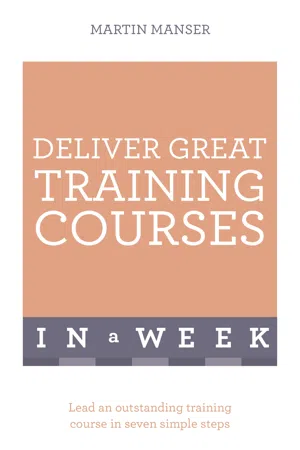
Deliver Great Training Courses In A Week
Lead An Outstanding Training Course In Seven Simple Steps
- 128 pages
- English
- ePUB (mobile friendly)
- Available on iOS & Android
eBook - ePub
Deliver Great Training Courses In A Week
Lead An Outstanding Training Course In Seven Simple Steps
About this book
Information

At the end of last week, your boss suggested that you should think about organizing some training courses for colleagues. Since then you have spent the weekend becoming enthusiastic about everything you can do. You are now ready to put all your plans energetically into action.
But where do you start? Arranging speakers? Booking venues? This chapter is designed to help you channel your energy and enthusiasm effectively and begin to lay a firm foundation for your training.
Today we will look at some basic questions:
• What are you aiming to achieve?
• How do people learn?
• What are the best ways of enabling colleagues to learn? What about online courses?
• How do people train?
• Should you use an internal or external trainer?
• What areas, broadly speaking, do you want the training to cover?
• What practical points do you need to consider?
Some basic questions
In your preparation as you consider training, you should ask yourself the following questions:
• Who?
– Who needs training? For example, certain individuals with particular needs or all colleagues with a certain role?
– Who needs to be involved? Do you have all the necessary resources?
– Who will lead the training, for example experts in the area, or yourself?
– If you are an outside trainer or are using a particular venue, who is the contact person you will deal with? Ensure that you have their contact details.
– Who will authorize the cost?
• Why?
– Why is the training needed? What is its context in your company or organization?
– Why are you leading, organizing or arranging the training? Consider your role: are you the best person to lead the actual training or would someone else be more suitable?
• Where?
– Where will the training be held?
– Where will you find suitable trainers, if you are not leading the actual training yourself?
• When?
– When will you hold the training? Soon? In three months’ time? Next year? How much notice do you need to give the venue where you are holding the training? How much notice do you need to give the participants and the speaker? (Throughout this book, I use the word ‘participants’, not ‘delegates’, because I want to emphasize ‘participants’ actively taking part in a training course rather than their merely attending.)
– When will you put in place a timetable for all the arrangements that need to be made?
• How?
– How did the requirement for training arise: what is its context?
– How did this particular need fit into the overall aims of the learning and development programme of your company or organization?
– How are you going to train the colleagues concerned? What method(s) will you use? Will you hold a face-to-face training course or develop an online course or use a combination of both styles?
– How long will the training course be? Is there to be more than one course? Will the training take place over a number of days? If so, how many?
– How is the need for training to be presented? Will colleagues be told they have to go on the course or will they be persuaded over a period of time that this course would be very helpful to them?
– How will the training be presented? What visual aids, for example PowerPoint, will you need?
– How will any special needs of the participants be accommodated?
– How will the impact of the training on individuals or organizations be measured and evaluated?
– How will you know whether the training has been effective?
– How much will the training cost (and who is going to pay for it)?
• What?
– What is the purpose of the training?
– What, in broad terms, do you expect to be covered in the training?
– What is expected from the training? What do you want participants to be ab...
Table of contents
- Cover
- Title
- About the Author
- Dedication
- Contents
- Introduction
- Sunday: What is training?
- Monday: Identify the training needs clearly
- Tuesday: Design the course carefully
- Wednesday: Plan variety creatively
- Thursday: Implement your plan successfully
- Friday: Evaluate the training thoroughly
- Saturday: Refine your skills constantly
- 7 × 7
- Answers
- Copyright
Trusted by 375,005 students
Access to over 1.5 million titles for a fair monthly price.
Study more efficiently using our study tools.
Frequently asked questions
Yes, you can cancel anytime from the Subscription tab in your account settings on the Perlego website. Your subscription will stay active until the end of your current billing period. Learn how to cancel your subscription
No, books cannot be downloaded as external files, such as PDFs, for use outside of Perlego. However, you can download books within the Perlego app for offline reading on mobile or tablet. Learn how to download books offline
Perlego offers two plans: Essential and Complete
- Essential is ideal for learners and professionals who enjoy exploring a wide range of subjects. Access the Essential Library with 800,000+ trusted titles and best-sellers across business, personal growth, and the humanities. Includes unlimited reading time and Standard Read Aloud voice.
- Complete: Perfect for advanced learners and researchers needing full, unrestricted access. Unlock 1.5M+ books across hundreds of subjects, including academic and specialized titles. The Complete Plan also includes advanced features like Premium Read Aloud and Research Assistant.
We are an online textbook subscription service, where you can get access to an entire online library for less than the price of a single book per month. With over 1.5 million books across 990+ topics, we’ve got you covered! Learn about our mission
Look out for the read-aloud symbol on your next book to see if you can listen to it. The read-aloud tool reads text aloud for you, highlighting the text as it is being read. You can pause it, speed it up and slow it down. Learn more about Read Aloud
Yes! You can use the Perlego app on both iOS and Android devices to read anytime, anywhere — even offline. Perfect for commutes or when you’re on the go.
Please note we cannot support devices running on iOS 13 and Android 7 or earlier. Learn more about using the app
Please note we cannot support devices running on iOS 13 and Android 7 or earlier. Learn more about using the app
Yes, you can access Deliver Great Training Courses In A Week by Martin Manser in PDF and/or ePUB format, as well as other popular books in Business & Human Resource Management. We have over 1.5 million books available in our catalogue for you to explore.