Digital Marketing In A Week is a simple and straightforward guide to brilliant digital marketing, giving you everything you need to know in just seven short chapters. From social marketing and search engine optimization, to 'paid' advertising, mobile marketing and creating the perfect website for driving sales, you'll discover the perfect toolkit to drive your successful digital marketing.This book introduces you to the main themes and ideas of digital marketing, giving you a knowledge and understanding of the key concepts, together with practical and thought-provoking exercises. Whether you choose to read it in a week or in a single sitting, NLP In A Week is your fastest route to success: - Sunday: Building the ultimate sales website
- Monday: SEO: The backbone of any digital marketing strategy
- Tuesday: Social media marketing madness
- Wednesday: Pay per click (PPC) simplified and explained
- Thursday: Mobile optimization and getting mobile users
- Friday: Email marketing - why you should do it no matter what
- Saturday: Other marketing tricks and tips in the modern world ABOUT THE SERIES
In A Week books are for managers, leaders, and business executives who want to succeed at work. From negotiating and content marketing to finance and social media, the In A Week series covers the business topics that really matter and that will help you make a difference today. Written in straightforward English, each book is structured as a seven-day course so that with just a little work each day, you will quickly master the subject. In a fast-changing world, this series enables readers not just to get up to speed, but to get ahead.
- 128 pages
- English
- ePUB (mobile friendly)
- Available on iOS & Android
eBook - ePub
About this book
Information
Today we are going to discuss another tool that should be in every digital marketer’s toolkit and that is pay per click (PPC) marketing.
SEO and social media are great ways to get traffic for ‘free’ – although not totally 100 per cent free because you’re spending time that not all business people have to spare to be able to create content, get links, likes and shares and so on from your marketplace.
Sometimes it is nice just to click a couple of buttons and get visitors and this is exactly what PPC can do for you, but only if you do it right.
Don’t go crazy now and say I told you PPC is a magic button to make money online. Far be it from me to say such a thing. What PPC can do is make money on demand if you do it right. This, like anything, requires work plus knowledge and analytical ability to read numbers, and then you need to apply those numbers.
First, let’s talk about the state of the PPC market and then get into how to do it right.
PPC ads in a nutshell
It should come as no surprise that Google is number one in this arena. Google’s AdWords (PPC) system is the primary revenue stream for Google ($59 billion in 2014 – almost 90 per cent of their total revenue) – well, at least until their driverless cars and other projects are available to the public.
Facebook is Google’s next major competitor in the PPC space but their revenue is just a tenth of Google’s and uses a different system (which I personally think is better) that we will get into later in this section.
And also you have the smaller players like Yahoo Search Marketing, and Bing PPC that all have their place.
Google search ads
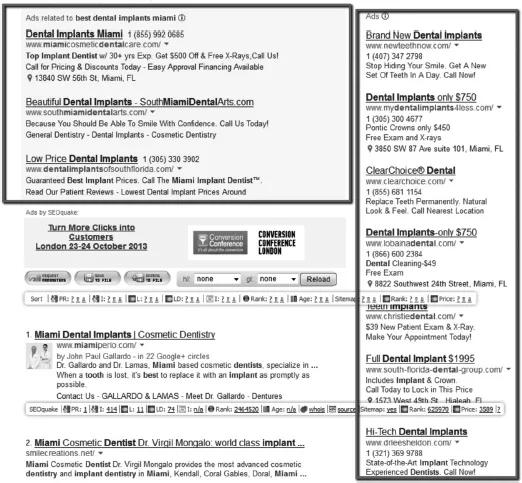
When someone types in keywords, the first two to three listings are ads as well as all the links on the right side of the page.
This is Google’s Search Network.
You can see a sample screenshot of those ads below in the highlighted boxes:
Also Google has its tentacles (shh don’t tell them I said that, I mean its ads) on millions of websites across the web.
This is known as Google’s Display Network. Website owners can apply to Google to have these ads on their websites via their AdSense Program and this is a legitimate way to help monetize a website.
You can learn more about Google’s Ad Networks here:
http://adwords.google.com
So how does PPC marketing work?
There are two main types of PPC – keyword related and demographically related.
Keyword related is how Google does it in their Search Network.
You bid on which keywords (search terms) your ad will show up on the right-hand side of and you pay $x.xx or just $.xx every time your advert is clicked.
You can find out the average cost per click (CPC) for each keyword using either the Google Keyword Planner or Google’s Traffic Estimator tool (accessible only from within a paid AdWords account).
The price you pay is a combination of the amount of competition for the keyword and how popular your ad is. The more times your ad is clicked in your PPC campaign, the more Google rewards you by ever so slowly nudging you up the paid ad rankings.
So if your ad was initially placed fourth and ended up getting more clicks than the third, second and first place ads, it’s possible that your ad will jump the queue into first place and you’ll still be paying the same amount as you were when you were in fourth place.
Once again, Google rewards relevancy with ranking, and because ads in first place generally get more clicks than lower-positioned ads (assuming it does get the clicks), you’ll end up sending more traffic to your website at a lower cost than your competitors!
Google’s Display Network
This is a bit different from the Search Network for two reasons:
First, with the Search Network you’re limited to only using text ads. But because the Display Network is made up of external websites, you can use a text ad, a banner image ad or a video ad.
Second, you don’t bid on keywords shown up from a search; instead you bid to show your ad on pages Google deems relevant to a keyword.
And with the Display Network, you can either pay CPC or CPM. CPM is Cost Per Mille, the cost per 1,000 impressions. So when Google shows your ad 1,000 times, you pay $x.xx regardless of whether your ads are clicked or not.
Facebook ads
Facebook does both PPC and CPM but they are demographic-based. Their PPC netw...
Table of contents
- Cover
- Title
- About the Author
- Contents
- Introduction
- Sunday: Building the ultimate sales website
- Monday: SEO: The backbone of any digital marketing strategy
- Tuesday: Social media marketing madness
- Wednesday: Pay per click (PPC) simplified and explained
- Thursday: Mobile optimization and getting mobile users
- Friday: Email marketing – why you should do it no matter what
- Saturday: Other marketing tricks and tips in the modern world
- 7 × 7
- Answers to questions
- Copyright
Trusted by 375,005 students
Access to over 1.5 million titles for a fair monthly price.
Study more efficiently using our study tools.
Frequently asked questions
Yes, you can cancel anytime from the Subscription tab in your account settings on the Perlego website. Your subscription will stay active until the end of your current billing period. Learn how to cancel your subscription
No, books cannot be downloaded as external files, such as PDFs, for use outside of Perlego. However, you can download books within the Perlego app for offline reading on mobile or tablet. Learn how to download books offline
Perlego offers two plans: Essential and Complete
- Essential is ideal for learners and professionals who enjoy exploring a wide range of subjects. Access the Essential Library with 800,000+ trusted titles and best-sellers across business, personal growth, and the humanities. Includes unlimited reading time and Standard Read Aloud voice.
- Complete: Perfect for advanced learners and researchers needing full, unrestricted access. Unlock 1.5M+ books across hundreds of subjects, including academic and specialized titles. The Complete Plan also includes advanced features like Premium Read Aloud and Research Assistant.
We are an online textbook subscription service, where you can get access to an entire online library for less than the price of a single book per month. With over 1.5 million books across 990+ topics, we’ve got you covered! Learn about our mission
Look out for the read-aloud symbol on your next book to see if you can listen to it. The read-aloud tool reads text aloud for you, highlighting the text as it is being read. You can pause it, speed it up and slow it down. Learn more about Read Aloud
Yes! You can use the Perlego app on both iOS and Android devices to read anytime, anywhere — even offline. Perfect for commutes or when you’re on the go.
Please note we cannot support devices running on iOS 13 and Android 7 or earlier. Learn more about using the app
Please note we cannot support devices running on iOS 13 and Android 7 or earlier. Learn more about using the app
Yes, you can access Digital Marketing In A Week by Nick Smith in PDF and/or ePUB format, as well as other popular books in Business & Digital Marketing. We have over 1.5 million books available in our catalogue for you to explore.