Most of us spend hours every day typing emails and other documents at work, yet how
many of us have ever had any training in writing skills? New and aspiring managers
find themselves having to write advertising copy or press releases, while many
businesses want to engage successfully online. Effective Business Writing in a week is
a practical guide to better communication at work, whether through more traditional
forms such as business reports or through email, websites and social media.Keywords:
Style
Structure
Email
Business reports
Presentations
Letters
Advertising
Press releases
Letters
social media
website copy
- 128 pages
- English
- ePUB (mobile friendly)
- Available on iOS & Android
eBook - ePub
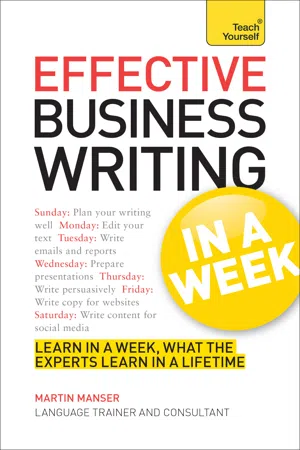
Effective Business Writing in a Week: Teach Yourself
About this book
Information

You should allow some time to elapse between writing your first draft and then checking it, whenever possible. The intervening time can be as short as a break for coffee or as long as a few days, but when you come to check your text, your thinking might be: ‘Who wrote this – it isn’t bad’ or, more likely, ‘Who wrote this – it’s awful’.
For example, on checking your document, you may find that you have written too much about something that on further reflection was not very important. Or you may realize that you have not written enough about something more important. Now is the time to redress that balance. Don’t leave it as it is, hoping for the best and leaving the readers to sort out what you are trying to say. Remember that if your text isn’t clear to you (when you have spent some time on writing it), it won’t be clear to your readers.
Today we discuss the need to read through your text again, checking it, revising it and changing certain words and phrases.
Let’s look at certain techniques you can use to check the documents you write.
Make sure your text is accurate
Recently, I was checking a costing I had written for a publisher and discovered to my horror that for some reason I had written down numbers that were half what they should be. Fortunately, I managed to correct the error before I sent it off. And we’ve all received emails inviting us to a meeting on Tuesday 14 September, only to discover that 14 September is a Wednesday. The result is that many colleagues spend precious time emailing requests for clarification and then having to respond to them with the exact date. It would have been better if the person who originally sent the message had checked the details before sending it.
So: read through your text. Are all facts, e.g. dates, sums of money, spellings of names, correct? George Stephenson (railway engineer); Robert Louis Stevenson (Scottish writer). Do percentages in a table or chart add up to 100 per cent (i.e. not 91 per cent or 110 per cent): you will lose credibility if you are wrong.
Don’t simply check what is there. Also check what isn’t there too. Have you missed out vital logical steps in your argument?

If your text isn’t clear to you, it won’t be clear to your readers.

Make sure your text is grammatical
‘A box of pencils are on the table’ or ‘is on the table?’ Our brain may say the plural ‘pencils’ should be followed by the plural are, but grammatically, the correct form is is: a box (singular) of pencils is on the table. Similarly:
• ‘the criteria (plural) are…’; ‘the criterion (singular) is…’
• ‘there are fewer (not less) rooms’
• ‘it will be more colder tomorrow’ (change to simply colder)
• ‘the Queen Mother will lay [should be lie] in state for three days’.
Every language has its trickier aspects of usage and if you are not a native speaker of English, you may face problems of interference from your own language. For example, a Chinese student wrote: ‘After briefly introduce the concept…’ [should be introducing] and a German student wrote: ‘not much people’ when he should have written ‘not many people’.
There are also differing attitudes to English usage, but if you are writing a formal report, you should not allow your poor or careless use of English to affect your argument. If you do so, you are less likely to communicate your message effectively to the people you are trying to persuade.
Should I use ‘that’ or ‘which’?
Sometimes it is easier to remember a concrete example than an abstract rule, and here the words from the children’s story ‘...
Table of contents
- Cover
- Dedication
- About the Author
- Title
- Contents
- Introduction
- Sunday Plan your Writing Well
- Monday Edit your Text Thoroughly
- Tuesday Write Effective Emails and Reports
- Wednesday Give Excellent Presentations
- Thursday Write Persuasively
- Friday Build a Successful Website
- Saturday Use Social Media Effectively
- Surviving in Tough Times
- Answers
- Copyright
Trusted by 375,005 students
Access to over 1.5 million titles for a fair monthly price.
Study more efficiently using our study tools.
Frequently asked questions
Yes, you can cancel anytime from the Subscription tab in your account settings on the Perlego website. Your subscription will stay active until the end of your current billing period. Learn how to cancel your subscription
No, books cannot be downloaded as external files, such as PDFs, for use outside of Perlego. However, you can download books within the Perlego app for offline reading on mobile or tablet. Learn how to download books offline
We are an online textbook subscription service, where you can get access to an entire online library for less than the price of a single book per month. With over 1.5 million books across 990+ topics, we’ve got you covered! Learn about our mission
Look out for the read-aloud symbol on your next book to see if you can listen to it. The read-aloud tool reads text aloud for you, highlighting the text as it is being read. You can pause it, speed it up and slow it down. Learn more about Read Aloud
Yes! You can use the Perlego app on both iOS and Android devices to read anytime, anywhere — even offline. Perfect for commutes or when you’re on the go.
Please note we cannot support devices running on iOS 13 and Android 7 or earlier. Learn more about using the app
Please note we cannot support devices running on iOS 13 and Android 7 or earlier. Learn more about using the app
Yes, you can access Effective Business Writing in a Week: Teach Yourself by Martin Manser in PDF and/or ePUB format, as well as other popular books in Business & Business Writing. We have over 1.5 million books available in our catalogue for you to explore.