Decode Chinese values and cultural norms while identifying cross-cultural factors that often lead to failed business negotiations with Encountering the Chinese. In this third edition, the advice and recommended skills enable Westerners and the Chinese to establish more effective and rewarding relationships, both inside and outside of the People's Republic of China.
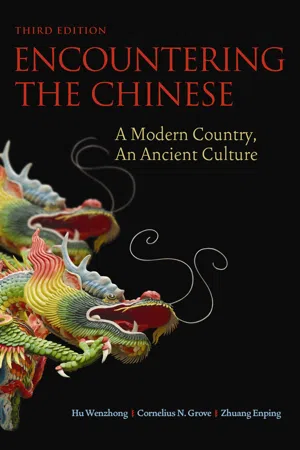
eBook - ePub
Encountering the Chinese
A Modern Country, An Ancient Culture
- 224 pages
- English
- ePUB (mobile friendly)
- Available on iOS & Android
eBook - ePub
About this book
Trusted by 375,005 students
Access to over 1.5 million titles for a fair monthly price.
Study more efficiently using our study tools.
Information
PART I
Advice for Westerners Interacting with the Chinese
In this part we offer information and advice for Westerners located anywhere in the world (including the People’s Republic of China) who are interacting with the Chinese.
ONE
Chinese Titles and Forms of Address
CHINESE NAMING PRACTICES
In the United States, a person’s full name is written and spoken with the given name first and the family name second. In China the reverse is true: the family name is followed by the given name. In the Chinese name Zhang Minwen, for example, Zhang is the family name and Minwen is the given name. If an English title is added, the result would be Miss Zhang, Dr. Zhang, or Lieutenant Zhang.
The Chinese who deal with Westerners sometimes reverse the order of their two names to conform with Western practice, which can confuse Westerners who know that family names in China are traditionally placed first. For example, an American receiving a letter from Minwen Zhang, M.D., might mistakenly begin the reply, “Dear Dr. Minwen.”
There is no foolproof way to avoid this kind of mistake, but there is one useful rule of thumb. More than 95 percent of Chinese family names are one-syllable words, including the ten most common ones (they are Wang, Li, Zhang, Liu, Chen, Yang, Huang, Zhao, Wu and Zhou. Each has a population of more than twenty million in mainland China). But Chinese given names are often two syllables. In the case of the two names Zhang and Minwen, one could be virtually certain that Zhang is the family name and Minwen is the given name.
However, not all Chinese given names are two syllables. More and more young people in China, especially in Beijing and the northern provinces, have one-syllable names. In the case of names such as Chen Qin and Zhao Zhe, for example, the foreigner who does not recognize the one hundred or so most common Chinese family names is reduced to guessing or asking. (In these examples, Chen and Zhao are the family names.)
AN OVERVIEW OF CHINESE FORMS OF ADDRESS
The Chinese have a much wider range of official titles and formal address forms than Westerners, with many Chinese terms having no counterpart in English. The Chinese routinely use many more occupation-linked titles (such as doctor, professor, secretary, and major) than do Westerners. Even within Chinese families, older members are normally referred to and addressed by younger members according to their formal roles within the family—older brother, cousin, sister-in-law, and so forth—rather than by their given names. But older members typically use given names when addressing their juniors.
A valid generalization about the Chinese, then, is that they prefer formality when addressing one another in the course of daily life. In situations where they feel that an informal address is appropriate, they have two alternatives. The first is to use the person’s given name, a practice limited to close relatives and friends. The more common alternative is to add an age-relative prefix—xiao for those younger than oneself, lao for those older than oneself—to the family name of the person being addressed. (More information about xiao and lao appears later in this chapter.)
In China, forms of address have been affected by the political climate in a way that has no parallel in the West. In the 1950s, shortly after the People’s Republic of China was founded, the equalizing term tongzhi (comrade) was widely used because words denoting hierarchical rank were politically improper. In the late 1960s and early 1970s during the Cultural Revolution, teams of workers assumed power in most institutions. They tended to address one another using the term shifu (master worker), a form that became so widespread it was applied even to those who were anything but master workers. In the 1980s, when China was intent on opening itself to the outside world, forms of address paralleling Mr., Mrs., Miss, and Ms. in the West were revitalized and have been used in large cities, especially by those with good education background. But blue-collar workers still tend to address one another using the term shifu. Today people who work in foreign-owned companies and joint venture enterprises often take on Western given names like David, Henry, Catherine, or Anne and are generally addressed as such.
It is becoming more common that college students, English majors in particular, adopt Western given names, and prefer to use those given names with their foreign teachers. There might be two reasons for this. First, it is easier for their foreign teachers to remember them by their Western given names. Second, having Western given names seems to be a fashionable practice among the young. However, these students still address each other by their Chinese names. Those working in foreign-owned companies or joint enterprises often adopt and use Western names in their interaction with foreign boss or colleagues although they still keep their Chinese names.
Note that it is uncommon for people in their forties and fifties (and beyond) to have Western names, even if they adopted Western names when they were younger.
CHINESE FORMS OF ADDRESS WESTERNERS SHOULD USE
The Chinese Equivalents of Mrs., Miss, Ms., and Mr.
Just as a Chinese person’s given name normally follows his or her family name, so does a Chinese person’s title. The Chinese man who in English would be called Mr. Li is Li xiansheng (literally, Li Mr.) in Chinese. Miss Chen in English is Chen xiaojie (literally, Chen Miss) in Chinese.
A woman in the PRC does not take her husband’s family name but keeps that of her father. The Chinese word nüshi is best translated as “Ms.”. It is actually a rather formal title for an adult woman and has nothing to do with marriage. It is not unlike Madam in English. The Chinese in the PRC seldom used nüshi among themselves over the past few decades, but nowadays they prefer its use on many occasions, although it may sound formal. Women in the People’s Republic who were married before 1950 bear the family name of their husbands and should be addressed using taitai, as in Chen taitai (Mrs. Chen). Many ethnic Chinese women from Hong Kong, Taiwan, and elsewhere take the name of their husbands even today, and therefore are properly addressed as taitai.
You may address any young woman who is not likely to be married as xiaojie; Miss Zhao would be Zhao xiaojie. This form of address is socially delicate in the case of women in their late twenties and thirties, however, because it is widely assumed in China that by that age a woman should be married. If you do not know whether a woman of this age is married, we suggest you address her as xiaojie.
Suppose you are acquainted with a woman named Yang Yonglan who is about to marry a man named Gao Longsheng. Prior to their marriage, you address her as Yang xiaojie (Miss Yang). After their marriage, you will address her as Yang nüshi or Gao taitai (the latter is only used in some circles in the PRC). However, there will be no change in your address of Gao Longsheng as a result of his marriage; he will remain Gao xiansheng (Mr. Gao). This is the traditional practice in China, but some married women in their late thirties or early forties may prefer to be addressed as xiaojie or Miss plus their last names in English because nüshi sounds formal and this may also remind them of their age.
However, you should use discretion when using xiaojie to address young women, because in some parts of China xiaojie has become a euphemistic term for ladies who engage in sex-related work. In restaurants waitresses used to be addressed as xiaojie, but now increasingly they are called fuwuyuan (attendants).
Chinese Official and Occupation-Linked Titles
Instead of using the Chinese equivalents of Mr., Miss, Ms., or Mrs., the Chinese themselves usually use official and occupation-linked titles, especially for official correspondence and during formal occasions such as banquets. You should do likewise if you know the title.
Some Chinese titles are the equivalents of those in daily use in Western countries: doctor, ambassador, mayor, lieutenant, detective, and so forth. All official and occupation-linked titles used in the West have equivalents in the People’s Republic; the only difference is that they are used more frequently in the PRC.
Many terms that Westerners consider appropriate only for descriptive purposes are used in China as titles that recognize a person’s rank and/or special skills. These are routinely appended to a person’s family name when he or she is addressed. For example, Lin Rongcheng is a minister in the cabinet; he is addressed by just about everyone as Lin buzhang, Minister Lin. Other terms in widespread and frequent use include the Chinese equivalents of manager, deputy manager, chief engineer, engineer, foreman, bureau director, workshop director, section head, accountant, (police) captain, editor-in-chief, hospital administrator, and dozens of others. There is some variation from institution to institution on the extent to which these occupation-linked terms are used, but generally it is safe to say that the use of such titles is stronger in inland provinces and rural areas than in coastal provinces and cities. (See appendix B for a list of the most commonly used titles.)
At Chinese universities, titles such as president, chancellor, vice president, director, dean, chairman, and so forth are used more frequently than they are in Western countries. It is noteworthy, however, that the Chinese equivalents of professor and associate professor are used more frequently in correspondence and introduction than in face-to-face exchanges. Similarly, Chinese academics with doctorates are addressed by title in correspondence (and are usually represented as such on their business cards) but are rarely verbally addressed as Doctor. Westerners who have doctorates may find, however, that their Chinese students address them as Doctor both in and out of class. Many Westerners who teach in Chinese universities prefer to be addressed by their first names, but if they do not ask their Chinese students to call them by their first names, the students will address them formally with Doctor or Professor plus their last names. Chinese students never address their Chinese professors by their given names as this is considered a lack of courtesy. They greet Chinese professors with Professor plus their family names in English, but in Chinese they would use laoshi instead because the Chinese equivalent of professor (jiaoshou) sounds too formal while laoshi implies respect.
The use of academic and administrative titles in address forms in China is to show one’s respect for the other person on both formal and informal occasions, which indicates greater power distance between the addresser and addressee. And the difference between China and most Western countries in addressing is an indicator of difference in power consciousness between them.
A common word that does not have an exact equivalent in English is laoshi, which is used in educational institutions at all levels to designate anyone who teaches. For example, the primary school teacher Zhao Shumei is Zhao laoshi; the university professor Dai Wangdao is Dai laoshi. Laoshi is usually translated as “teacher,” but that is not really accurate. Teacher in English is used almost exclusively to designate, but not to address, people who are instructors below the university and college levels. Although laoshi does not indicate rank, it is a term of considerable respect. In fact, laoshi conveys more respect than professor does in English. The implication of addressing an instructor as laoshi is somewhat similar (in English) to followers addressing a religious sage as teacher. It is interesting to note that in recent years the address form laoshi has extended its use to well beyond educational circles. For instance, a young actor may address an experienced actor (often a movie star) as laoshi. A young newscaster may likewise address an anchor person as laoshi.
The Informal Prefixes Xiao and Lao
The closest the Chinese come to being informal or familiar with people who are not their family members or most intimate friends is to use either xiao or lao followed by the person’s family name. This is the only exception to the rule that the family name precedes the title. The student Li Changrong is called in this context Xiao Li, not Li xiao. Note also that xiao or lao may be used with persons of either sex (although lao tends to be used more frequently with males). Xiao may be translated as “young” or “junior’;’ lao as “old” or “senior.” Xiao doubles as the Chinese word for little, but when used as a title it does not normally belittle the person so addressed. Xiao is a diminutive mainly used for familiarity.
Which term is used generally depends on the relation between the ages of the speaker and the person spoken to. Though young children rarely use these words with other children, the rule of thumb is this: an older person of any age calls a younger person with whom he or she is familiar Xiao So-and-so; a younger person calls an older person Lao So-and-so.
On rare occasions, when the speaker wishes to acknowledge the advanced age and exceptional venerability of the person addressed, lao is used following the family name. It is likely that you will never have an opportunity to use lao in this way.
An American of our acquaintance told us that he once seriously embarrassed himself by using lao inappropriately. He overheard a famous eighty-year-old scientist addressed as “Zhang lao.” A few minutes later, the American addressed one of his Chinese colleagues, whose age was perhaps sixty years, as “Li lao.” This appellation was met by loud, but also hurt, guffaws from Mr. Li as well as others within earshot. Even at age sixty, Mr. Li was not nearly venerable enough to be addressed with lao following his family name, for this form of address is reserved for a very small, highly prestigious group of older people within a community.
If you remain in frequent contact with the same Chinese for more than a few weeks, you are likely to begin using xiao and lao in your exchanges with them. The age-relative rule stated here will apply in many cases, but there are enough exceptions so that it would be wise to find out how each individual is usually addressed by Chinese friends and colleagues. If almost all Chinese call your interpreter Xiao Zhang, for instance, you should not call him Lao Zhang regardless of your relative ages.
OTHER FORMS OF ADDRESS USED IN THE PRC
A considerable number of Chinese address others with whom they are not well acquainted as tongzhi, although this form is not used as extensively as it was decades ago. Though tongzhi is translated as “comrade,” it usually does not indicate an affiliation with the Communist Party. It is a general term used irrespective of age, rank, sex, or occasion. When hailing someone on the street to ask directions, a Chinese might call out, “Tongzhi.” We suggest you avoid the word tongzhi in Chinese, although it is sometimes used by some Chinese officials on formal occasions.
Shifu was very popular during the Cultural Revolution. These days its use tends to be restricted to people in skill- and service-linked occupations, such as plumbers, electricians, repair personnel, or blue-collar workers in general and, on some occasions, peddlers. Use shifu when addressing people in these occupational roles. But if you are dealing with a female shop attendant or waitress, use shouhuoyuan or fuwuyuan instead.
The Chinese often extend kinship terms to people not related by blood or marriage. The Chinese equivalents of uncle, aunt, brother, and sister are even used by the Chinese when asking someone for directions in the street. And the people approached generally welcome the use of such terms. A Chinese man or woman might say to an elderly gentleman, for example, “Uncle, how do I get to the railway station?” A child might address an unknown woman as “granny.” But our advice is that you do not use such kinship terms, for it is difficult for a foreigner to determine which term is appropriate in what situation.
The Chinese may also ask their children to use these kinship terms to address you. If you visit a friend in his home, for example, he may ask his child to address you as “Aunt” or “Uncle” in Chinese. If you are in your mid-sixties or even older, you might be called “Grandpa” or “Grandma.” If you feel uncomfortable with such address forms, you may of course offer an alternative form, such as your given name. In the case of an American or British man married to a Chinese woman, it would be natural for her to address her husband’s parents as “Father” and “Mother” since this is the Chinese way to address one’s parents-in-law, but in many cases it might not be customary for the American or British son-in-law to address his wife’s parents as “Father” or “Mother.” That is why some Chinese parents complain about their American so...
Table of contents
- Cover Page
- Title Page
- Copyright Page
- TABLE OF CONTENTS
- ACKNOWLEDGMENTS
- FOREWORD
- PREFACE TO THE THIRD EDITION
- INTRODUCTION: A BRIEF BACKGROUND TO THE CHINESE WAY OF LIFE
- PART I Advice for Westerners Interacting with the Chinese
- PART II Advice for Westerners Living and Working in the PRC
- APPENDIX A: GLOSSARY OF CHINESE TERMS
- APPENDIX B: CHINESE TITLES AND FORMS OF ADDRESS
- RECOMMENDED READINGS
- INDEX
Frequently asked questions
Yes, you can cancel anytime from the Subscription tab in your account settings on the Perlego website. Your subscription will stay active until the end of your current billing period. Learn how to cancel your subscription
No, books cannot be downloaded as external files, such as PDFs, for use outside of Perlego. However, you can download books within the Perlego app for offline reading on mobile or tablet. Learn how to download books offline
Perlego offers two plans: Essential and Complete
- Essential is ideal for learners and professionals who enjoy exploring a wide range of subjects. Access the Essential Library with 800,000+ trusted titles and best-sellers across business, personal growth, and the humanities. Includes unlimited reading time and Standard Read Aloud voice.
- Complete: Perfect for advanced learners and researchers needing full, unrestricted access. Unlock 1.5M+ books across hundreds of subjects, including academic and specialized titles. The Complete Plan also includes advanced features like Premium Read Aloud and Research Assistant.
We are an online textbook subscription service, where you can get access to an entire online library for less than the price of a single book per month. With over 1.5 million books across 990+ topics, we’ve got you covered! Learn about our mission
Look out for the read-aloud symbol on your next book to see if you can listen to it. The read-aloud tool reads text aloud for you, highlighting the text as it is being read. You can pause it, speed it up and slow it down. Learn more about Read Aloud
Yes! You can use the Perlego app on both iOS and Android devices to read anytime, anywhere — even offline. Perfect for commutes or when you’re on the go.
Please note we cannot support devices running on iOS 13 and Android 7 or earlier. Learn more about using the app
Please note we cannot support devices running on iOS 13 and Android 7 or earlier. Learn more about using the app
Yes, you can access Encountering the Chinese by Cornelius Grove,Hu Wenzhong in PDF and/or ePUB format, as well as other popular books in Social Sciences & Cultural & Social Anthropology. We have over 1.5 million books available in our catalogue for you to explore.